These are a collection of resources (YouTube videos, journal and news articles, books, and online tools) for bio-inspired design that I’ve come across over the years. Some are just great inspiration for successful bio-inspired design, others are tools that can help you better implement your own bio-inspiration! A lot of these resources are also covered in my Bio-Inspired Engineering Design class (Texas A&M MEEN 440/696). Descriptions of each are below.



- AskNature: Innovation Inspired By Nature
“Find biological strategies and inspired ideas relative to your innovation challenges, so you can emulate time-tested forms, processes, and systems.” Warning: these are primarily all biological strategies that have already been applied as bio-inspiration/biomimicry. It’s a great place to start but it can be a difficult place to find novel ideas.
Also includes the new “BioMole” tool, more literature on which can be found in the IEEE 2019 poster documentation here.
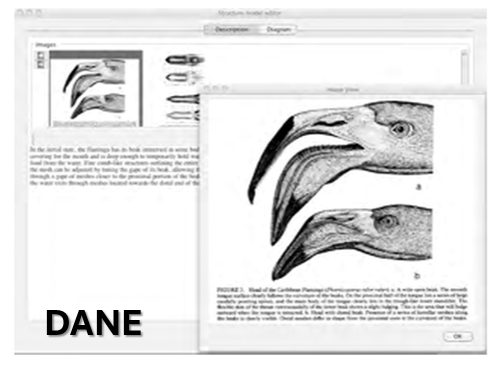
A computational tool for supporting designers to generate novel solutions for product design problems by providing, as stimuli, information about relevant natural or artificial systems. The software has a database with entries from natural and artificial systems that can be searched or browsed.
DANE 2.0 was developed at the Design Intelligence Lab at the Georgia Institute of Technology. DANE is a tool that, as one of its primary functions, facilitates biologically inspired design with two abilities: 1) to create and maintain structured descriptions of biological systems and 2) to quickly access descriptions useful to a designer’s project. It also has a design case library containing approximately 40 FBS models of natural and artificial systems.
“The Biomimicry Institute provides tools to develop sustainable solutions for a balanced ecosystem by empowering people to learn and apply nature-inspired strategies in design. We offer access to free online resources, design challenges where people learn by practicing, support for bringing solutions to market, and serve as a connective tissue for a global network of innovators.”
In response to COVID-19 they introduced “30 days of Reconnection” that guide people through using a design journal to explore the world around you, both in person and online. “What might we return to after 30 (or more) days of observing how a leaf works, how a spider senses, how ants assign duties to one another, or how energy and mass are linked in a perpetual life cycle dance?”
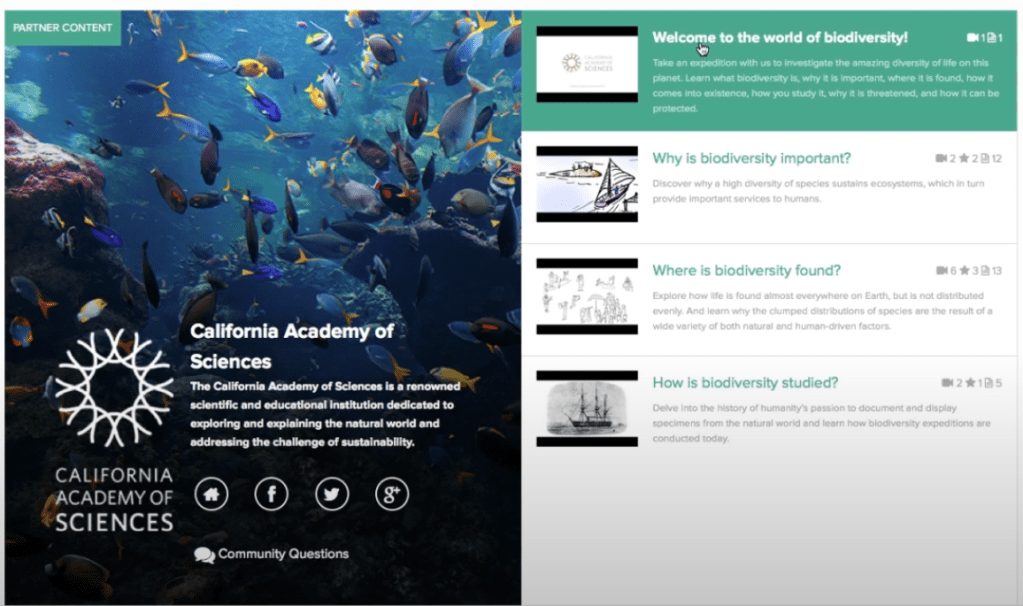
Explore the California Academy of Sciences world of biodiversity through Khan Academy. The modules are short, easy to understand, and fun!
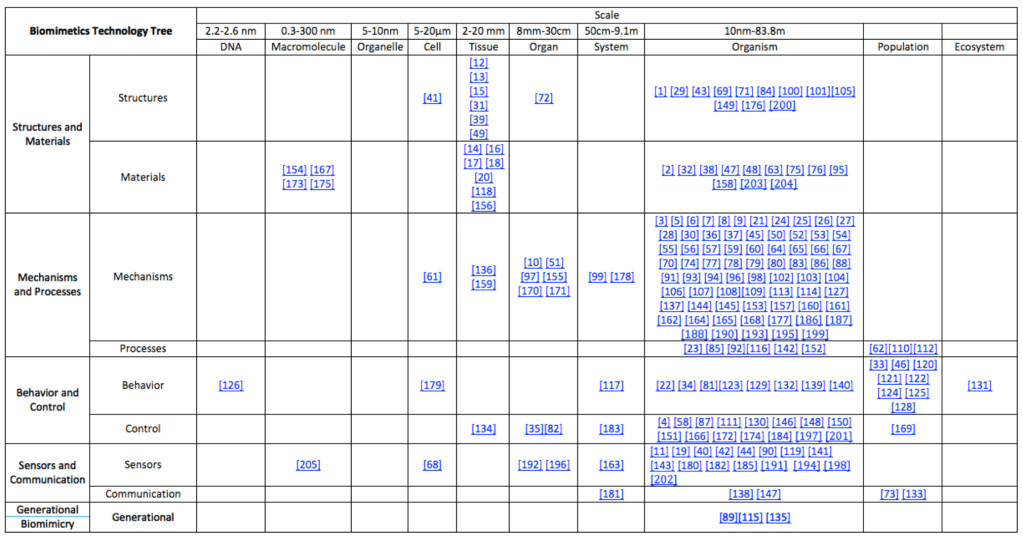
This resource is older (2010 last update) but it contains a scholarly paper index of biomimetic papers, a Biomimetic Technology Tree, and a glossary of common biological terms written from an engineering perspective.
The BBC runs this program that has a podcast series. The program includes podcasts and videos of cool bio-inspiration, both successful applied and potential new solutions.
- World Wildlife Fund “Biodiversity Toolkit”
The activities within the biodiversity toolkit provide students with an understanding of the importance of nature and how all living things are connected. The biodiversity resource guide is designed to give you all the information you need to teach your students about biodiversity and the impacts of human activity. The guide provides basic biodiversity facts, why biodiversity and nature matter, what threats our planet’s biodiversity is facing, what WWF is doing to help, and what kids can do to help.
- Seek app by iNaturalist
Take your nature knowledge up a notch with Seek! Use the power of image recognition technology to identify the plants and animals all around you. Earn badges for seeing different types of birds, amphibians, plants, and fungi and participate in monthly observation challenges with Our Planet on Netflix. Get outside and point the Seek Camera at living things. Identify wildlife and plants you see and take pictures to earn badges. Learn fun facts about the organisms all around you.
- Biomimicry 3.8’s free “Introduction to Biomimicry: Foundational Course“
The Introduction to Biomimicry Foundational Course was specifically developed for everyone–no matter their discipline or background–wanting to take the first step in understanding and developing a practice in biomimicry. 3+ hours of content where you’ll learn the basics of biomimicry.
Get inspired by listening to some of the “Ologies” podcasts by Alie Ward, who encourages you to think about the world differently by learning new things.
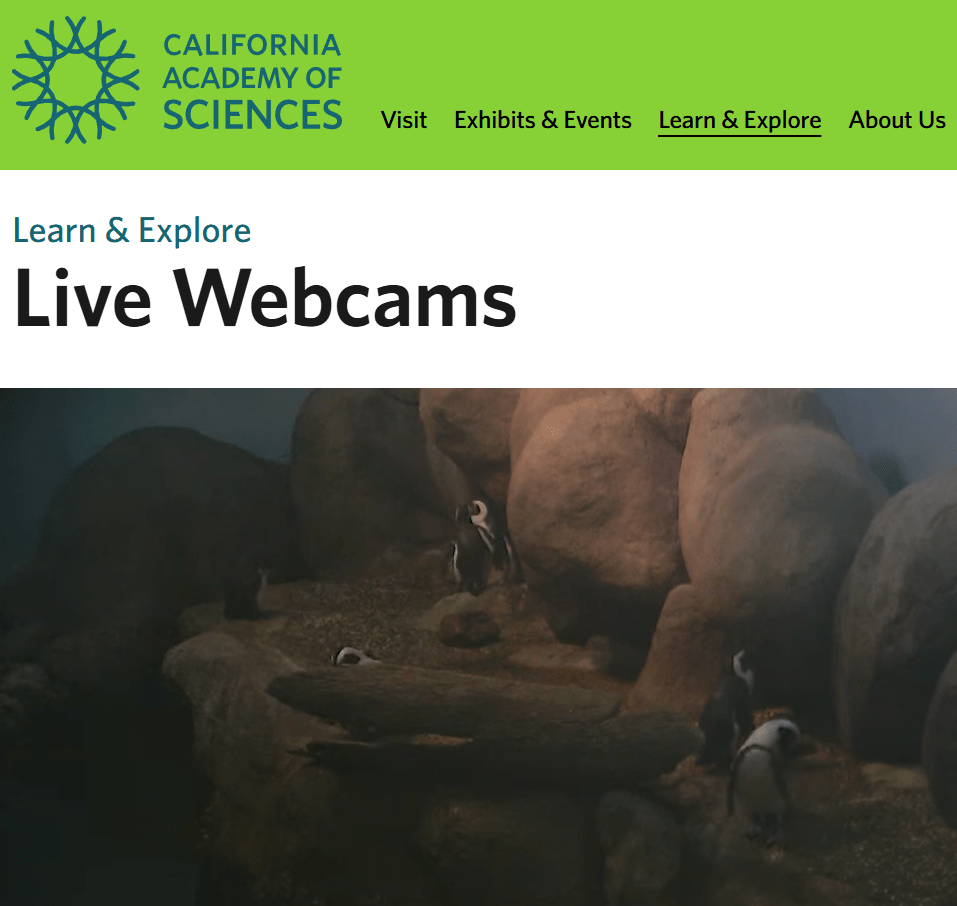
- Animal Webcams at the California Academy of Sciences
The best of the California Academy of Sciences, now streaming. Watch graceful stingrays, colorful coral reef, and African penguin colony in vivid HD, or set your sights on the Pacific from our Farallon Islands webcam.
- Practical Biomimetics by Julian Vincent
An ontology of biomimetics based on trade-offs by Dr. Julian Vincent who explains: “I wanted to be an ecologist. After my first degree (Cambridge, Natural Sciences, Zoology) I went to Sheffield Uni and did a PhD on insect hormones. Reading Uni saw me wander into the general area of mechanical properties of biological materials. In 2000 I was invited to Bath Uni. Department of Mechanical Engineering “To show us the tricks nature uses.“ I retired eight years later and still wonder indeed, what are the “tricks”? That’s what this site is about.”
The Harvard Wyss Institute seeks to leverage recent insights into how Nature builds, controls, and manufactures to develop new engineering innovations – a new field of research we call Biologically Inspired Engineering. By emulating biological principles of self-assembly, organization, and regulation, they are developing disruptive technology solutions for healthcare, energy, architecture, robotics, and manufacturing, which are translated into commercial products and therapies through the formation of new startups and corporate alliances.
Nature provides a wealth of solutions that can inspire engineers to create better designs. The Primer on Natural Systems is developed as a tool for Systems Engineering professionals and Project Managers to introduce and integrate Natural Systems thinking and approaches into their processes and products. By asking “How can Nature help me solve this problem?” engineers can leverage living and non-living systems to provide inspiration for solutions to system engineering challenges. Download a free copy at the website above.
The biomimetic technology tree maintains a database of relations between biology & engineering using biological length scales as a means of measurement. The goal of the tool is to simplify the navigation of biomimetic relationships and the generation of functional models for engineers. The tool is a matrix relating biological length scales (columns) to engineering concepts (rows). Pieces of research are then classified based on their engineering application and biological size.
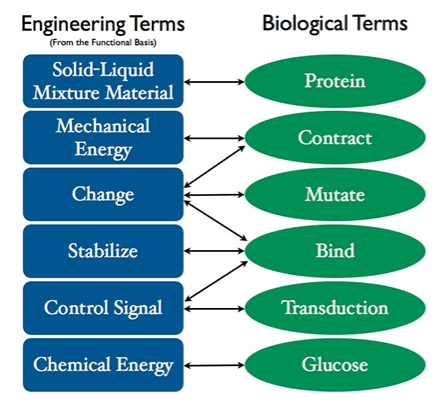
The thesaurus attempts to address terminology and understanding issues, using a structure similar to the standard lexicon of a flow-based functional model to qualitatively represent a system in terms of its function (i.e., what the system does) as opposed to its form (i.e., what comprises the system).
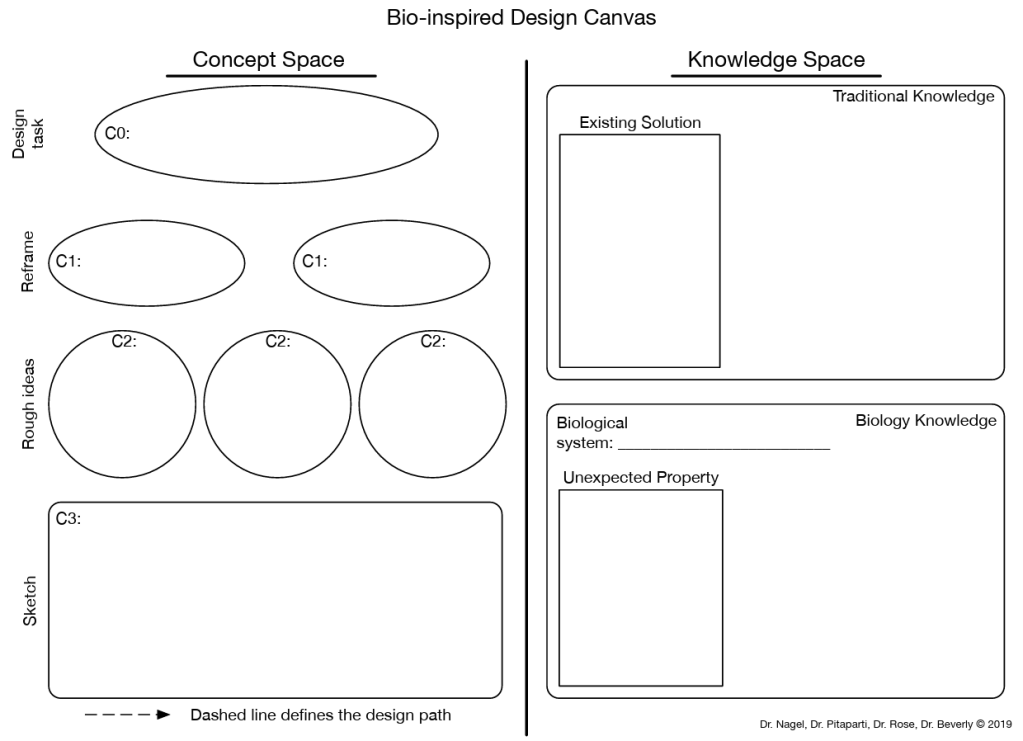
The Bio-inspired Design (BID) Canvas is a visual guide that provides a framework to structure the thought processes that build the BID mindset. It is grounded in the engineering design theory known as Concept-Knowledge (C-K) Theory and is a statistically validated approach to creating high quality concepts inspired by nature and has significant capability to produce innovative design solutions.
 BiSSL: Bio-inspired Systems Lab