Journal Paper on Circular Economy in Manufacturing Published in JMSE

Two BiSSL students, Ph.D. student Hadear Hassan and MS alumna Amira Bushagour, have coauthored a paper in ASME’s Journal of Manufacturing Science and Engineering. The paper, originally presented at the 2024 MSEC conference, focuses on useful overlaps between reconfigurable manufacturing and circular economy efforts by assessing the adaptability and connection to circular economy principles in 44 different manufacturing system configurations.
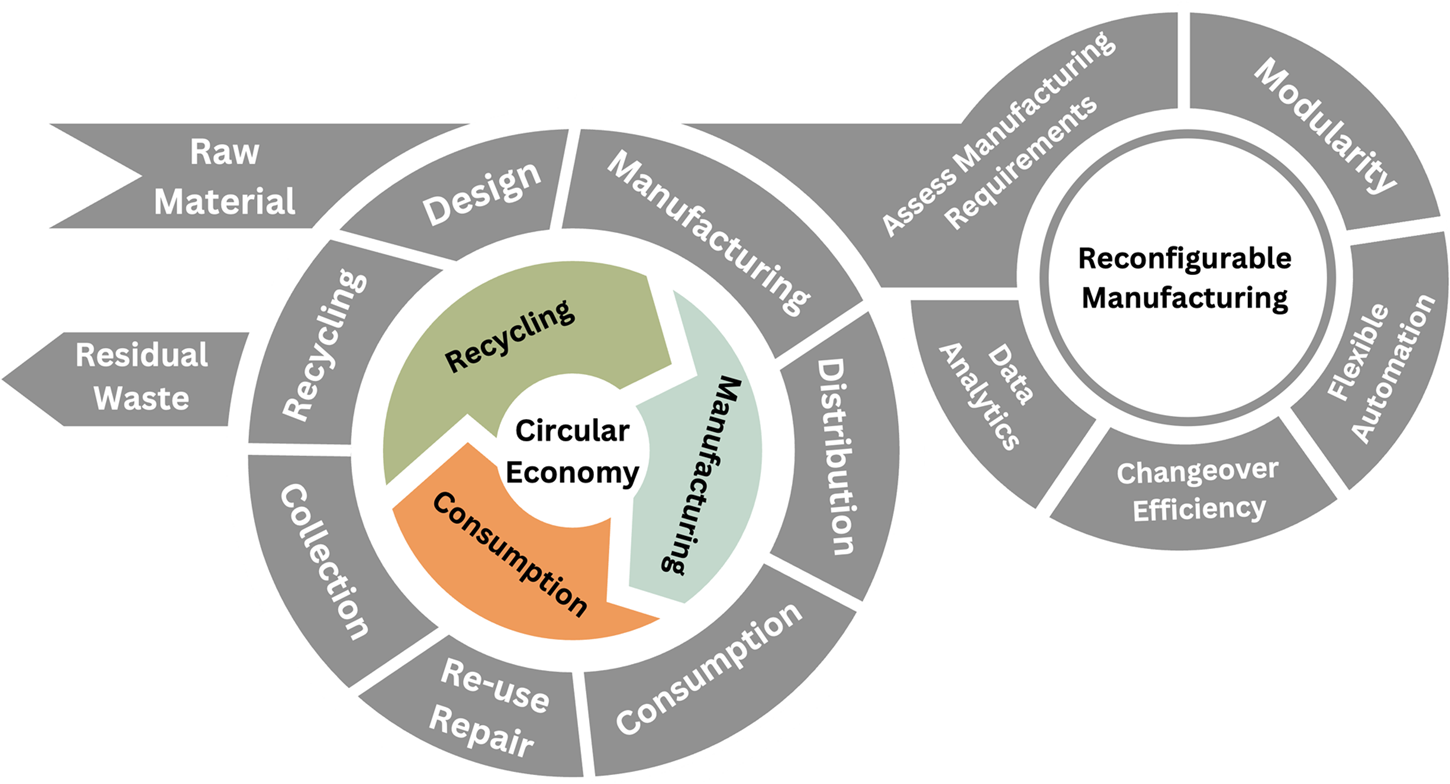
Reconfigurability in manufacturing signifies a system’s capacity to promptly adapt to evolving needs. This adaptability is critical for markets to maintain operations during unexpected disruptions, including weather anomalies, cyber-attacks, and physical obstructions. Concurrently, the concept of a circular economy is gaining popularity in manufacturing to mitigate waste and optimize resource utilization. Circular economy principles aim to reduce environmental impacts while maximizing economic benefits by emphasizing the reuse of goods and resource byproducts. The nexus between reconfigurability and the circular economy stems from their shared pursuit of sustainability and resilience. Interestingly, biological ecosystems also exhibit these traits, showcasing exceptional adaptability to disturbances alongside the ability to effectively utilize available resources during normal operations. This study explores various manufacturing system configurations to assess both their adaptability and connection to circular economy principles. 44 configurations are categorized based on layout (e.g., job shop, flow line, cellular) and analyzed using convertibility, cyclicity, and Degree of System Order metrics. A significant positive correlation (R2 = 0.655) is found between high convertibility and ecologically similar levels of structural cycling, suggesting that effective resource utilization supports adaptability in manufacturing systems. Furthermore, this paper proposes the existence of a possible “window of vitality” for cyclicity, as it demonstrates a significant correlation (R2 = 0.855) between the Degree of System Order and cyclicity. Identifying systems that strike a balance between redundancy, efficiency, convertibility, and cyclicity can aid manufacturing system designers and decision-makers in making choices that address increasing requirements for both sustainability and resilience.

Hassan, H., A. Bushagour, and A. Layton. (2024) “Resilient Circularity in Manufacturing: Synergies between Circular Economy and Reconfigurable Manufacturing.” ASME Journal of Manufacturing Science and Engineering. 146(11): 110902. DOI: 10.1115/1.4065744

2 New Cyber-Physical Power Systems Papers Published

Two new papers have been recently published from the BiSSL group first-authored and co-authored by its students resulting from a collaborative grant with Sandia National Lab and Dr. Kate Davis’ group in Electrical Engineering.

Highlights include:

1. A graph-embedding technique, Node2Vec, to capture neighborhood relationships with second-order biased random walks for risk assessment in cyber-physical power grids.
2. Highly realistic and synthetic cyber network topologies for power grids to perform our case studies.
3. Visualization of the risk assessment with various methods for a more comprehensive situational awareness for grid operators.

Modern power grids and other complex systems are a fusion of physical and cyber components, giving rise to intricate interdependencies. These interdependencies, however, also expose vulnerabilities that can be exploited by adversaries. This paper delves into the critical examination of these interconnections, inspired by Ecological Network Analysis (ENA) techniques. By drawing from ecological modeling, we aim to understand the role of cyber-physical interdependencies in the resilience of complex systems. We introduce various modeling methods, including bipartite and tripartite networks, to analyze and map these interdependencies in the context of the IEEE WSCC 9-bus and the ACTIV 200-bus case study. The paper explores how these models can identify key actors and assess network resilience. Through a detailed methodology, we apply ecological metrics and community identification techniques to comprehensively evaluate the system’s interactions. The findings offer insights into the interplay of cyber and physical elements in power grids and other complex systems. These analysis methods show that tripartite networks produce more information on indirect interactions within a complex network. Additionally, they provide detailed information on how disturbances could propagate in a cyber-physical power system. Denial of service scenarios for the WSCC 9-bus and the ACTIV 200-bus case studies are employed to support this conclusion.

Payne, E., S. Hossain-McKenzie, N. Jacobs, K. Davis, A. Layton. (2024) “Analyzing Cyber-Physical Modularity and Interdependence Using Bio-Inspired Graph Modeling.” IEEE Access. DOI: 10.1109/ACCESS.2024.3450368
This article explores vulnerabilities in modern power systems due to interdependencies between physical, cyber-physical, and cyber devices. Ecological Network Analysis (ENA) assists in constructing bipartite and tripartite networks for the WSCC 9-bus and ACTIV 200-bus systems. The findings reveal that tripartite networks offer deeper insights into indirect interactions, enhancing our understanding of systemic resilience under denial-of-service scenarios.

Abstract: Power systems are facing an increasing number of cyber incidents, potentially leading to damaging consequences to both physical and cyber aspects. However, the development of analytical methods for the study of large-scale power infrastructures as cyber-physical systems is still in its early stages. Drawing inspiration from machine-learning techniques, the authors introduce a method inspired by the principles of graph embedding that is tailored for quantitative risk assessment and the exploration of possible mitigation strategies of large-scale cyber-physical power systems. The primary advantage of the graph embedding approach lies in its ability to generate numerous random walks on a graph, simulating potential access paths. Meanwhile, it enables capturing high-dimensional structures in low-dimensional spaces, facilitating advanced machine-learning applications, and ensuring scalability and adaptability for comprehensive network analysis. By employing this graph embedding-based approach, the authors present a structured and methodical framework for risk assessment in cyber-physical systems. The proposed graph embedding-based risk analysis framework aims to provide a more insightful perspective on cyber-physical risk assessment and situation awareness for power systems. To validate and demonstrate its applicability, the method has been tested on two cyber-physical power system models: the Western System Coordinating Council (WSCC) 9-Bus System and the Illinois 200-Bus System, thereby showing its advantages in enhancing the accuracy of risk analysis and comprehensiveness of situational awareness.

Sun, S., H. Huang, E. Payne, S. Hossain-McKenzie, N. Jacobs, H. Vincent Poor, A. Layton, and K. Davis. (2024) “A Graph Embedding-Based Approach for Automatic Cyber-Physical Power System Risk Assessment to Prevent and Mitigate Threats at Scale.” The Institution of Engineering and Technology (IET) Cyber-Physical Systems: Theory & Applications. DOI: 10.1049/cps2.12097

Dr. Layton Gives Graduate Research Seminar at UW Madison, Mechanical Engineering

Dr. Astrid Layton will be visiting the University of Wisconsin-Madison to give a seminar on the research going on in the BiSSL group for their graduate seminar series. Her talk, titled “Tackling Engineering’s Sustainability and Resilience Problems Using Biological Systems,” will cover some of the bio-inspired techniques that BiSSL has found to be helpful when improving engineering systems for sustainability and resilience goals.