Dr. Debalina Sengupta and “Disaster Resilience: Are we ready before the next one strikes?”

Texas A&M Energy Institute Lecture Series

July 2, 2020 12-1pm CT Zoom Meeting

Dr. Debalina Sengupta is the Associate Director of the Texas A&M Engineering Experiment Station’s Gas & Fuels Research Center, as well as the Water, Energy, and Food Nexus Coordinator in the Texas A&M Energy Institute at Texas A&M University.

Abstract: We are witnessing history, and living through it. Never before in recent times has a pandemic spread around the world and paralyzed nations, economies, resources, and most importantly, people, all at the same time. It has exposed vulnerabilities to systems in ways that we are yet to fathom. As we wade through solving the immediate human health concerns and crisis, there is a deeper question that we need to address. The role of different entities and players in the society need to be taken into consideration for determining the resilience to disasters of great magnitude.

Over the past two decades, statistics suggest that the intensity of natural disasters have been increasing, and the damages caused by them have been impacting the lives of millions. Hurricanes and flooding events have increasingly influenced coastal communities and given rise to terms as climate refugees. Disaster management has primarily been a top-down approach from governance perspectives. The Post-Katrina Emergency Management Reform Act of 2006 saw a comprehensive push towards disaster management strategies, and the need for emergency planning and implementation. However, the multiple failures during disasters and the resulting increase in losses to human lives, property, and progress of regions have yet again shown us that a convergent, interdisciplinary research approach is required to address the four stages of disaster management: Response, Recovery, Mitigation, and Preparedness. From analyzing vulnerabilities and risks to identifying root causes and critical elements in the full cycle of disaster management, interventions can be designed for timely recovery and minimizing loss of life. Deriving from concepts of sustainable development, this webinar will provide a framework for resilience studies, and seek to develop partnerships that can bring translational research components for innovative approaches towards disaster resilience.

MEFEGs Monthly Faculty Lunch: Dr. Cynthia Hipwell speaks about “When your experiment does not go as planned”

June 26, 2020 12-1pm CT

The Mechanical Engineering Female Graduate Students (MEFEGs) is honored to invite Dr. Cynthia Hipwell to share her experience in our monthly faculty lunch this Friday noon. Dr. Hipwell spent 21 years in industry – most of that as a data storage leader at Seagate Technology, and is known as a technology and business process innovator. She is a member of the National Academy of Engineering and National Academy of Inventors and is very passionate about promoting innovative thought and curriculum at Texas A&M. The faculty lunch will be discussion based and it is a good opportunity to interact with female faculties within MEEN department.

ASEE 2020 Conference Presentation

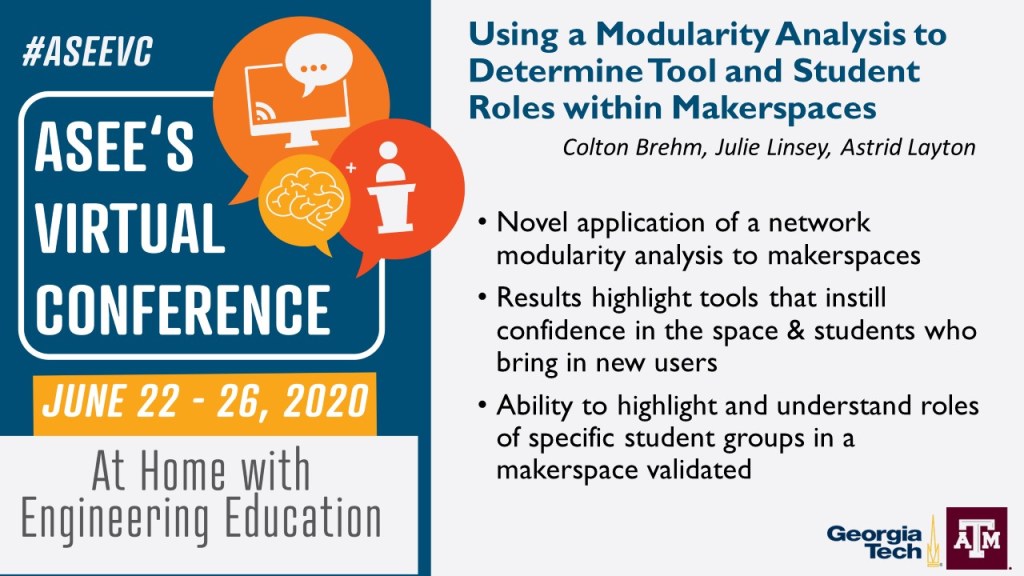
Exciting work done by MS alum Colton Brehm, in collaboration with Dr. Julie Linsey at Georgia Tech, was presented at the American Society for Engineering Education (ASEE) 2020 conference virtually. Colton’s conference paper that was presented and discussed is titled: “Using a Modularity Analysis to Determine Tool and Student Roles within Makerspaces.” We’re really excited to continue this work with new A&M BiSSL PhD student Samuel Blair! The conference continues all week! https://www.asee.org/annual-conference/2020

Research paper accepted to the Journal of Industrial Ecology

BiSSL alumn Colton Brehm (MS graduate May 2020) just had his full-length research paper accepted in the Journal of Industrial Ecology! The paper, titled “Nestedness in eco-industrial networks: exploring linkage distribution to promote sustainable industrial growth,” investigates the use of nestedness – a structural characteristic of ecological food webs, to guide the design of Eco-Industrial Networks (EINs) to improve their sustainability, creating a more circular economy.

Abstract: “Eco-Industrial Networks (EINs) have gained support as a solution that simultaneously reduces environmental burdens and promotes economic interests. EINs operate under a mutualistic framework, where waste materials and energy are exchanged between industries to their mutual benefit, creating a diverse web of flows. Recent studies have focused on analogies between food webs (FWs) and EINs, measuring a network’s success at ecological imitation as representative of its sustainability. Studies have focused heavily on the number of links and nodes in a network, but have neglected the economic reality that each investment comes at the opportunity cost of all alternatives. This analysis focuses on the nestedness metric as used by ecologists to address this pivotal facet to the FW-EIN analogy. Nestedness describes an ecological strategy for the position of links between nodes in a network in a way that maximizes network cycling for a given number of connections. This metric presents many advantages for EIN design and analysis, including maturity independence, size normalization, and a strong statistical record in highly mutualistic ecological systems. Application of nestedness to EINs indicates a lower presence of nested structures and more randomness than what is typically seen in FWs. The industrial networks also display a correlation between high nestedness and internal cycles, suggesting that the reuse of materials and energy in EINs can be improved upon by increasing the nestedness of structures.”

Brehm, C., & Layton, A. (2020). “Nestedness in eco-industrial networks: exploring linkage distribution to promote sustainable industrial growth.” Journal of Industrial Ecology. DOI: 10.1111/jiec.13057

CIRP Life Cycle Engineering (LCE) 2020 Virtual Conference

Two BiSSL students, PhD student Abheek Chatterjee and recent MS graduate Colton Brehm, had their first authored peer-reviewed publications presented at the 2020 CIRP Life Cycle Engineering conference. The conference, originally meant to be in Grenoble, France was entirely virtual due to COVID-19.

Abstract: “Supply chain design has traditionally focused on using the shortest path or the minimum number of paths to reduce operational costs. This approach, however, fails to account for a system’s response to external disruptions. A novel supply chain design is proposed that mimics the optimal balance of efficient and redundant pathways found in nature’s resilient ecosystems. A comparison of traditional and bio-inspired supply chain designs are done using a disruption scenario, showing that the bio-inspiration significantly reduces the supply chain’s vulnerability to cascading failures.”Chatterjee, A., & Layton, A. (2020). Bio-inspired Design for Sustainable and Resilient Supply Chains. Paper presented at the 27th CIRP Life Cycle Engineering (LCE) Conference, Grenoble, France.

https://www.youtube.com/embed/-djMmo7RRiU?version=3&rel=1&showsearch=0&showinfo=1&iv_load_policy=1&fs=1&hl=en&autohide=2&start=14146&wmode=transparentYou can see the 10 minute presentation from Day 2 (May 14) of the CIRP LCE 2020, Circular Economy track, given by Abheek Chatterjee, here on YouTube (start 2:55:47).

“The sustainability of industrial practices is a growing point of emphasis in the research and business communities demanding effective systems-level solutions. Eco-Industrial Parks (EIPs), networks of co-located industries connected through mutually beneficial collaborations are a popular systems-level solution but have experienced highly variable degrees of success. Nestedness, a structure prevalent in mutualistic networks found in nature is our design focus for improved outcomes. This paper investigates how ecologically-similar nestedness values in EIPs relate to reductions of freshwater imports. The results indicate a range of nestedness values that support water conservation and critical thresholds for maximizing capital investments.”Brehm, C., Chatterjee, A., & Layton, A. (2020). Mimicking the nested structures of ecosystems in the design of industrial water networks. Paper presented at the 27th CIRP Life Cycle Engineering (LCE) Conference, Grenoble, France.

https://www.youtube.com/embed/dpAxPXpEymc?version=3&rel=1&showsearch=0&showinfo=1&iv_load_policy=1&fs=1&hl=en&autohide=2&start=7725&wmode=transparentYou can see the 10 minute presentation from Day 1 (May 13) of the CIRP LCE 2020, Eco-Design track, given by Colton Brehm, here on YouTube (start 2:08:47).

Two students become the latest successful BiSSL Graduates!

Colton Brehm
Shelby Warrington

Congratulations to two of BiSSL’s research students for graduating today! Graduate student Colton Brehm graduates with his MS in Mechanical Engineering. He’ll be starting at SAIC in their Mission Support division doing Probabilistic Risk Assessment in June. Undergraduate student Shelby Warrington graduates with her BS in Mechanical Engineering. She’ll be starting graduate school at Yale for a Masters of Environmental Management, specializing in Urban or Industrial Ecology in the Fall. We will sincerely miss them both in the BiSSL group and wish them the best moving forward!

Two BiSSL students get papers accepted to 2020’s IDETC-CIE conference

Two BiSSL students, PhD student Abheek Chatterjee and MS almuni Tirth Dave, have had their “International Design Engineering Technical Conference & Computers and Information in Engineering Conference” (IDETC-CIE) papers accepted to the 2020 conference, to be held in St. Louis, MO August 16-19, 2020.

Abheek’s paper was accepted to the CIE sub-conference on Systems Engineering Information Knowledge Management (SEIKM):

Chatterjee, A., Malak, R., & Layton, A. (2020). Exploring a Bio-Inspired System of Systems Resilience vs. Affordability Tradespace. ASME 2020 Computers and Information in Engineering Conference, St. Louis, MO.

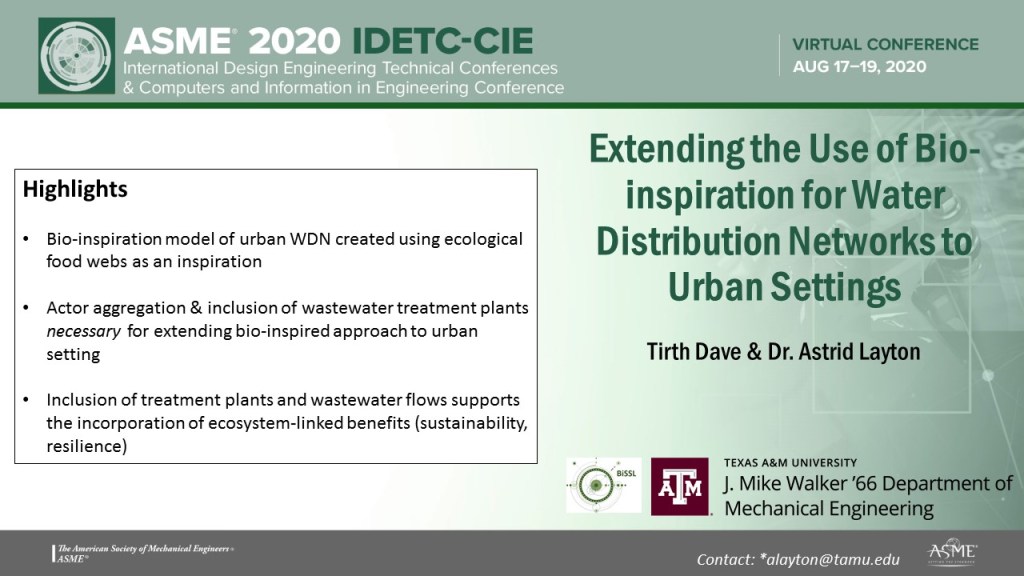
Tirth’s paper was accepted to the IDETC sub-conference on Design Theory and Methodology (DTM):

Dave, T., & Layton, A. (2020). Extending the Use of Bio-Inspiration for Water Distribution Networks to Urban Settings. ASME 2020 International Design Engineering Technical Conference, St. Louis, MO.

Texas A&M Engineering: SoundBytes Podcast Episode “Engineer This!: Taking inspiration from food webs to power grids” (Featuring Dr. Astrid Layton)

On this episode of Engineer This!” the SoundBytes team asks Dr. Astrid Layton about one of her research projects looking at the design of power grids using inspiration from nature. You can find a full transcript of the episode here.

Nature and industry may have more in common than we think. Dr. Astrid Layton, assistant professor in the J. Mike Walker ’66 Department of Mechanical Engineering, is taking concepts from food webs and applying them to power grids to find ways to help the systems run with more resilience.