MEGSO, MEFEGs, and MEEN Girls present: “Info Session for Grad School”

October 6-7, 2020

The Mechanical Engineering Graduate Student Organization (MEGSO), the Mechanical Engineering Female Graduate Student Group (MEFEGs), and the Mechanical Engineering Undergraduate Women’s group (MEEN Girls) are together hosting an informational session series about “Graduate School as a Mechanical Engineer.”

Faculty/Staff Panel: Tuesday, October 6th 3:30-4:30pm
Student Panel: Wednesday, October 7th 4:30-5:30pm

Ask questions or come to hear the answers! Find out about admittance procedures, what it’s like to be a graduate student firsthand, and what opportunities you can unlock!

Article in ASME’s Mechanical Engineering Magazine: “How the Food Web Can Keep the Electricity Flowing” by Jean Thilmany

“Whether intended or not, engineered, industrial systems often mirror those found in the natural world. Case in point: the relationship between today’s electrical power grid and the way food chains function.

Drawing on principles from bio-designed systems—in this case, the food web—will help scientists build more resilience into the electrical power grid, said Astrid Layton, an assistant professor of mechanical engineering at Texas A&M University. She collaborates with Katherine Davis, an A&M assistant professor of electrical engineering, on the project.

A more resilient power grid means reducing the damage from outages and shorten their duration, Layton said.”https://www.asme.org/topics-resources/content/how-the-food-web-can-keep-the-electricity-flowing

Purdue’s Environmental & Ecological Engineering Department Graduate Seminar

Excited to share our BiSSL group’s research to the Environmental & Ecological Engineering Department at Purdue! Feel free to virtually stop by if you’re free, I’ll be talking about “Ecosystems as Design Inspiration for Resilient and Sustainable Human-Engineered Networks.”

Seminar Abstract: Biological ecosystems have been through millions of years of R&D, producing complex networks of interacting species that are able to support individual needs while maintaining system-level functions. In this talk, Dr. Layton will show that biological networks offer a relatively untapped source of design inspiration for improving the sustainability and resilience of our human-engineered networks. Quantitative descriptors and analysis techniques are adapted from ecology through close collaboration with ecologists, enabling desirable ecosystem characteristics to be used as optimization guides for industrial resource networks (or eco-industrial parks, EIPs), water networks, supply chains, and power grids. Characteristics such as a high level of cycling of materials/energy within the system and a unique balance between redundant and efficient pathways are connected back to the achievement of traditional engineering goals such as cost and robustness.

ASME News: “How the Food Web Can Keep the Electricity Flowing”

Sep 29, 2020 Author: Jean Thilmany (original posting of article)

Biodesigned systems such as the food web may help researchers build grid resilience.

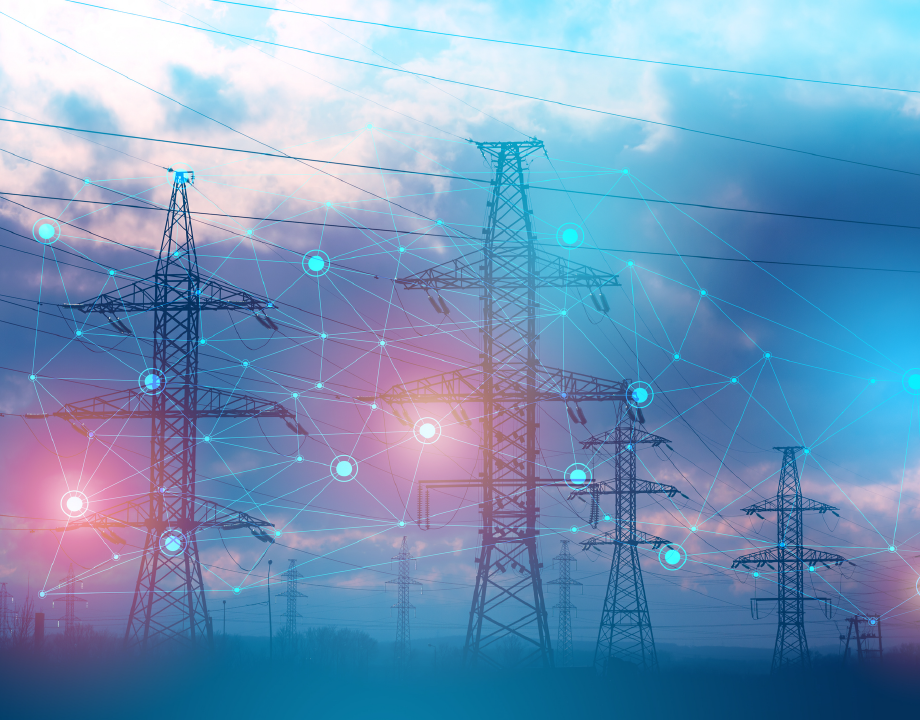
Whether intended or not, engineered, industrial systems often mirror those found in the natural world. Case in point: the relationship between today’s electrical power grid and the way food chains function.

Drawing on principles from biodesigned systems—in this case the food web—will help scientists build more resilience into the electrical power grid, said Astrid Layton, an assistant professor of mechanical engineering at Texas A&M University. She collaborates with Katherine Davis, an A&M assistant professor of electrical engineering, on the project.

A more resilient power grid means reducing the damage from outages and shorten their duration, Layton said.

The food chain holds clues to greater grid resiliency. Image: Wikimedia Commons

A food web is a system of interlocking and interdependent food chains. It goes beyond predators that depend on their prey for survival but—at the other end of the system—actors like earthworms or fungi that take dead organic material and break it down and cause it to decompose so the ecosystem can use it again, Layton said.

Designing the power grid to continually circulate energy in this interlocking manner can aid with stability. “Food webs have a lot of these cyclical patterns that happen.” Layton noted.

“Essentially you start at one species, and you follow the arrows and you wind back up at that same species if you just follow the arrows around,” she said. “This represents the energy sort of remaining in the system or the materials remaining in the system for as long as possible. It’s really being able to maximize the use of what you already have inside the system.”

But power grids right now are extremely linear, like a lot of engineered networks,” she added. “You look at the start of your material or energy that’s flowing through the system, and you follow it through and you’re essentially following a straight line, even as you pass a series of nodes or actors along the way.”

By studying how different types of interactions, structures and patterns within food webs mingle, and incorporating those movements into a power grid, the grid has less opportunity for failure, the researchers believe.

For instance, one important way food webs are resilient, Layton realized, is that after a food system suffers a disruption, it doesn’t necessarily have to recover to its initial state.

“They can recover to alternate, also stable states,” she said. The predator may be able to sustain life for a time by eating another type of prey animal, for example.

She and Davis are applying the analogy to power grids to find ways they also may be able to quickly reset themselves to an alternative, yet stable, state. Using that method, areas that are more critical during times of disruption than others—such as hospitals or first responder centers—should see the least disruption to their power supply.

“The implications we could have power grids that are able to deliver power even when we have large-scale disturbances,” Layton said. “With the increase in weather-related disturbances this is particularly important. Especially if you start thinking about critical power consumers such as first responders and vulnerable populations—the impact to these consumers when the power goes out is significantly worse.”

The Houston area, for example, experienced a drop in power-system performance during Hurricane Harvey, a Category 4 storm that inundated the region for several days in August and September of 2017. It was critical that first responders and hospitals to maintain power.

Investigations on grid resiliency and the pollution-cutting potential investigation are still in the early stages, though it looks promising, Layton said.

“A recent publication of ours shows that the bio-inspired grid designs perform significantly better than the traditionally designed grids when we put them through contingency analyses,” Layton said.

A contingency analysis is a “what if” scenario that evaluates, provides and prioritizes the impacts on an electric power system whenever typically unplanned problems or outages occur.

“Biological ecosystems have been around for a long time and that’s lots of rounds of design iteration to produce something that we as engineers can really learn from to make things better,” Layton said.

The pair also hope to use their findings to better incorporate renewable electricity into the grid to cut atmospheric pollution levels.

Texas A&M’s Civil and Environmental Engineering Department: Environmental, Water Resources, and Coastal Engineering Graduate Seminar

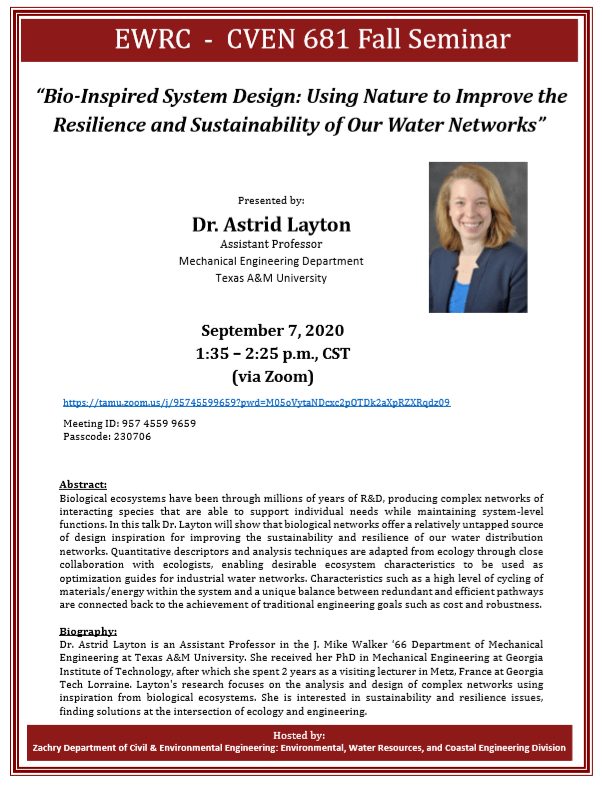
Honored to have been invited to give a graduate seminar in A&M’s Civil Engineering Department for the Environmental, Water Resources, and Coastal Engineering students. Feel free to virtually stop by if you’re free, I’ll be talking about my research regarding “Bio-Inspired System Design: Using Nature to Improve the Resilience and Sustainability of Our Water Networks.”

Seminar Abstract: Biological ecosystems have been through millions of years of R&D, producing complex networks of interacting species that are able to support individual needs while maintaining system-level functions. In this talk Dr. Layton will show that biological networks offer a relatively untapped source of design inspiration for improving the sustainability and resilience of our water distribution networks. Quantitative descriptors and analysis techniques are adapted from ecology through close collaboration with ecologists, enabling desirable ecosystem characteristics to be used as optimization guides for industrial water networks. Characteristics such as a high level of cycling of materials/energy within the system and a unique balance between redundant and efficient pathways are connected back to the achievement of traditional engineering goals such as cost and robustness.

Fall 2020 J. Mike Walker ’66 Department of Mechanical Engineering Graduate Excellence Fellowship

Congratulations to BiSSL PhD student Abheek Chatterjee for winning a J. Mike Walker ’66 Department of Mechanical Engineering Graduate Excellence Fellowship for continuing students for the Fall 2020 semester! The highly competitive graduate scholarship awards graduate students doing excellent research, academic performance, and leadership in the department.

meen logo

BiSSL PhD student Abheek Chatterjee wins “Best Paper” award for his 2020 IDETC-CIE conference paper!

Abheek his paper was written in collaboration with Dr. Richard Malak, in CIE’s SEIKM division titled “Exploring a Bio-Inspired System of Systems Resilience vs. Affordability Tradespace

Abstract: “The objective of this study is to investigate the value of an ecologically inspired architectural metric called the Degree of System Order in the System of Systems (SoS) architecting process. Two highly desirable SoS attributes are the ability to withstand and recover from disruptions (resilience) and affordability. In practice, more resilient SoS architectures are less affordable and it is essential to balance the trade-offs between the two attributes. Ecological research analyzing long-surviving ecosystems (nature’s resilient SoS) using the Degree of System Order metric has found a unique balance of efficient and redundant interactions in their architecture. This balance implies that highly efficient ecosystems tend to be inflexible and vulnerable to perturbations while highly redundant ecosystems fail to utilize resources effectively for survival. Motivated by this unique architectural property of ecosystems, this study investigates the response to disruptions vs. affordability trade-space of a large number of feasible SoS architectures. Results indicate that the most favorable SoS architectures in this trade-space share a specific range of values of Degree of System Order. This suggests that Degree of System Order can be a key metric is engineered SoS development. Evaluating the Degree of System Order does not require detailed simulations and can, therefore, guide the early stage SoS design process towards more optimal SoS architectures.”

A. Chatterjee, R. Malak, and A. Layton, “Exploring a Bio-Inspired System of Systems Resilience vs. Affordability Tradespace,” presented at the ASME 2020 International Design Engineering Technical Conference, virtual, 2020.

Two student papers are presented at the 2020 IDETC-CIE Conference

BiSSL alum Tirth Dave gave a presentation on his conference paper “Extending the Use of Bio-inspiration for Water Distribution Networks to Urban Settings” in IDETC’s DTM division.

BiSSL Ph.D. student Abheek Chatterjee presented his paper, written in collaboration with Dr. Richard Malak, in CIE’s SEIKM division titled “Exploring a Bio-Inspired System of Systems Resilience vs. Affordability Tradespace.” The paper was presented in the Complex Systems Engineering and Design session.

Research paper accepted to the journal Reliability Engineering & System Safety

BiSSL PhD student Abheek Chatterjee just had his full-length research paper accepted in the Journal Reliability Engineering &System Safety! The paper, titled “Mimicking Nature for Resilient Resource and Infrastructure Network Design,” investigates the use of ecological robustness – a functional characteristic of ecological food webs, to guide the design of a supply chain case study to improve its ability to survive network disturbances.

Abstract: “Increasingly prevalent extreme weather events have caused resilience to become an essential sustainable development component for resource and infrastructure networks. Existing resilience metrics require detailed knowledge of the system and potential disruptions, which is not available in the early design stage. The lack of quantitative tools to guide the early stages of design for resilience, forces engineers to rely on heuristics (use physical redundancy, localized capacity, etc.). This research asserts that the required quantitative guidelines can be developed using the architecting principles of biological ecosystems, which maintain a unique balance between pathway redundancy and efficiency, enabling them to be both productive under normal circumstances and survive disruptions. Ecologists quantify this network characteristic using the ecological fitness function. This paper presents the required reformulation required to enable the use of this metric in the design and analysis of resource and infrastructure networks with multiple distinct, but interdependent, interactions. The proposed framework is validated by comparing the resilience characteristics of two notional supply chain designs: one designed for minimum shipping cost and the other designed using the proposed bio-inspired framework. The results support using the proposed bio-inspired framework to guide designers in creating resilient and sustainable resource and infrastructure networks.”

Chatterjee, A., & Layton, A. (2020). “Mimicking Nature for Resilient Resource and Infrastructure Network Design.” Reliability Engineering and System Safety. DOI: 10.1016/j.ress.2020.107142

Dr. Debalina Sengupta and “Disaster Resilience: Are we ready before the next one strikes?”

Texas A&M Energy Institute Lecture Series

July 2, 2020 12-1pm CT Zoom Meeting

Dr. Debalina Sengupta is the Associate Director of the Texas A&M Engineering Experiment Station’s Gas & Fuels Research Center, as well as the Water, Energy, and Food Nexus Coordinator in the Texas A&M Energy Institute at Texas A&M University.

Abstract: We are witnessing history, and living through it. Never before in recent times has a pandemic spread around the world and paralyzed nations, economies, resources, and most importantly, people, all at the same time. It has exposed vulnerabilities to systems in ways that we are yet to fathom. As we wade through solving the immediate human health concerns and crisis, there is a deeper question that we need to address. The role of different entities and players in the society need to be taken into consideration for determining the resilience to disasters of great magnitude.

Over the past two decades, statistics suggest that the intensity of natural disasters have been increasing, and the damages caused by them have been impacting the lives of millions. Hurricanes and flooding events have increasingly influenced coastal communities and given rise to terms as climate refugees. Disaster management has primarily been a top-down approach from governance perspectives. The Post-Katrina Emergency Management Reform Act of 2006 saw a comprehensive push towards disaster management strategies, and the need for emergency planning and implementation. However, the multiple failures during disasters and the resulting increase in losses to human lives, property, and progress of regions have yet again shown us that a convergent, interdisciplinary research approach is required to address the four stages of disaster management: Response, Recovery, Mitigation, and Preparedness. From analyzing vulnerabilities and risks to identifying root causes and critical elements in the full cycle of disaster management, interventions can be designed for timely recovery and minimizing loss of life. Deriving from concepts of sustainable development, this webinar will provide a framework for resilience studies, and seek to develop partnerships that can bring translational research components for innovative approaches towards disaster resilience.