Come check out MEEN Girls, A&M’s Mechanical Engineering undergraduate women’s group, Thursday, September 19th at 6pm for their first meeting of the semester!

Come check out MEEN Girls, A&M’s Mechanical Engineering undergraduate women’s group, Thursday, September 19th at 6pm for their first meeting of the semester!


Our collaborative and multidisciplinary research on by-product reuse and supporting a circular economy will be presented by Mechanical Engineering’s Dr. Astrid Layton and Architecture’s Dr. Ahmed Ali today at the Texas A&M College of Architecture’s 21st Annual Research Symposium “Natural, Built, Virtual” http://symposium.arch.tamu.edu/symposium/2019/
The presentation will cover the past year of our project ” Matrix Trays: Waste to Opportunities,” a seed grant project supported by Texas A&M’s President’s Excellence Fund. Read more about the outcome of the Mechanical Engineering Senior Design component of the project here: https://engineering.tamu.edu/news/2019/07/student-designed-smart-shades-reflect-a-more-sustainable-future.html

Resilience Rising: Research and Practice on Hurricane Harvey and Hazards of the Future Symposium
BiSSL PhD student Abheek Chatterjee will be presenting his resilient system design related research “Investigating Ecosystems’ Mimicry towards Design of Resilient Resource and Infrastructure Networks” this Friday, September 6th at the “Resilience Rising” symposium being hosted by TAMU College of Architecture.
The symposium will be held in Rudder Tower on the College Station campus. Come learn and network with fellow TAMU researchers and practitioners as they discuss recent projects on Hurricane Harvey and disaster resilience! The event is free but registration is limited.
The schedule will include:
For questions contact us at hrrc@arch.tamu.edu

Congratulations to two of our BiSSL graduate research students, Ph.D. student Abheek Chatterjee and Masters student Tirth Dave, for winning the J. Mike Walker ’66 Department of Mechanical Engineering Graduate Excellence Fellowship for continuing students for the Fall 2019 semester! The highly competitive graduate scholarship awards graduate students doing excellent research, academic performance, and leadership in the department.

BiSSL graduate students Varuneswara Panyam and Abheek Chatterjee presented their first-authored papers this week in Anaheim, CA. The papers for their talks “Bio-Inspired Human Network Design: Multi-Currency Robustness Metric Formulation Inspired By Ecological Network Analysis” and “Bio-inspired modeling approaches for human networks with link dissipation” can be found only through ASME IDETC2019.
MS student Jewel Williams graduated from Texas A&M University with her Masters of Science this August 2019 after successfully defending her thesis earlier this summer. Her thesis was titled “Opportunities of Applying System Analysis to the US Waste Management System: Bio-Inspired Solutions for a More Circular Economy”
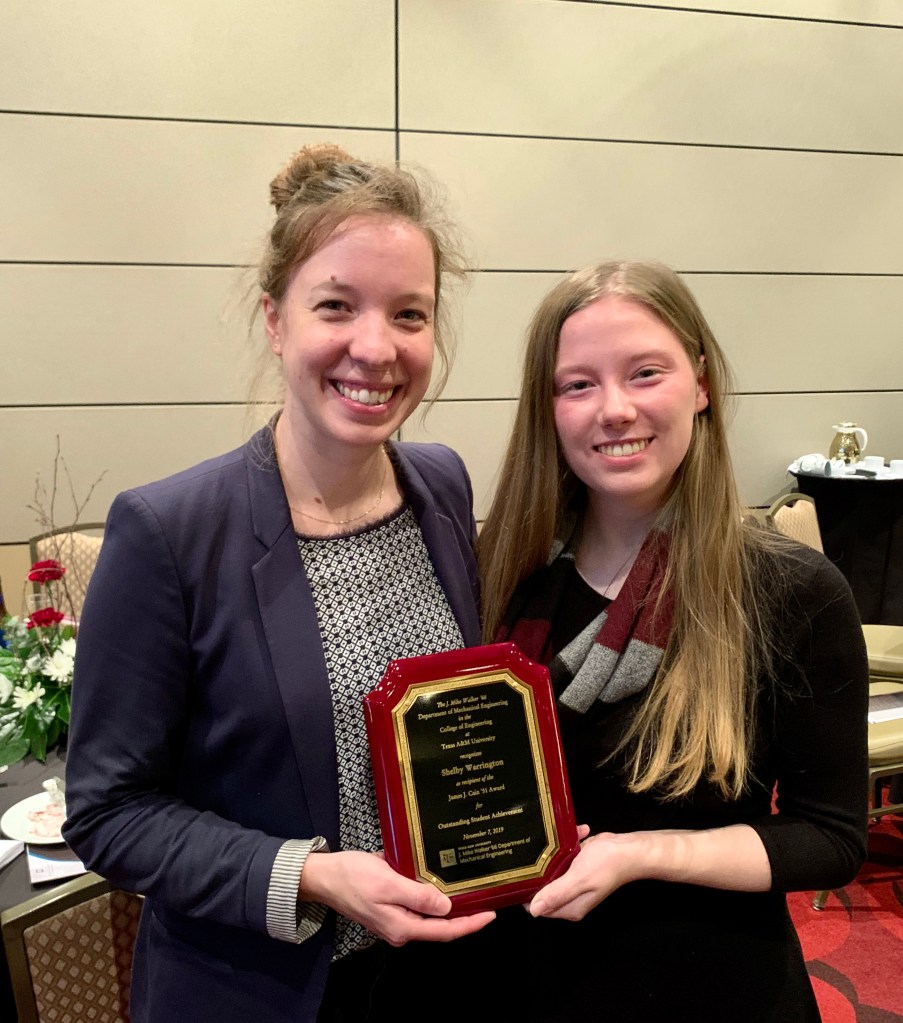
Jewel Williams successfully presented her 1st authored paper, with BiSSL undergrad Shelby Warrington as 2nd author, at the ASME’s International Manufacturing Science and Engineering Conference held in Erie, PA.

Abstract: Circular economy aims to address limited resources through the continuous circulation of materials and energy. Recirculating low quality materials for reuse is a sustainability goal that is analogous to the primary function of Nature’s detritus species, a keystone for the proper functioning of ecosystems. Prior applications of ecosystem structure to human network design uncovered that even the most economically successful networks of industries demonstrate a lack of analogous detritus actors in the form of reuse and recycling. The recycling industry’s volatile nature, dependency on international factors, and financial difficulties prevent this strategy from becoming an efficient alternative. Creativity in design, inspired by ecosystems, is proposed here as a method to repurpose manufacturing byproducts that are otherwise seen as low quality waste materials. Realizing the reuse potential of these materials can create detrital-type feedback loops, an attribute that supports the characteristic resilience and efficiency of ecosystems. The work here analyzes existing methods of pursuing circular economy and investigates the potential benefits generated by purposefully adding connects that create detrital-feedback-loops at the consumer and producer levels.
(2019) Williams, J.; S. Warrington; A. Layton. Waste Reduction: A review of common options and alternatives. ASME International Manufacturing Science and Engineering Conference. Erie, PA.
Our interdisciplinary paper with Electrical Engineering, first authored by BiSSL grad student Varuneswara Panyam, has been published in Applied Energy. The paper covers our proposed method for using ecosystems to guide the design of power grids towards a more biologically-inspired resilience.
The paper is available for free download here through July 16, 2019.
Technological advances have created a world where humans are highly dependent on an uninterrupted electric power supply, yet extreme weather events and deliberate attacks continue to disrupt power systems. Inherently robust ecological networks present a rich source of robust design guidelines for modern power grids. Analyses of ecosystem networks in literature suggest that this robustness is a consequence of a unique preference for redundant pathways over efficient ones. The structural similarity between these two system-types is exploited here through the application of ecological properties and analysis techniques to long-term power grid design. The level of biological similarity between these two system-types is quantitatively investigated and compared by computing ecological network metrics for a set of synthetic power systems and food webs. The comparison substantiates the use of the ecological robustness metric for optimizing the design of power grid networks. A bio-inspired optimization model is implemented, which restructures the synthetic power systems to mimic ecosystem robustness. The bio-inspired optimal networks are evaluated using N-1, N-2, and N-3 contingency analyses to assess system performance under the loss of 1, 2, and 3 components respectively. The bio-inspired grids all experienced significantly fewer violations in each loss scenario compared to traditional configurations, further supporting the application of the ecological robustness metric for power system robustness. The results provide insights into how ecological robustness can guide the design of power systems for improved infrastructural resilience to better survive disturbances.
“Bio-inspired design for robust power grid networks” by Varuneswara Panyam, Hao Huang, Katherine Davis, Astrid Layton
Matrix Trays: Waste to Opportunities, a seed grant project supported by Texas A&M’s President’s Excellence Fund, funded a Mechanical Engineering senior design/capstone team with myself and Dr. Ahmed Ali from the Architecture department as their advisors. Read more about the project here: “Student-designed smart shades reflect a more sustainable future”


“The project focused on taking a very common industry byproduct, a single-use matrix tray used for placing small electronic chips, and conceiving and prototyping a new product that would use the trays that removed them from the waste stream,” Layton said. “This goal aligns with those of a circular economy where the label ‘waste’ is removed by recognizing existing value. The students were given free rein in their concept generation, a freedom that resulted in an exciting final product with significant potential for future work.”

BiSSL MS student Colton Brehm was a finalist for the Leo Award for best paper for his CIRP Life Cycle Engineering conference paper “Designing eco-industrial parks in a nested structure to mimic mutualistic ecological networks.”
Abstract: Industrial Ecology uses ecological systems as a guide for improving the sustainability of complex industrial systems. Eco-Industrial Parks (EIPs) have gained support as a solution that seeks to simultaneously reduce environmental burdens and promote economic interests by exchanging materials and energy between industries to their mutual benefit. Recent studies have focused on drawing relations between food webs (FWs) and EIPs to improve the sustainability of the latter using ecological metrics, such as the level of cycling or average connections between actors. This study incorporates a new ecological metric, nestedness, into the discussion of sustainable design for EIPs. The association of nestedness with mutualistic ecological networks supports its application to EIP design. The work here improves the understanding of holistic network structure with the goal of improving future design decisions for EIPs with purposeful placement of material and energy flows.
The full paper is available here.