Two New BiSSL Papers Published

Two journal papers related to the use of bio-inspired system design approaches for cyber-physical systems from the BiSSL group have recently been accepted for publication! The 1st stems directly from a current ongoing grant with Sandia National Labs with BiSSL Ph.D. student Emily Payne as co-author and the 2nd is a culmination of multiple collaborations across mechanical and electrical engineering at Texas A&M and is led by former BiSSL Ph.D. student Abheek Chatterjee, now a post-doc at NIST.

Abstract: Cyber-physical systems have behavior that crosses domain boundaries during events such as planned operational changes and malicious disturbances. Traditionally, the cyber and physical systems are monitored separately and use very different toolsets and analysis paradigms. The security and privacy of these cyber-physical systems requires improved understanding of the combined cyber-physical system behavior and methods for holistic analysis. Therefore, we propose leveraging clustering techniques on cyber-physical data from smart grid systems to analyze differences and similarities in behavior during cyber-, physical-, and cyberphysical disturbances. Since clustering methods are commonly used in data science to examine statistical similarities in order to sort large datasets, these algorithms can assist in identifying useful relationships in cyber-physical systems. Through this analysis, deeper insights can be shared with decision-makers on what cyber and physical components are strongly or weakly linked, what cyber-physical pathways are most traversed, and the criticality of certain cyber-physical nodes or edges. This paper presents several types of clustering methods for cyber-physical graphs of smart grid systems and their application in assessing different types of disturbances for informing cyber-physical situational awareness. The collection of these clustering techniques provide a foundational basis for cyber-physical graph interdependency analysis.

Jacobs, N., S. Hossain-McKenzie, S. Sun, E. Payne, A. Summers, L. Al Homoud, A. Layton, K. Davis, and C. Goes. (2024) โ€œLeveraging Clustering Techniques for Cyber-Physical System Analysis to Enhance Disturbance Characterization.โ€ The Institution of Engineering and Technology (IET) Cyber-Physical Systems: Theory & Applications.

Abstract: The design of resilient infrastructure is a critical engineering challenge for the smooth functioning of society. These networks are best described as Cyber-Physical Systems of Systems (CPSoS): integration of independent constituent systems, connected by physical and cyber interactions, to achieve novel capabilities. Bio-inspired design, using a framework called the Ecological Network Analysis (ENA), has been shown to be a promising solution for improving the resilience of engineering networks. However, the existing ENA framework can only account for one type of flow in a network. Thus, it is not yet applicable for the evaluation of CPSoS. The present work addresses this limitation by proposing a novel multigraph model of CPSoS, along with guidelines and modified metrics that enable ENA evaluation of the overall (cyber and physical) network organization of the CPSoS. The application of the extended framework is demonstrated using an energy infrastructure case study. This research lays the critical groundwork for investigating the design of resilient CPSoS using biological ecosystems inspiration.

Chatterjee, A., H. Huang, R. Malak, K. Davis, and A. Layton. (2024) โ€œExtending Ecological Network Analysis to Design Resilient Cyber-Physical System of Systems.โ€ IEEE Open Journal of Systems Engineering.

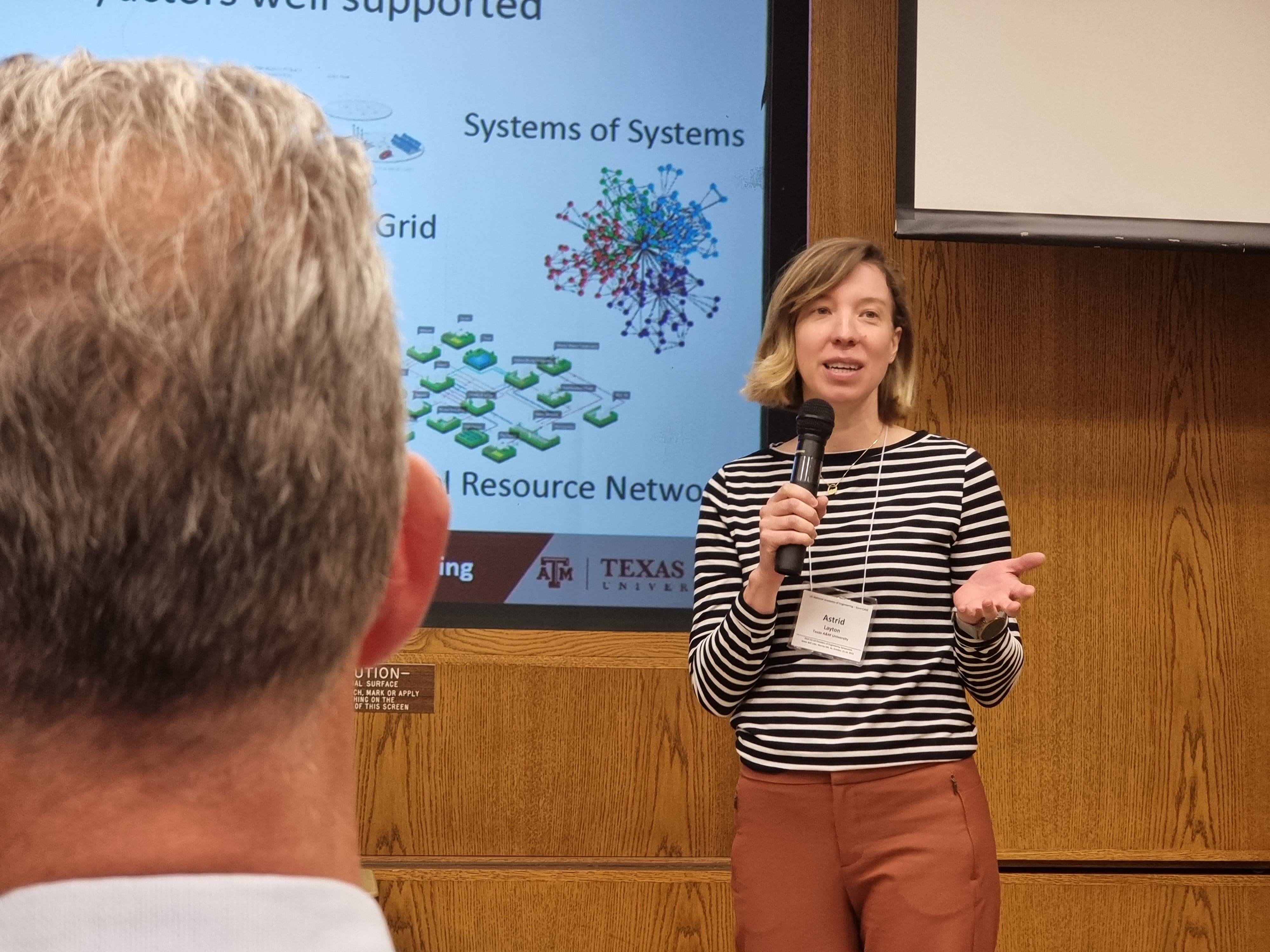
Dr. Astrid Layton selected to attend the 2023 EU-US Frontiers of Engineering (EU-US FOE) Symposium hosted by the National Academy of Engineering and Nokia Bell Labs

BiSSL group director Dr. Astrid Layton was selected to attend the 2023 EU-US Frontiers of Engineering (EU-US FOE) Symposium hosted by the National Academy of Engineering (NAE) and Nokia Bell Labs. The National Academy of Engineering holds an annual US Frontiers of Engineering symposium that brings together 60 highly accomplished early-career engineers from EU and US universities, companies, and government to discuss leading-edge research and technical work across a range of engineering fields. Convening engineers from disparate fields and challenging them to think about developments and problems at the frontiers of areas different from their own can lead to a variety of desirable results. These include collaborative work, the transfer of new techniques and approaches across fields, and the establishment of contacts among the next generation of leaders in engineering. The objectives for the bilateral meetings also have the added element of facilitating international cooperation and understanding. The symposium – which covers the topics of The Quantum Era Challenge, Future Challenges in Additive Manufacturing, Clean Hydrogen, and The Computational Era of Life Sciences – will take place from October 15-18 at the National Academiesโ€™ Beckman Center in Murray Hill, New Jersey.

Invited Graduate Research Seminar at University of Michigan

Dr. Layton gave an invited seminar presentation at University of Michigan titled “How Nature’s Systems Can Guide More Resilient and Sustainable Human Network Design” Sept. 26, 2023. The talk coincided with some excellent collaborative brainstorming with Dr. Sita Syal and other new contacts.

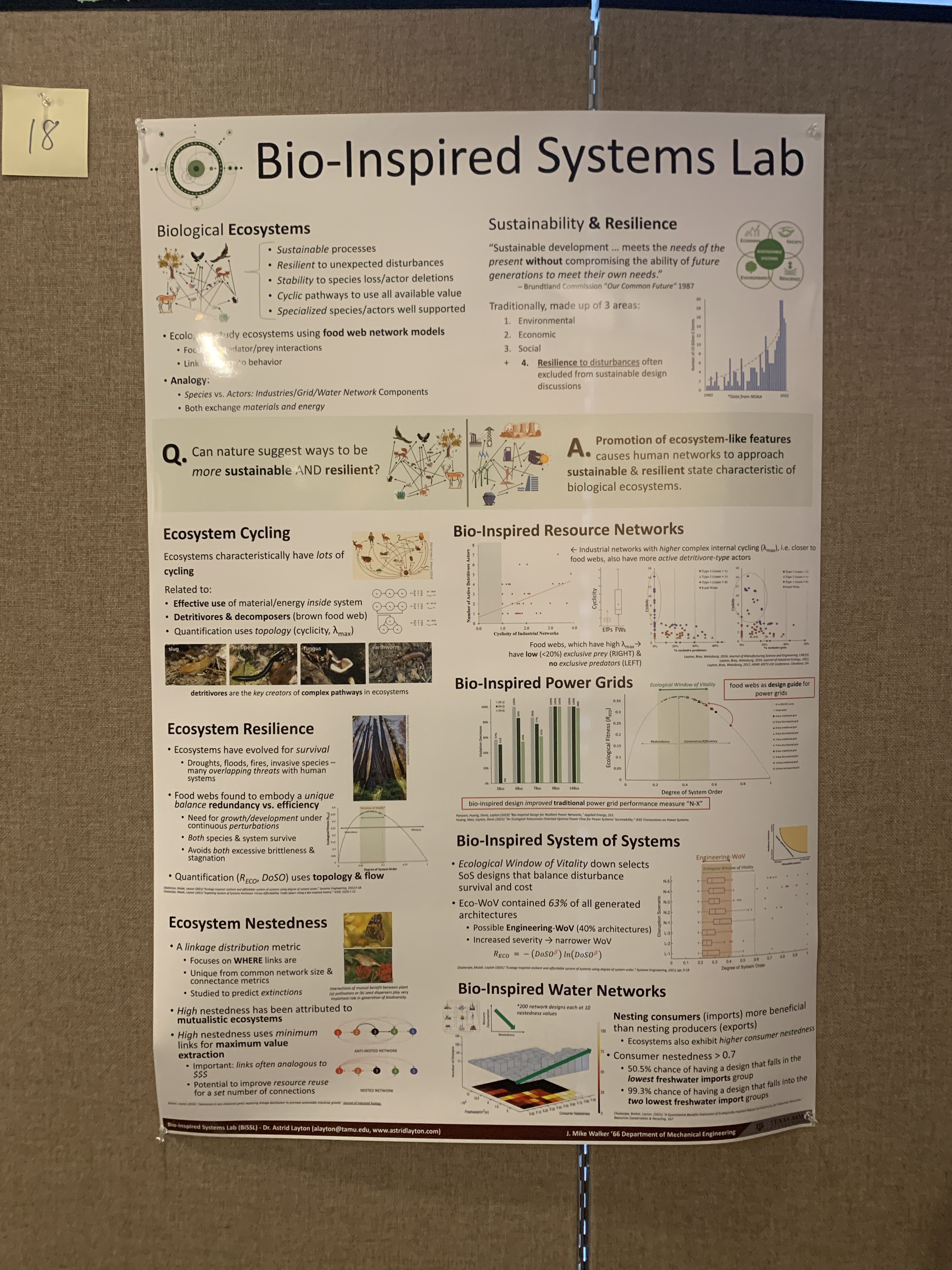
Abstract: Inspiration from nature has produced some fascinating, novel, and life-changing solutions for the human world. Most of these bio-inspired designs however have been product-based, but taking a systems perspective when we look to nature taps inspirations that can improve the critical networks we depend on. This talk focuses on biological ecosystems, in particular, complex networks of interacting species that are able to support individual needs while maintaining system-level functions during both times of abundance and unexpected disturbances. This talk will show how these networks can offer inspiration for achieving both sustainability AND resilience. Quantitative ecosystem descriptors and analysis techniques adapted from ecology enable desirable ecosystem characteristics to be used as design guides for things like industrial resource networks, water networks, supply chains, and power grids.

Graduate Awards and Fellowships for 3 BiSSL PhD Students

Two BiSSL Ph.D. students – Hadear Hassan and Emily Payne – have been awarded 2023 J. Mike Walker โ€™66 Impact Awards. The award is given to two male and two female graduate students who have demonstrated academic/scholarly achievements, as well as have leadership and/or entrepreneurial focus/experience and innovative excellence. The winners each receive a $5,000 fellowship. BiSSL Ph.D. student Luis Rodriguez was awarded a Sally and Ray Bowen โ€™58 Fellowship for 2022/23. Congratulations Hadear, Emily, and Luis! They’ll all be recognized at the 2023 Mechanical Engineering Scholarship & Fellowship Banquet in October in the Memorial Student Center.

Luis Rodriguez (back left) and Hadear Hassan (front 2nd from left) had their awards presented at the 2023 Mechanical Engineering Scholarship & Fellowship Banquet. They are both co-advised by Dr. Cynthia Hipwell (front-center).
(L-R) Emily Payne (BiSSL), Maulik Kotecha (Product Synthesis Engineering Lab), Shantanu Vyas (Mixed-Initiative Design Lab), Wanyu Xu (Product Synthesis Engineering Lab), Qiyu Li, Luis Rodriguez (BiSSL)

Successful IDETC-CIE 2023 in Boston

Another excellentย ASME (American Society of Mechanical Engineers)ย IDETC-CIE conference is in the books!

BiSSL Ph.D. studentsย Hadear Hassanย andย Emily Payneย from theย J. Mike Walker ’66 Department of Mechanical Engineering at Texas A&M Universityย each presented their first-authored papers, sharing their research that will help us achieve a moreย sustainableย andย resilientย world.

Hadear’s (in collaboration with Emily) was on “Quantifying the Sustainability and Robustness of Manufacturing Systems Using Energy and Ecological Network Analysis” and Emily’s (in collaboration with former undergraduate researcher Hannah Wagner) was on “Resilienceย & Sustainability in Certified Green Buildings:ย Applying Ecosystem Concepts to Aid in More Dynamicย Green Communities.”

Dr. Layton also presented the work of MS student Samuel Blair (who graduated in May 2023) on “Measuring the Health of Makerspaces During Large Disruptions such as the COVID-19 Pandemic.”

We also got to hang out with Dr. Abheek Chatterjee, who graduated from our lab last December!

(L-R) Abheek Chatterjee, Astrid Layton, Emily Payne, Hadear Hassan

Dr. Layton Invited Seminar at University of Pittsburgh

Following the ASEE 2023 workshop on our makerspace modeling/analysis GUI use, Dr. Layton was invited to come give a research seminar at University of Pittsburgh to share the NSF funded makerspace work her and Dr. Julie Linsey at Georgia Tech have been doing. Her talk was titled: “From Makerspaces to Industries: How Bio-Inspired Network Models Can Alter Functioning Via Form”

The youngest attendee Renee was 10 years old and already a makerspace expert!

Joint (JMD & JMSE) Special Issue On Advances In Design And Manufacturing For Sustainability

Dr. Layton is a guest editor for an upcoming special issue on sustainability in design and manufacturing being published jointly between ASME’s journals of Mechanical Design and Manufacturing Science and Engineering. Drafts are due July 31, 2023.

This special issue is a joint effort between the ASME Manufacturing Engineering Division (MED) and the Design Engineering Division (DED) as part of a collaboration to advance design and manufacturing research in sustainability. As the need grows for methodologies and tools capable of supporting sustainable systems, this collection welcomes new scientific approaches, data-driven techniques, informatics solutions, and case studies at the intersection of sustainability, design, and manufacturing. The call focuses on the main challenges the design and manufacturing communities face regarding sustainability and seeks to identify emerging research trends as well as current industry practices for integrating sustainability principles into the design and implementation of engineered systems and processes. Recent advances and future directions along the design-manufacturing continuum are welcome, including submissions on topics such as design decisions, manufacturing process development, manufacturing systems optimization, supply chain integration, sustainable energy systems, product user interaction, and product end-of-life analysis.

Topic Areas

  • Circular Economy and Industry 5.0
  • Artificial intelligence for sustainable design and manufacturing
  • Sustainability analytics
  • Sustainable additive manufacturing and additive remanufacturing
  • Design for recycling, remanufacturing, and reuse
  • CAD integration of sustainable design methods and techniques
  • Sustainable energy systems
  • Industrial ecology in design, manufacturing, and automation
  • Environmental justice in design and eco-design approaches
  • Human-centric design and manufacturing
  • Remanufacturing and advanced recycling processes for critical materials
  • System efficiency and Decarbonization

Sandia National Lab Visit

Ph.D. student Emily Payne and Dr. Astrid Layton joined collaborators Dr. Kate Davis and her Ph.D. students Leen and Akram for a visit to Sandia National Lab in Albuquerque, NM. The trip was part of an ongoing collaborative LDRD grant with Sandia looking at cyber-physical power systems for resilience. The trip even evolved some exploring Petroglyph National Monument!

Dr. Layton Invited Seminar for the INCOSE Natural Systems Working Group (NSWG)

BiSSL director Dr. Astrid Layton was invited to give a research seminar to the INCOSE Natural Systems Working Group.

Abstract: Inspiration from nature has produced some fascinating, novel, and life-changing solutions for the human world. Most of these bio-inspired designs however have been product based. Taking a systems perspective when we look to nature taps inspirations that can improve the critical networks we depend on. This talk focuses on biological ecosystems, in particular, complex networks of interacting species that are able to support individual needs while maintaining system-level functions. These networks offer inspiration for achieving both sustainability AND resilience in the design of our human-engineered networks. Quantitative ecosystem descriptors and analysis techniques adapted from ecology enable desirable ecosystem characteristics to be used as design guides for things like industrial resource networks, water networks, supply chains, and power grids.

โ€œBiological Ecosystems as Quantitative System Design Inspiration for Resilient and Sustainable Human Networksโ€ Dr. Astrid Layton

This image has an empty alt attribute; its file name is image.png