Invited Research Seminar at the University of Miami, Department of Industrial and Systems Engineering

Dr. Astrid Layton was invited by the Department of Industrial and Systems Engineering at the University of Miami to share BiSSL group work on bio-inspired system resilience. Her talk, titled “Using Biological Inspiration to Guide the Design of Human Networks for Resilience” is also now featured in the University’s Climate Resilience Academy UM YouTube series.

Abstract: Biological ecosystems have been through millions of years of R&D, producing complex systems of systems made up of interacting species that are able to support individual needs while maintaining system-level functions. In this talk Dr. Layton will show that ecosystems offer a relatively untapped source of design inspiration for improving the resilience of our human engineered networks in conjunction with goals like sustainability and cost. Quantitative descriptors and analysis techniques are adapted from ecology, enabling desirable ecosystem characteristics to be used as optimization and design guides for industrial resource networks (or eco-industrial parks, EIPs), water networks, supply chains, cyber-physical systems, and power grids. Ecological characteristics such as high levels of materials/energy cycling and a unique balance between redundant and efficient pathways offer novel routes to achieving traditional engineering goals.

Prof. Astrid Layton (Texas A&M) discusses biological inspiration for resilient human networks. It is shown that ecosystems offer a relatively untapped source of design inspiration for improving the resilience of our human-engineered networks in conjunction with goals like sustainability and cost. #design#bioinspired#resilience#sustainability

BiSSL MS Energy Student Alexander Duffy defends his thesis!

Masters of Energy student Alexander Duffy successfully defended his master’s thesis on Friday. The committee consisted of BiSSL head Dr. Astrid Layton, Dr. Katherine Davis from Electrical & Computer Engineering, and Dr. Helen Reed from Aerospace Engineering. His thesis was titled Design and analysis of satellite networks for ecological resilience.”

Alexander Duffy defends his MS thesis research

BiSSL Ph.D. Student Abheek Chatterjee defends his thesis!

The first Ph.D. student to graduate from BiSSL, Abheek Chatterjee, successfully defended his dissertation on Wednesday! The committee consisted of BiSSL head Dr. Astrid Layton, Drs. Richard Malak and Douglas Allaire from Mechanical Engineering, and Dr. Nancy Currie-Gregg from Industrial & Systems Engineering. His thesis was titled An Investigation of Ecologically-Inspired Architecting Principles for Resilient System of Systems Design.”

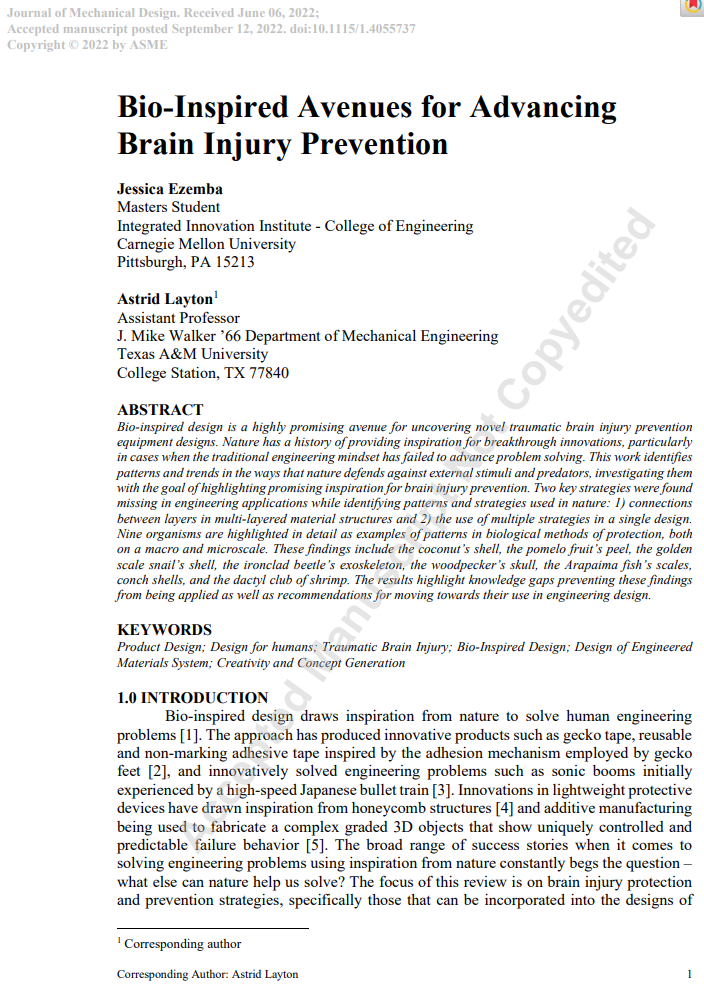
Huge congratulations to BiSSL alum Jessica Ezemba on her first authored paper being accepted to the Journal of Mechanical Design!

Jessica was an undergraduate researcher student in BiSSL while at Texas A&M. Her work combining her interest in brain injuries with bio-inspired design turned into a full-length journal article that has now been accepted for publication in the Journal of Mechanical Design. Jessica is currently a graduate student at Carnegie Mellon University in their MIIPS program and is planning on pursuing a Ph.D. thereafter.

The paper is titled “Bio-Inspired Avenues for Advancing Brain Injury Prevention” and can be found here:

Abstract: “Bio-inspired design is a highly promising avenue for uncovering novel traumatic brain injury prevention equipment designs. Nature has a history of providing inspiration for breakthrough innovations, particularly in cases when the traditional engineering mindset has failed to advance problem solving. This work identifies patterns and trends in the ways that nature defends against external stimuli and predators, investigating them with the goal of highlighting promising inspiration for brain injury prevention. Two key strategies were found missing in engineering applications while identifying patterns and strategies used in nature: 1) connections between layers in multi-layered material structures and 2) the use of multiple strategies in a single design. Nine organisms are highlighted in detail as examples of patterns in biological methods of protection, both on a macro and microscale. These findings include the coconut’s shell, the pomelo fruit’s peel, the golden scale snail’s shell, the ironclad beetle’s exoskeleton, the woodpecker’s skull, the Arapaima fish’s scales, conch shells, and the dactyl club of shrimp. The results highlight knowledge gaps preventing these findings from being applied as well as recommendations for moving towards their use in engineering design.”

(2022) *Ezemba, J.; Layton, A. “Bio-Inspired Avenues for Advancing Brain Injury Prevention.” Journal of Mechanical Design. DOI: 10.1115/1.4055737

Two BiSSL Student Papers Presented at the 2022 IDETC-CIE Conference in St. Louis, Missouri

Ph.D. candidate Abheek Chatterjee presented two student-led papers at this year’s IDETC-CIE conference. BiSSL MS student alum Tyler and Abheek collaborated on the paper “Exploring the Effects of Partnership and Inventory for Supply Chain Resilience Using an Ecological Network Analysis,” presented to Design for Manufacturing and the Life Cycle (DFMLC). Abheek also collaborated with undergraduate alum Cade Helbig and Dr. Rich Malak on the paper “A Survey of Graph-Theoretic Approaches for Resilient System of Systems Design,” presented to System Engineering and Information Knowledge Management (SEIKM).

Two BiSSL MS Students Graduate!

Congratulations to Tyler Wilson and Garrett Hairston for graduating with their MS degrees, they both defended their MS theses this May. Garrett started in the BiSSL group as an undergraduate researcher back in Fall 2019 and Tyler began his MS with BiSSL in Fall 2020.

Garrett’s thesis is titled: “Using Bio-Inspired Techniques to Design for Improved Sustainability and Robustness in Net Zero Communities”

In the global effort to combat climate change, the continued emergence of Net Zero Communities (NZCs) can play a large role in establishing a sustainable foundation on which progress can be made. NZC design, however, is complicated by the need to balance the system’s ability to achieve sustainable performance with its ability to maintain system operation during disturbances. These two design objectives, sustainable use of resources and system robustness, are often found in opposition to one another, but design inspiration can be taken from biological ecosystems, which have benefitted from generations of incremental evolution to display positive network characteristics with regards to both efficient resource use and robustness. This thesis focuses on applying the knowledge of what makes these ecosystems successful, as well as the techniques ecologists use to characterize them, to identify Net Zero (NZ) modifications that can simultaneously improve both of the aforementioned design objectives. First, a dataset of NZCs including quantitative energy and water flows throughout each case is constructed. This dataset then enables the use of Ecological Network Analysis on NZC networks, specifically identifying Finn’s Cycling Index (FCI) and Degree of System Order (DoSO) as metrics corresponding to sustainable and robust design, respectively. The results show that for the NZ modifications tested, a strong correlation exists between FCI and NZ performance, suggesting that FCI can be used as a proxy for sustainable network behavior. Additionally, a negative correlation emerges between FCI and DoSO. This result is significant as lower DoSO is indicative of improved network robustness, especially in the face of increasingly large disturbances, meaning that the modifications tested were in direct support of both sustainability and robustness. These findings hold true through disturbance testing, where the modified networks with higher NZ performance are also able to maintain the highest levels of operation during a disturbance. As such, this thesis provides proof of concept that bio-inspiration can be used to inform NZC design and impart improved sustainability and robustness into the networks.

Hairston, Garrett. (2022) “Using Bio-inspired Techniques to Design for Improved Sustainability and Robustness in Net Zero Communities.” MS, Mechanical Engineering, Texas A&M University.

Tyler’s thesis is titled: “Designing and Optimizing Supply Chain Networks for Resilience using Ecological Network Analysis”

Abstract: Traditional supply chain policies and design efforts, such as lean-manufacturing, prize efficiency over all other factors and are being challenged as supply chains struggle to bounce back from recent disruptions. Supply chain design guidelines that address resilience require a balanced approach between efficiency and redundancy, one that presents flexibility in a way that acknowledges profit requirements. Ecological Network Analysis reveals a unique balance of pathway efficiency and redundancy within ecosystems. This balance results in efficient steady-state operations and survival upon disruption. Supply chain networks are evaluated here using the same ecological analysis, providing design guidelines for achieving a balanced system-level resilience. Significant insights include that the validity of ecologically inspired supply chain design is contingent on the supply chain’s properties and that under the right conditions, the ecological balance of efficiency and redundancy can vastly improve the performance of supply chains during disruptions.

Wilson, Tyler. (2022) “Designing and Optimizing Supply Chain Networks for Resilience using Ecological Network Analysis.” MS, Mechanical Engineering, Texas A&M University.