Two BiSSL students get papers accepted to 2020’s IDETC-CIE conference

Two BiSSL students, PhD student Abheek Chatterjee and MS almuni Tirth Dave, have had their “International Design Engineering Technical Conference & Computers and Information in Engineering Conference” (IDETC-CIE) papers accepted to the 2020 conference, to be held in St. Louis, MO August 16-19, 2020.

Abheek’s paper was accepted to the CIE sub-conference on Systems Engineering Information Knowledge Management (SEIKM):

Chatterjee, A., Malak, R., & Layton, A. (2020). Exploring a Bio-Inspired System of Systems Resilience vs. Affordability Tradespace. ASME 2020 Computers and Information in Engineering Conference, St. Louis, MO.

Tirth’s paper was accepted to the IDETC sub-conference on Design Theory and Methodology (DTM):

Dave, T., & Layton, A. (2020). Extending the Use of Bio-Inspiration for Water Distribution Networks to Urban Settings. ASME 2020 International Design Engineering Technical Conference, St. Louis, MO.

BiSSL Presentation at 18th Annual Conference on Systems Engineering Research (CSER 2020)

BiSSL is looking forward to representing our bio-inspired systems of systems (SoS) design work at this year’s 18th Annual Conference on Systems Engineering Research in Redondo Beach, CA. The conference this year is focused on “Recent Trends and Advances in Model-based Systems” and will be going on from March 19-21, 2020. PhD student Abheek Chatterjee is first author on a paper with our collaborator Dr. Richard Malak titled: “A Bio-inspired Framework for Analyzing and Predicting the Trade-off between System of Systems Attributes.” We hope to see you all there!

2 BiSSL Papers Accepted to the 27th CIRP-Life Cycle Engineering Conference

Two BiSSL students, MS student Colton Brehm and PhD student Abheek Chatterjee, have had full papers accepted to 2020’s CIRP LCE conference! The 2020 conference focuses on “the role that engineering must play in the achievement of the sustainable future that people wish.” The conference this year is hosted by Grenoble INP – Institut d’Ingénierie Univ. Grenoble Alpes and will be held in Grenoble, France May 13-15, 2020.

  • Abheek Chatterjee, Colton Brehm, and Astrid Layton (2020) “Mimicking the nested structures of ecosystems in the design of industrial water networks.”
  • Abheek Chatterjee and Astrid Layton (2020) “Bio-inspired Design for Sustainable and Resilient Supply Chains.”

TEXAS A&M CONFERENCE ON ENERGY

PhD student Hao Huang from the Power Systems group in Electrical Engineering will be presenting our Bio-Inspired Power Grid design work at the Fourth Annual TEXAS A&M CONFERENCE ON ENERGY on September 23-25, 2019. The event is sponsored by the Texas A&M Energy Research Society in partnership with the Texas A&M Energy Institute. The presentations will include a poster presentation in the “Seed Grant Poster Session” on Monday 23td 3:30-4:30pm as well as an oral presentation in the “Energy-Efficiency, Economics, Sustainability, and Policies” session on Wednesday 25th from 11:05-11:20am.

Layton and Ali Present at A&M College of Architecture’s 21st Annual Research Symposium

Natural, Built, Virtual — the Texas A&M College of Architecture’s 21st Annual Research Symposium

(L to R) Dr. Ahmed Ali and Dr. Astrid Layton

Our collaborative and multidisciplinary research on by-product reuse and supporting a circular economy will be presented by Mechanical Engineering’s Dr. Astrid Layton and Architecture’s Dr. Ahmed Ali today at the Texas A&M College of Architecture’s 21st Annual Research Symposium “Natural, Built, Virtual” http://symposium.arch.tamu.edu/symposium/2019/

The presentation will cover the past year of our project ” Matrix Trays: Waste to Opportunities,” a seed grant project supported by Texas A&M’s President’s Excellence Fund. Read more about the outcome of the Mechanical Engineering Senior Design component of the project here: https://engineering.tamu.edu/news/2019/07/student-designed-smart-shades-reflect-a-more-sustainable-future.html

BiSSL Student Presents at A&M’s Resilience Rising Symposium

Resilience Rising: Research and Practice on Hurricane Harvey and Hazards of the Future Symposium

BiSSL PhD student Abheek Chatterjee will be presenting his resilient system design related research “Investigating Ecosystems’ Mimicry towards Design of Resilient Resource and Infrastructure Networks” this Friday, September 6th at the “Resilience Rising” symposium being hosted by TAMU College of Architecture.

The symposium will be held in Rudder Tower on the College Station campus. Come learn and network with fellow TAMU researchers and practitioners as they discuss recent projects on Hurricane Harvey and disaster resilience! The event is free but registration is limited.

The schedule will include:

  • Presentations
  • Panel Discussions
  • Student Poster Presentation and Competition
  • Pecha Kucha Style Quick Presentations

For questions contact us at hrrc@arch.tamu.edu

Presentations of BiSSL Work at IDETC-CIE 2019

BiSSL graduate students Varuneswara Panyam and Abheek Chatterjee presented their first-authored papers this week in Anaheim, CA. The papers for their talks “Bio-Inspired Human Network Design: Multi-Currency Robustness Metric Formulation Inspired By Ecological Network Analysis” and “Bio-inspired modeling approaches for human networks with link dissipation” can be found only through ASME IDETC2019.

BiSSL Presentation at ASME’s 2019 International Manufacturing Science and Engineering Conference

Jewel Williams successfully presented her 1st authored paper, with BiSSL undergrad Shelby Warrington as 2nd author, at the ASME’s International Manufacturing Science and Engineering Conference held in Erie, PA.

Abstract: Circular economy aims to address limited resources through the continuous circulation of materials and energy. Recirculating low quality materials for reuse is a sustainability goal that is analogous to the primary function of Nature’s detritus species, a keystone for the proper functioning of ecosystems. Prior applications of ecosystem structure to human network design uncovered that even the most economically successful networks of industries demonstrate a lack of analogous detritus actors in the form of reuse and recycling. The recycling industry’s volatile nature, dependency on international factors, and financial difficulties prevent this strategy from becoming an efficient alternative. Creativity in design, inspired by ecosystems, is proposed here as a method to repurpose manufacturing byproducts that are otherwise seen as low quality waste materials. Realizing the reuse potential of these materials can create detrital-type feedback loops, an attribute that supports the characteristic resilience and efficiency of ecosystems. The work here analyzes existing methods of pursuing circular economy and investigates the potential benefits generated by purposefully adding connects that create detrital-feedback-loops at the consumer and producer levels.

(2019) Williams, J.; S. Warrington; A. Layton. Waste Reduction: A review of common options and alternatives. ASME International Manufacturing Science and Engineering Conference. Erie, PA.

BiSSL Grad Student Finalist for the Leo Best Paper Award at CIRP-Life Cycle Engineering

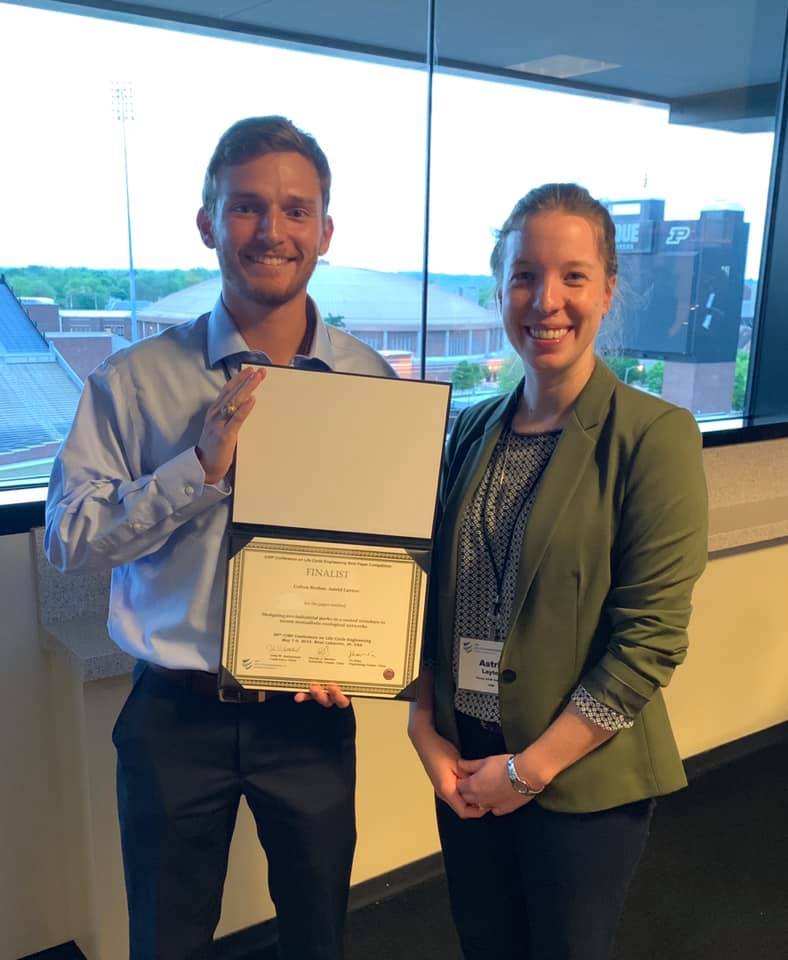
Colton Finalist

BiSSL MS student Colton Brehm was a finalist for the Leo Award for best paper for his  CIRP Life Cycle Engineering  conference paper “Designing eco-industrial parks in a nested structure to mimic mutualistic ecological networks.”

Abstract: Industrial Ecology uses ecological systems as a guide for improving the sustainability of complex industrial systems. Eco-Industrial Parks (EIPs) have gained support as a solution that seeks to simultaneously reduce environmental burdens and promote economic interests by exchanging materials and energy between industries to their mutual benefit. Recent studies have focused on drawing relations between food webs (FWs) and EIPs to improve the sustainability of the latter using ecological metrics, such as the level of cycling or average connections between actors. This study incorporates a new ecological metric, nestedness, into the discussion of sustainable design for EIPs. The association of nestedness with mutualistic ecological networks supports its application to EIP design. The work here improves the understanding of holistic network structure with the goal of improving future design decisions for EIPs with purposeful placement of material and energy flows.

The full paper is available here.