BiSSL Grad Students Varuneswara Panyam & Abheek Chatterjee Papers Accepted to the 2019 ASME International Design Engineering Technical Conferences

idetc2019

Congratulations to BiSSL graduate students Varuneswara Panyam and Abheek Chatterjee for each of their first-authored papers being accepted to the 2019 ASME International Design Engineering Technical Conferences: 31st International Conference on Design Theory and Methodology (DTM) in the Biologically Inspired Design session. They will be presenting their papers in Anaheim, California August 18-21, 2019.

Varuneswara Panyam and Astrid Layton, “Bio-inspired modeling approaches for human networks with link dissipation”

Structural similarities between human networks and biological ecosystems have inspired biomimetic design of human networks. The approach requires the networks to be represented as graphs, where the actors are nodes and the connections between actors are links. A major oversight in the application of ecosystem-based modeling to human networks thus far has been in the selection of actors and links. Transfers between species in a biological ecosystem are direct, happening when the species are co-located. Human networks often require a physical aid to complete the transaction, such as power transmission lines, pipelines, or vehicles. These exchange methods experience dissipation, which is not captured in current applications of ecosystem-based human network modeling. Human networks modeled as ecosystems thus far simply categorize exchanges as links in the graph, effectively forcing dissipation during material/energy transport to be neglected. This dissipation can sometimes be high relative to the total energy/material exchanged and thus is a potentially large oversight. Three hypothetical power grids and three Italian urban water distribution networks are used to quantify the impact of modeling interaction aids — power lines and water pipelines — as actors (and thus including any dissipation) in an ecosystem model. Ecological structural and flow metrics previously applied to human networks are evaluated between the two modeling methods. The comparison shows that the impact of this overlooked aspect is potentially significant and warrants consideration.

Abheek Chatterjee and Astrid Layton, “Bio-Inspired Human Network Design: Multi-Currency Robustness Metric Formulation Inspired By Ecological Network Analysis”

The Ecological Network Analysis (ENA) metric ecological robustness quantifies the unique balance that biological food webs have between their pathway efficiency and redundancy, enabling them to maximize their robustness to system disturbances. This robustness is a potentially desirable quality for human systems to mimic. Modeling the interactions between actors in human networks as predator-prey type exchanges (of a medium or currency rather than caloric exchanges) enables an ENA analysis. ENA has been shown to be a useful tool in improving the design of human networks because it allows the characteristics of biological networks to be mimicked. The application of these metrics is, however, limited to networks with only one flow type. Human networks are composed of many different types of flow interactions and thus a biologically-inspired indicator of total system robustness must take into account all of these interactions. This work further develops the traditional ENA ecological robustness metric to accommodate various flows between actors in multi-currency human networks. Two novel methods for quantifying multi-currency flow network robustness are introduced. The mathematical derivation for these new metrics is presented. The water network for the Kalundborg Eco-Industrial Park (EIP) is used as a case study to determine benefits of the proposed robustness metrics. The results obtained using the single-currency robustness and the two multi-currency robustness metrics are compared using the case study. Based on the analysis of the results obtained at the system level, as well as at the sub-levels, both multi-currency metrics showed the ability to predict systems characteristics for the multi-currency Kalundborg EIP. While both of these are promising, more research regarding these metrics is needed in order to develop an elegant and comprehensive total system robustness metric.

1st Annual President’s Excellence Fund Symposium at Texas A&M

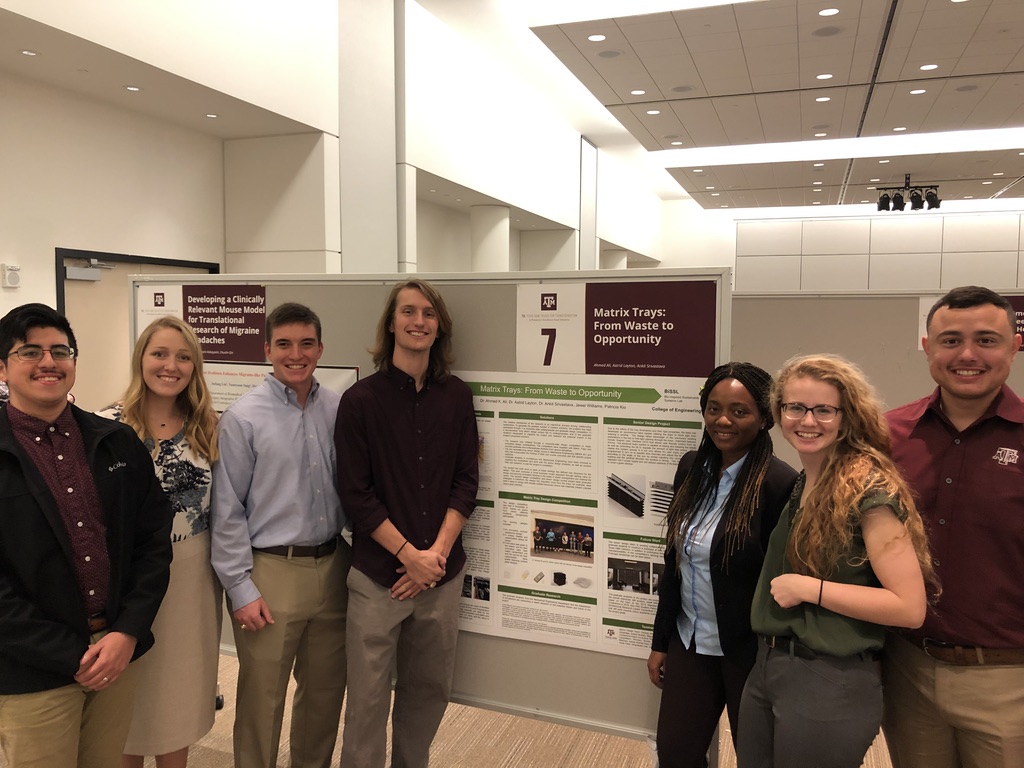
Dr. Ahmed Ali and I are very proud of our Mechanical Engineering Senior Design Team (Zachary Merrill, Alexandra Stewart, Austin Grosklags, Joseph Bustillo, and Miguel Cervantes) and our graduate students Jewel Williams and Patricia Kio, who represented our T3 project “Matrix Trays: From Waste to Opportunities” during the Symposium poster session.

UNADJUSTEDNONRAW_thumb_c68
(From left to right: Joseph Bustillo, Jewel Williams, Zachary Merrill, Austin Grosklags, Patricia Kio, Alexandra Stewart, Miguel Cervantes)

BiSSL Grad Student Colton Brehm Nominated for the Leo Award for Best Paper

cirp_logo

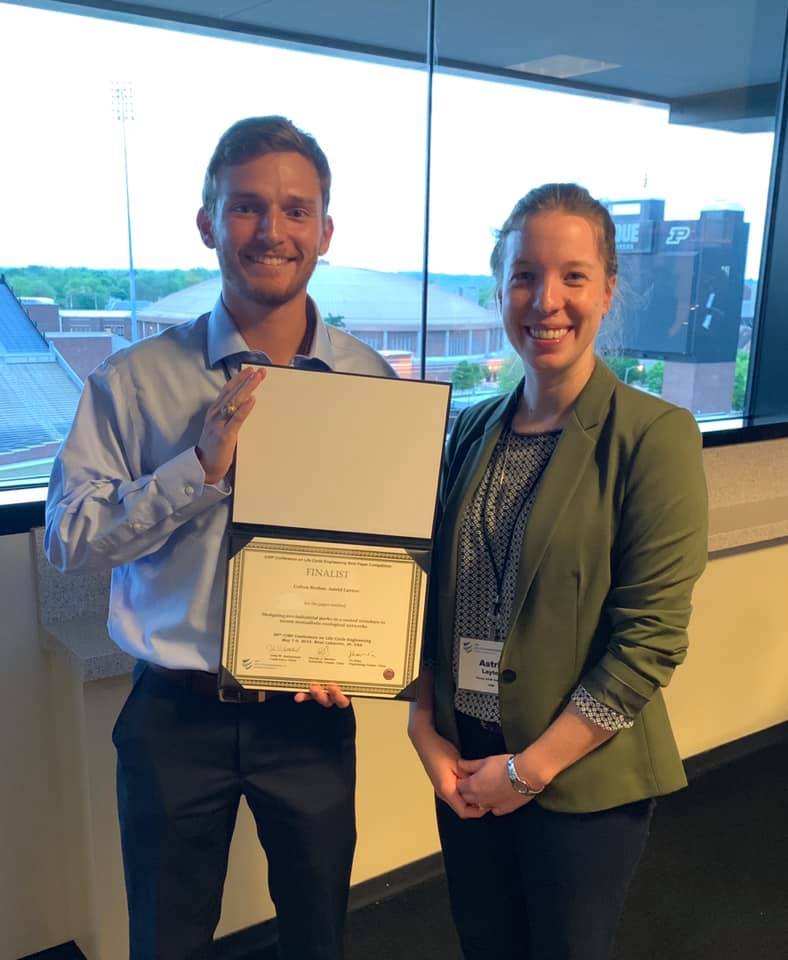
Congratulations to BiSSL MS student Colton Brehm! His conference paper for the 26th CIRP Life Cycle Engineering Conference on Advancing Industrial Sustainability, to be held at Purdue University May 2019, is nominated for the Leo Award for best paper!

“Designing eco-industrial parks in a nested structure to mimic mutualistic ecological networks,” first authored by Colton Brehm

Industrial Ecology uses ecological systems as a guide for improving the sustainability of complex industrial systems. Eco-Industrial Parks (EIPs) have gained support as a solution that seeks to simultaneously reduce environmental burdens and promote economic interests by exchanging materials and energy between industries to their mutual benefit. Recent studies have focused on drawing relations between food webs (FWs) and EIPs to improve the sustainability of the latter using ecological metrics, such as the level of cycling or average connections between actors. This study incorporates a new ecological metric, nestedness, into the discussion of sustainable design for EIPs. The association of nestedness with mutualistic ecological networks supports its application to EIP design. The work here improves the understanding of holistic network structure with the goal of improving future design decisions for EIPs with purposeful placement of material and energy flows.

TAMU Student Research Week

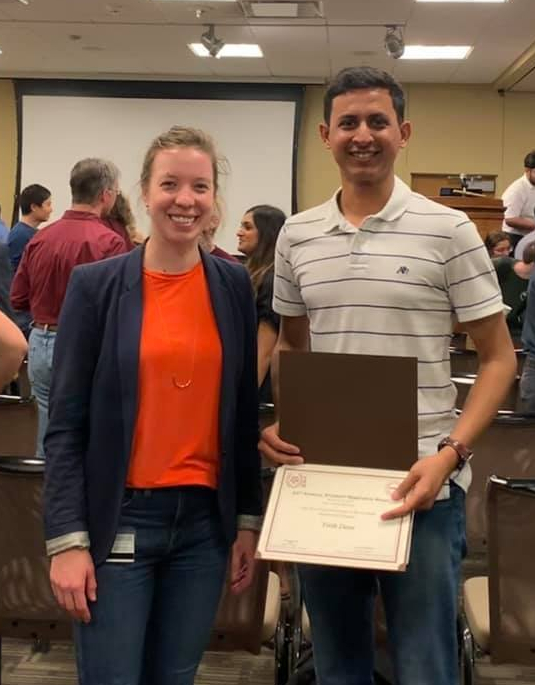
Dr. Astrid Layton and BiSSL MS student Tirth Dave with his award

BiSSL Master’s student Tirth Dave just won 1st place out of all Engineering Graduate Student Presentations at Student Research Week at Texas A&M University! His presentation was titled: “Sustainable Water Networks Design: A Bio-inspired Approach” 

Everyone here in the BiSSL group is so proud!

Student Research Week at Texas A&M is the largest, single-university student-run research symposium in the nation. Students get to show their research and have a chance to win up to $1,000 in award money and receive feedback from faculty and graduate student judges.

TAMU Student Research Week

Shelby Warrington presents her research poster

Clare Boothe Luce scholar and J. Mike Walker ’66 Department of Mechanical Engineering undergrad Shelby Warrington did an excellent job presenting her work at Student Research Week – Texas A&M University from our last 2 years working together on bio-inspired human system modeling!

Student Research Week at Texas A&M is the largest, single-university student-run research symposium in the nation. Students get to show their research and have a chance to win up to $1,000 in award money and receive feedback from faculty and graduate student judges.

The Clare Boothe Luce Scholar Program has, since its first grants in 1989, become one of the single most significant sources of private support for women in science, mathematics, and engineering in Higher Education in the United States. Clare Boothe Luce, the widow of Henry R. Luce, was a playwright, journalist, U.S. Ambassador to Italy, and the first woman elected to Congress from Connecticut. In her bequest establishing this program, she sought “to encourage women to enter, study, graduate, and teach” in science, mathematics, and engineering. To date, the program has supported more than 2,500 women. Learn more here.

Student-Led Paper Accepted for ASME’s Conference for Manufacturing Science & Engineering (MSEC) 2019

Congratulations to BiSSL Masters student Jewel Williams and undergraduate Clare Boothe Luce scholar Shelby Warrington for the acceptance of their peer-reviewed conference paper titled WASTE REDUCTION: A REVIEW OF COMMON OPTIONS AND ALTERNATIVES. The ASME Conference for Manufacturing Science and Engineering (MSEC) will be held in June at Penn State Erie, The Behrend College.

Paper Abstract:

Circular economy aims to address limited resources through the continuous circulation of materials and energy. Re-circulating low quality materials for reuse is a sustainability goal that is analogous to the primary function of Nature’s detritus species, a keystone for the proper functioning of ecosystems. Prior applications of ecosystem structure to human network design uncovered that even the most economically successful networks of industries demonstrate a lack of analogous detritus actors in the form of reuse and recycling. The recycling industry’s volatile nature, dependency on international factors, and financial difficulties prevent this strategy from becoming an efficient alternative. Creativity in design, inspired by ecosystems, is proposed here as a method to repurpose manufacturing byproducts that are otherwise seen as low quality waste materials. Realizing the reuse potential of these materials can create detrital-type feedback loops, an attribute that supports the characteristic resilience and efficiency of ecosystems. The work here analyzes existing methods of pursuing circular economy and investigates the potential benefits generated by purposefully adding connects that create detrital-feedback-loops at the consumer and producer levels.

WASTE REDUCTION: A REVIEW OF COMMON OPTIONS AND ALTERNATIVES

BiSSL Student Presentation at IEEE Texas Power & Energy Conference (TPEC) 2019

Enjoying the presentations going on at IEEE TPEC2019 (Texas Power and Energy Conference), including work we did with Dr. Kate Davis and her group, being presented by BiSSL MS student Varuneswara Panyam in College Station, TX.

Extreme events continue to show that existing power grid configurations can be vulnerable to disturbances. Drawing inspiration from naturally robust biological ecosystems presents a potential source of robust design guidelines for modern power grids. The robust network structure of ecosystems is partially derived from a unique balance between pathway efficiency and redundancy. Structural and basic-functional similarities support the application of ecological properties and analysis techniques to power grid design. The work presented here quantitatively investigates the level of similarity between ecosystems and power grids by applying ecological network metrics to a basic, realistic hypothetical 5-bus power system. A comparison between the power grid’s performance and average ecosystem performance substantiates the use of the ecological robustness metric for the development of a bio-inspired power grid optimization model. The bio-inspired optimization model re-configures the five-bus grid to mimic ecosystem robustness. The results demonstrate the potential of ecosystems to provide new robust design principles for power grids.

51354321_2126790484300523_6795573362551685120_n
“Bio-Inspired Design for Robust Power Networks” first authored by Varuneswara Panyam

Three BiSSL Student-Led Papers Accepted for the 2019 CIRP Life Cycle Engineering Conference

Congratulations to three of our BiSSL graduate students, Varun Panyam, Tirth Dave, and Colton Brehm, for the acceptance of each of their conference papers to the 26th CIRP Life Cycle Engineering Conference on Advancing Industrial Sustainability, to be held at Purdue University May 2019.

The evolution of power systems has recently seen a strong increase in renewable energy integration. This evolution has resulted in bidirectional pathways with two-way exchanges between the grid and consumers that is beginning to resemble the cyclic organization of food webs. Ecologically-similar cycling of materials and energy in industrial networks has previously been shown to improve network efficiency and reduce costs. The cyclic organization of food webs is proposed here as a design principle to quantify the effectiveness of two-way connections between the grid and consumers. The presence of ecosystem-like cycling in traditional power grid networks is investigated using the ecological metrics cyclicity and cycling index. Two hypothetical 5-bus grids are modified to replicate the two-way exchanges of real power systems with consumer renewable energy generation. The results show a positive correlation between increased structural cycling in grids and reliability improvements measured by the North American Electric Reliability Corporation (NERC) standard N-1 contingency analysis. These results suggest that the metrics cyclicity and cycling index can play a role in quantifying and improving the sustainability of power grids.

“An ecosystem perspective for the design of sustainable power systems” first authored by Varuneswara Panyam

Economic, environmental, and social advantages have been achieved over the years through byproducts and waste exchanges between industries. These Eco-Industrial Parks (EIPs) are touted to be ecologically similar, however when they are analyzed using Ecological Network Analysis (ENA) techniques it has been found that they do not successfully mimic analogous ecosystems. ENA coupled with average food webs characteristics are used here to create a bio-inspired design optimization for the water distribution network of the Kalundborg EIP in Denmark. The bio-inspired solution is compared to a cost-based solution to illustrate what the former can offer beyond a conventional approach. Both solutions similarly minimize freshwater consumption, however the bio-inspired solution has additional benefits that suggest a more sustainable and robust design, such as the ability to maintain network function in the event of a connection losses. The results suggest that consumption and cost reductions alone may not be the best optimization route.

“Bio-inspired design for resilient water distribution networks” first authored by Tirth Dave

Industrial Ecology uses ecological systems as a guide for improving the sustainability of complex industrial systems. Eco-Industrial Parks (EIPs) have gained support as a solution that seeks to simultaneously reduce environmental burdens and promote economic interests by exchanging materials and energy between industries to their mutual benefit. Recent studies have focused on drawing relations between food webs (FWs) and EIPs to improve the sustainability of the latter using ecological metrics, such as the level of cycling or average connections between actors. This study incorporates a new ecological metric, nestedness, into the discussion of sustainable design for EIPs. The association of nestedness with mutualistic ecological networks supports its application to EIP design. The work here improves the understanding of holistic network structure with the goal of improving future design decisions for EIPs with purposeful placement of material and energy flows.

“Designing eco-industrial parks in a nested structure to mimic mutualistic ecological networks” first authored by Colton Brehm