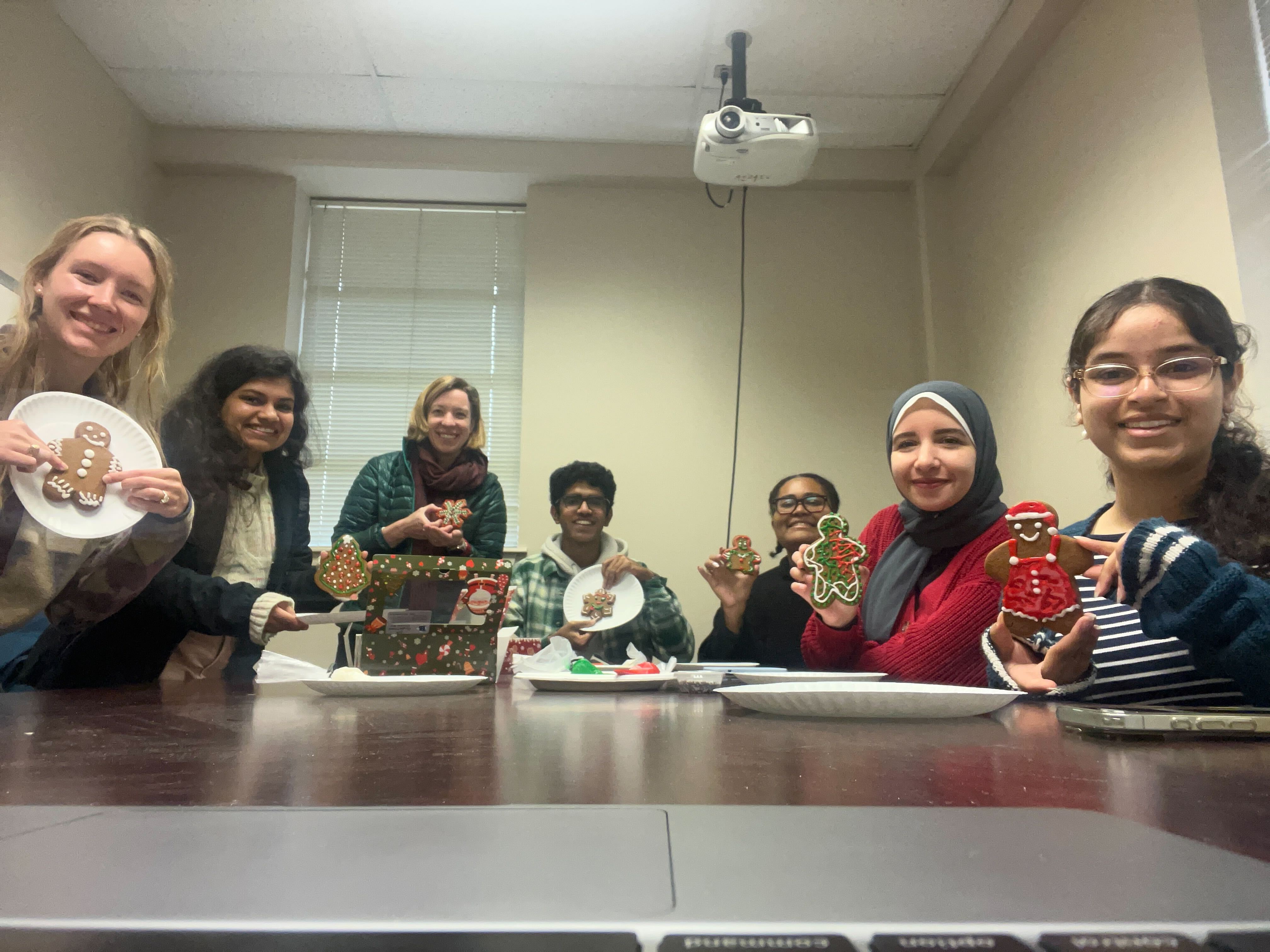
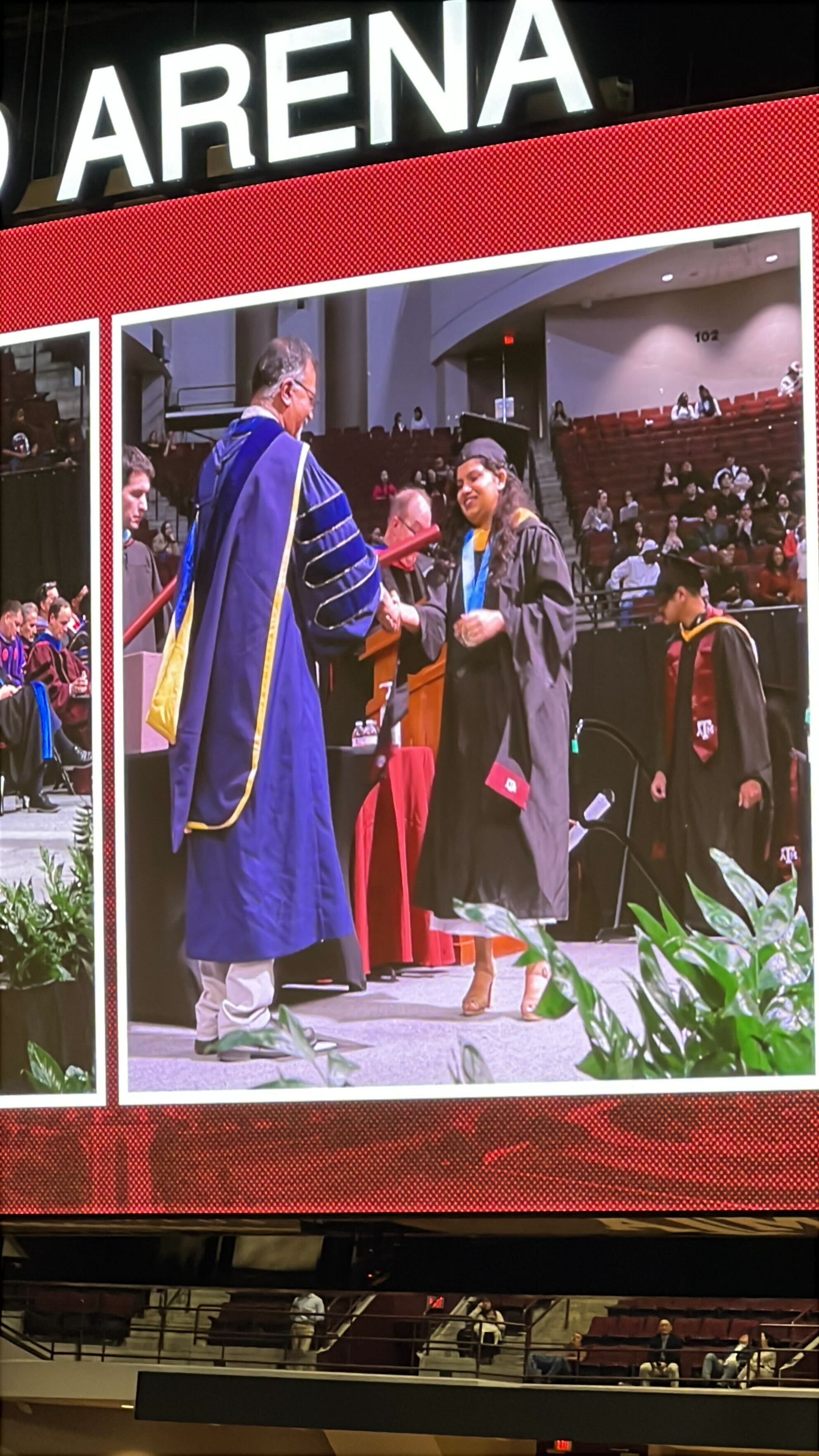
Ph.D. student Hadear Hassan successfully defends!

February 10, 2026

Ph.D. student Hadear Hassan joined our group in Fall 2021 after graduating with a BS in mechanical engineering from Texas A&M University. As of Tuesday this week she has successfully defended her Ph.D. thesis! Her thesis is titled “Quantitative System Analysis of Efficiency and Resilience in Complex Systems: Manufacturing and Innovation Networks” and uses bio-inspiration and systems modeling and analysis approaches to advance the fields of smart and sustainable manufacturing as well as entrepreneurial success.

Hadear has been advised by myself and Dr. Cynthia Hipwell since focusing her thesis more on innovation networks thanks to an opportunity to work with NSF’s ICorps program. In addition to her research pursuits, Hadear is also deeply invested in engineering education. Hadear was awarded the J. George H. Thompson Fellowship in 2022 and the 2023 Association of Former Students Distinguished Graduate Student Award for Excellence in Teaching, and is also an Associate Fellow in the Center for the Integration of Research, Teaching, and Learning (CIRTL) Academy for Future Faculty (AFF). She has also won both of our department’s Walker and Cain Impact Awards in 2023 and 2024, respectively. In 2025 she was awarded a coveted spot to attend the Global Young Scientists Summit in Singapore and the Brenda & Jerry Gray ’62 departmental fellowship.

Her thesis seeks to design systems that are both sustainable and resilient, whether those are manufacturing or innovation systems. The methodologies explored include Bio-Inspired Approaches, Multi-Criteria Decision Analysis, Discrete Event Simulation, and Social Network Analysis. These approaches benchmark existing systems and develop a comprehensive framework that facilitates their effective design and quantification. The framework is applied and evaluated through the case studies of manufacturing systems and innovation networks. The tools and benchmarks generated not only provide immediate sustainability benefits but also enable ongoing tracking and measurement of long-term impacts, aiding policy and decision-makers in achieving objectives while ensuring survival.
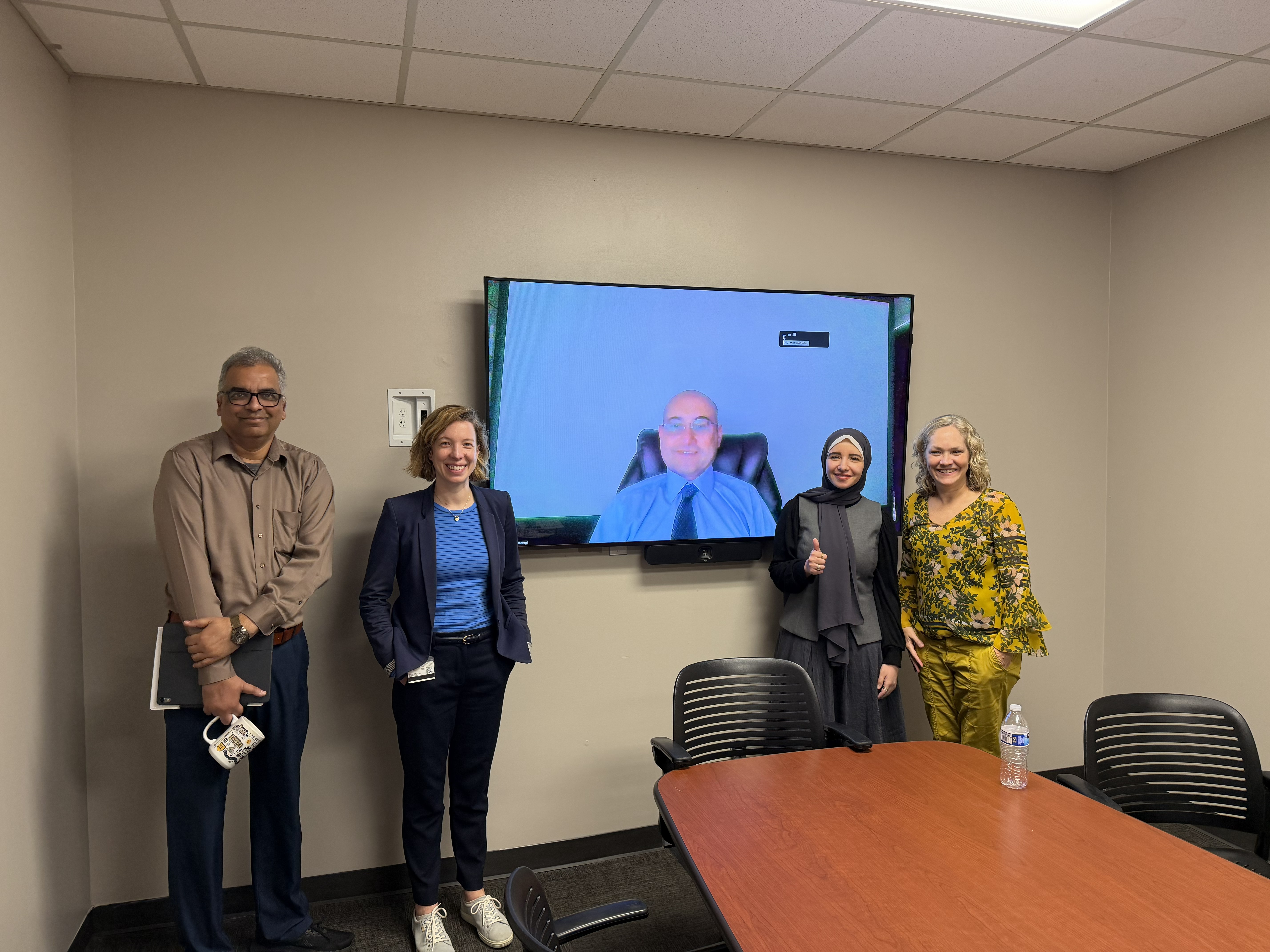
Committee members with Hadear Hassan. (L-R) Dr. Arun Srinivasa, Dr. Astrid Layton, Dr. Mahmoud El-Halwagi, Hadear Hassan, and Dr. Cynthia Hipwell.

Ph.D. Student Emily Payne Successfully Defends!

January 30, 2026

Ph.D. student Emily Payne joined the BiSSL group in Spring 2022 while she was still an undergraduate Architectural Engineering student. On January 30th she successfully defended her Mechanical Engineering PhD. Her Ph.D. thesis work is titled “Learning from Biological Ecosystems to Design and Analyze Resilience in Complex Multi-flow Systems” and has produced 5 journal papers and 5 conference papers. She’ll be starting at Johns Hopkins University’s Applied Physics Laboratory (APL) this summer after her graduation.

She is a member of the Society of Women Engineers and our Mechanical Engineering Female Graduate Student Association (MEFEGs) and actively supports engaging with the next generation of female engineers. She has collected a host of awards while a graduate student in BiSSL, including a Energy Institute Chevron Energy Graduate Fellow in 2025 and a Boeing Fellow in 2024, the Susan M. Arseven ’75 “Make A difference” memorial award from WISE in 2025, the 2023 J. Mike Walker ’66 Impact Award, and the Women in Engineering Chevron Award in 2023. Emily has worked on developing a more sustainable balance between building energy usage and resilient technology with research looking at improving the sustainable ranking of buildings. Her primary thesis work focuses on resilience in cyber-physical power systems, seeking to improve resilience through modeling the cyber-physical interface and our ability to understand risk propagation through the multi-layer complex network.

Her dissertation presents a holistic approach for the analysis of complex multi-flow systems taking inspiration from nature’s resilient ecosystems. Graph-based methodologies containing analogies from ecological modeling, including plant-pollinator networks and predator-prey networks, provide an innovative approach for balancing resilience, sustainability, and robustness. The proposed approaches assist in identifying critical interdependencies between components, analyzing patterns of adversarial system impact, and provide design suggestions for the future construction of cyber-physical power systems and sustainable buildings.

You can read a focus piece on Emily’s unique path to a Ph.D. in mechanical engineering here.

BiSSL MS Student Namrata Graduates!

December 2025

A huge congratulations to BiSSL graduate student Namrata Thakkar, who graduated with her MS degree in mechanical engineering this fall! Namrata started in the BiSSL group Summer 2023, after completing her Bachelor of Technology in Mechanical Engineering from Pandit Deendayal Energy University. Her thesis was on measuring the resilience of water network designs using bio-inspired approaches.

Two Successful BiSSL MS Defenses!

Samuel Blair and Luis Rodriguez both successfully defended their MS theses! Luis will be staying in the BiSSL group for his Ph.D. and Samuel is starting a role in industry this summer. We’re all so proud of them!

Samuel’s thesis is titled: “A Bio-Inspired Network Approach to Improve Understanding of Engineering Makerspaces” and Luis his thesis is titled: “Ecosystem Decentralization as a Design Guidelines for Resilient Water Networks.” Both have multiple conference papers published on their thesis research and have journal papers currently under review.

Most of the BiSSL group. (L-R) Luis Rodriguez, Samuel Blair, Abheek Chatterjee, Amira Bushagour, Hadear Hassan, Emily Payne, and Alexander Duffy.

BiSSL MS Energy Student Alexander Duffy defends his thesis!

Masters of Energy student Alexander Duffy successfully defended his master’s thesis on Friday. The committee consisted of BiSSL head Dr. Astrid Layton, Dr. Katherine Davis from Electrical & Computer Engineering, and Dr. Helen Reed from Aerospace Engineering. His thesis was titled Design and analysis of satellite networks for ecological resilience.”

Alexander Duffy defends his MS thesis research

BiSSL Ph.D. Student Abheek Chatterjee defends his thesis!

The first Ph.D. student to graduate from BiSSL, Abheek Chatterjee, successfully defended his dissertation on Wednesday! The committee consisted of BiSSL head Dr. Astrid Layton, Drs. Richard Malak and Douglas Allaire from Mechanical Engineering, and Dr. Nancy Currie-Gregg from Industrial & Systems Engineering. His thesis was titled An Investigation of Ecologically-Inspired Architecting Principles for Resilient System of Systems Design.”

Two BiSSL MS Students Graduate!

Congratulations to Tyler Wilson and Garrett Hairston for graduating with their MS degrees, they both defended their MS theses this May. Garrett started in the BiSSL group as an undergraduate researcher back in Fall 2019 and Tyler began his MS with BiSSL in Fall 2020.

Garrett’s thesis is titled: “Using Bio-Inspired Techniques to Design for Improved Sustainability and Robustness in Net Zero Communities”

In the global effort to combat climate change, the continued emergence of Net Zero Communities (NZCs) can play a large role in establishing a sustainable foundation on which progress can be made. NZC design, however, is complicated by the need to balance the system’s ability to achieve sustainable performance with its ability to maintain system operation during disturbances. These two design objectives, sustainable use of resources and system robustness, are often found in opposition to one another, but design inspiration can be taken from biological ecosystems, which have benefitted from generations of incremental evolution to display positive network characteristics with regards to both efficient resource use and robustness. This thesis focuses on applying the knowledge of what makes these ecosystems successful, as well as the techniques ecologists use to characterize them, to identify Net Zero (NZ) modifications that can simultaneously improve both of the aforementioned design objectives. First, a dataset of NZCs including quantitative energy and water flows throughout each case is constructed. This dataset then enables the use of Ecological Network Analysis on NZC networks, specifically identifying Finn’s Cycling Index (FCI) and Degree of System Order (DoSO) as metrics corresponding to sustainable and robust design, respectively. The results show that for the NZ modifications tested, a strong correlation exists between FCI and NZ performance, suggesting that FCI can be used as a proxy for sustainable network behavior. Additionally, a negative correlation emerges between FCI and DoSO. This result is significant as lower DoSO is indicative of improved network robustness, especially in the face of increasingly large disturbances, meaning that the modifications tested were in direct support of both sustainability and robustness. These findings hold true through disturbance testing, where the modified networks with higher NZ performance are also able to maintain the highest levels of operation during a disturbance. As such, this thesis provides proof of concept that bio-inspiration can be used to inform NZC design and impart improved sustainability and robustness into the networks.

Hairston, Garrett. (2022) “Using Bio-inspired Techniques to Design for Improved Sustainability and Robustness in Net Zero Communities.” MS, Mechanical Engineering, Texas A&M University.

Tyler’s thesis is titled: “Designing and Optimizing Supply Chain Networks for Resilience using Ecological Network Analysis”

Abstract: Traditional supply chain policies and design efforts, such as lean-manufacturing, prize efficiency over all other factors and are being challenged as supply chains struggle to bounce back from recent disruptions. Supply chain design guidelines that address resilience require a balanced approach between efficiency and redundancy, one that presents flexibility in a way that acknowledges profit requirements. Ecological Network Analysis reveals a unique balance of pathway efficiency and redundancy within ecosystems. This balance results in efficient steady-state operations and survival upon disruption. Supply chain networks are evaluated here using the same ecological analysis, providing design guidelines for achieving a balanced system-level resilience. Significant insights include that the validity of ecologically inspired supply chain design is contingent on the supply chain’s properties and that under the right conditions, the ecological balance of efficiency and redundancy can vastly improve the performance of supply chains during disruptions.

Wilson, Tyler. (2022) “Designing and Optimizing Supply Chain Networks for Resilience using Ecological Network Analysis.” MS, Mechanical Engineering, Texas A&M University.

Two BiSSL MS students defend their theses!

Congratulations to Tejas Adsul and Andrew Foster who both successfully defended their MS theses and will be graduating this summer!

Tejas Adsul’s MS thesis is titled “Ant-Inspired Innovation Research Strategies” and based on work with Dr. Cynthia Hipwell from Mechanical Engineering and Dr. Robert Puckett from Ecology & Evolutionary Biology.

Andrew Foster is graduating with his masters in energy through the Texas A&M Energy Institute. His thesis is “Ecological Uniqueness for Understanding Component Importance in Power Grids” and was done in collaboration with Dr. Kate Davis in Electrical Engineering.

Two students become the latest successful BiSSL Graduates!

Colton Brehm
Shelby Warrington

Congratulations to two of BiSSL’s research students for graduating today! Graduate student Colton Brehm graduates with his MS in Mechanical Engineering. He’ll be starting at SAIC in their Mission Support division doing Probabilistic Risk Assessment in June. Undergraduate student Shelby Warrington graduates with her BS in Mechanical Engineering. She’ll be starting graduate school at Yale for a Masters of Environmental Management, specializing in Urban or Industrial Ecology in the Fall. We will sincerely miss them both in the BiSSL group and wish them the best moving forward!