BiSSL Ph.D. student Hadear Hassan presented work at the annual ASME 2024 MSEC Manufacturing Science & Engineering Conference in Knoxville, TN. She presented two papers, both co-authored with BiSSL alum Amira Bushagour (who is now a Ph.D. student at Aarhus University in Denmark). One of the papers has already been selected for publication in the special issue of ASME’s Journal of Manufacturing Science and Engineering (JMSE).
Abstract: The circular economy (CE) is a resource system in which byproducts and traditional end-of-life resource flows are fed back into the system to reduce virgin resource use and waste production. Emerging technologies offer an exciting opportunity to support circular economy efforts, especially in the early design phase when opportunities for incorporating these technologies are relatively easy. Traditionally, however, the early design phase has access to very little data about resource flows which makes the introduction of new technologies difficult to do, especially with respect to market-related design decisions. In the later design stages, this data is easier to obtain but is met with increased inflexibility and costs that make these types of changes less common. This paper proposes the use of cyclicity, also known as spectral radius, and NS* minimal-data input metrics that can direct designers to options with the greatest theoretical impact on routing commonly wasted resources back into value circulation. Cyclicity is a metric commonly used in ecology to assess the existence and complexity of cycles, or material/energy pathways that can start and end at the same node, occurring in a system. The metric uses a topological adjacency matrix of resource flows between potential circular economy actors, modeled as a directional graph, and is calculated as the largest absolute eigenvalue of an adjacency matrix and can be a value of zero (no cycles), one (basic cycles), and any value larger than one (increasing presence and complexity of cycles). This study also evaluates actors making up the network as to whether they are part of a strong cycle, a weak component of a cycle, or are disconnected from a cycle, quantified with NS. In a strong cycle, all actors feed into the cycle and the cycle feeds back into the actors. Actors that are weakly connected to a cycle do not contribute to a cyclic pathway. Disconnected actors are not connected to any actor participating in cycling. This paper conducts two case studies on these design tools. The first, a survey of 51 eco-industrial parks (EIPs) and 38 ecological food webs to compare the presence and complexity of cycles in industrial resource systems to ecological resource systems. The latter, food webs, are very effective at retaining value inside the system boundaries. The former, EIPs, were built in support of circular economy principles to use waste streams from one industry as resource streams for others. The analysis shows that 46 out of 51 EIPs had cyclicity values of one or greater and an average of 54% of actors in an EIP are strong. The food webs all have a cyclicity greater than one and an average of 79% of actors in a food web are strong. These results can help decision makers consider CE-supporting pathways earlier in the design process, increasing the likelihood that emerging technologies are incorporated to maximize their CE impact. The second case study explores an emerging technology, Brine Miners, and how cyclicity and NS can be used to guide design decisions to impact the ability of this technology to aid in the creation of a circular economy. The exploration found that focusing on the creation of energy has the potential to add new actors to resource cycling and that diversifying the uses of byproducts creates more complex cycling within a hypothetical economy.
(Paper Number: MSEC2024-125107) “Cyclicity as an Early Circular Economy Design Tool for Emerging Technologies” by Amira Bushagour, Hadear Hassan, and Astrid Layton
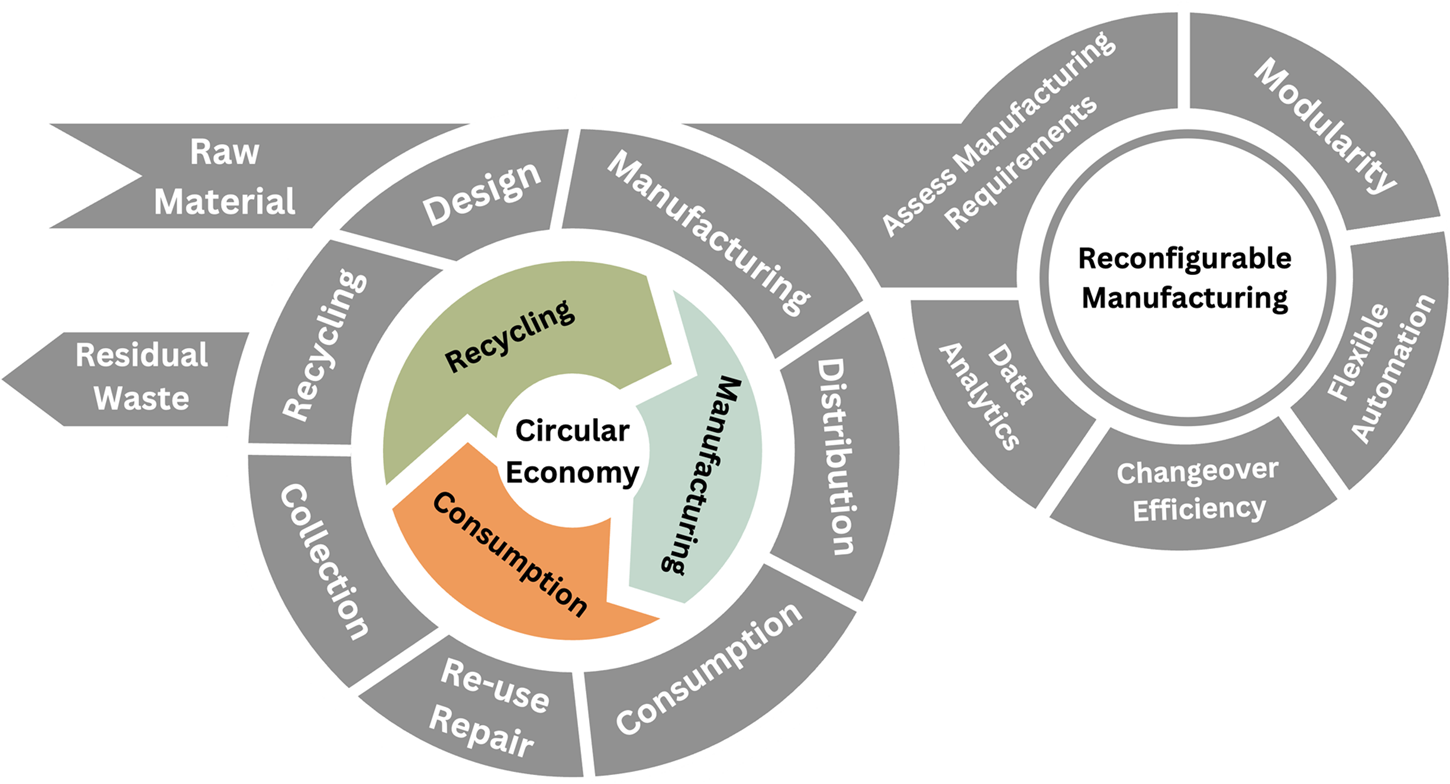
Abstract: Reconfigurability in manufacturing signifies a system’s capacity to promptly adapt to evolving needs. This adaptability is critical for markets to maintain operations during unexpected disruptions, including weather anomalies, cyber-attacks, and physical obstructions. Concurrently, the concept of a circular economy is gaining popularity in manufacturing to mitigate waste and optimize resource utilization. Circular economy principles aim to reduce environmental impacts while maximizing economic benefits by emphasizing the reuse of goods and resource byproducts. The nexus between reconfigurability and the circular economy stems from their shared pursuit of sustainability and resilience. Interestingly, biological ecosystems also exhibit these traits, showcasing exceptional adaptability to disturbances alongside the ability to effectively utilize available resources during normal operations. This study explores various manufacturing system configurations to assess both their adaptability and connection to circular economy principles. 44 configurations are categorized based on layout (e.g., job shop, flow line, cellular) and analyzed using convertibility, cyclicity, and Degree of System Order metrics. A significant positive correlation (R2 =0.655) is found between high convertibility and ecologically similar levels of structural cycling, suggesting that effective resource utilization supports adaptability in manufacturing systems. Furthermore, this paper proposes the existence of a possible ” window of vitality” for cyclicity, as it demonstrates a significant correlation (R2 =0.855) between the Degree of System Order and cyclicity. Identifying systems that strike a balance between redundancy, efficiency, convertibility, and cyclicity can aid manufacturing system designers and decision-makers in making choices that address increasing requirements for both sustainability and resilience.
(DOI: 10.1115/1.4065744) “Resilient Circularity in Manufacturing: Synergies between Circular Economy and Reconfigurable Manufacturing” by Hadear Hassan, Amira Bushagour, and Astrid Layton, Journal of Manufacturing Science and Engineering



 BiSSL: Bio-inspired Systems Lab