March 4, 2026
For this week’s Engineering Systems Design (ESD) multi-group meeting we welcomed Dr. Leah Chong from UT Austin’s Mechanical Engineering department to present her work on AI-assisted design.


For this week’s Engineering Systems Design (ESD) multi-group meeting we welcomed Dr. Leah Chong from UT Austin’s Mechanical Engineering department to present her work on AI-assisted design.
Dr. Layton presented BiSSL’s work on sustainable design using bio-inspired techniques at Clemson’s mechanical engineering department graduate seminar on April 11. The research seminar was titled “The Best of Both Worlds: An Ecological Design Guide for Engineering Sustainability & Resilience” and had an audience of mechanical engineering and mathematics.

Abstract: The resilient and sustainable characteristics of Nature’s ecosystems are the result of millions of years of design iterations. These complex systems of systems are made up of interacting species that support their own needs while maintaining system-level functions. Dr. Layton will discuss ecosystems as a relatively untapped source of design inspiration for improving the resilience and sustainability of our human-engineered networks. Adapting quantitative descriptors and analysis techniques from ecology for human designers enables desirable ecosystem characteristics to be used as optimization and design guides for everything from industrial resource networks to power grids. Ecological characteristics such as high levels of materials/energy cycling and a unique balance between redundant and efficient pathways offer novel routes to achieving traditionally ‘at odds’ engineering goals like resilience, sustainability, and cost.
Drs. Astrid Layton, Jessica Menold, Kosa Goucher-Lambert, Mohsen Moghaddam, and Zhenghui Sha were invited by Drs. Carolyn Seepersad and Julie Linsey at Georgia Tech for an insightful series of talks on The Future of Design for the annual “Rigi” meeting of the Design Society. The talks will be compiled in an editorial journal paper in the Journal of Mechanical Design later this year.

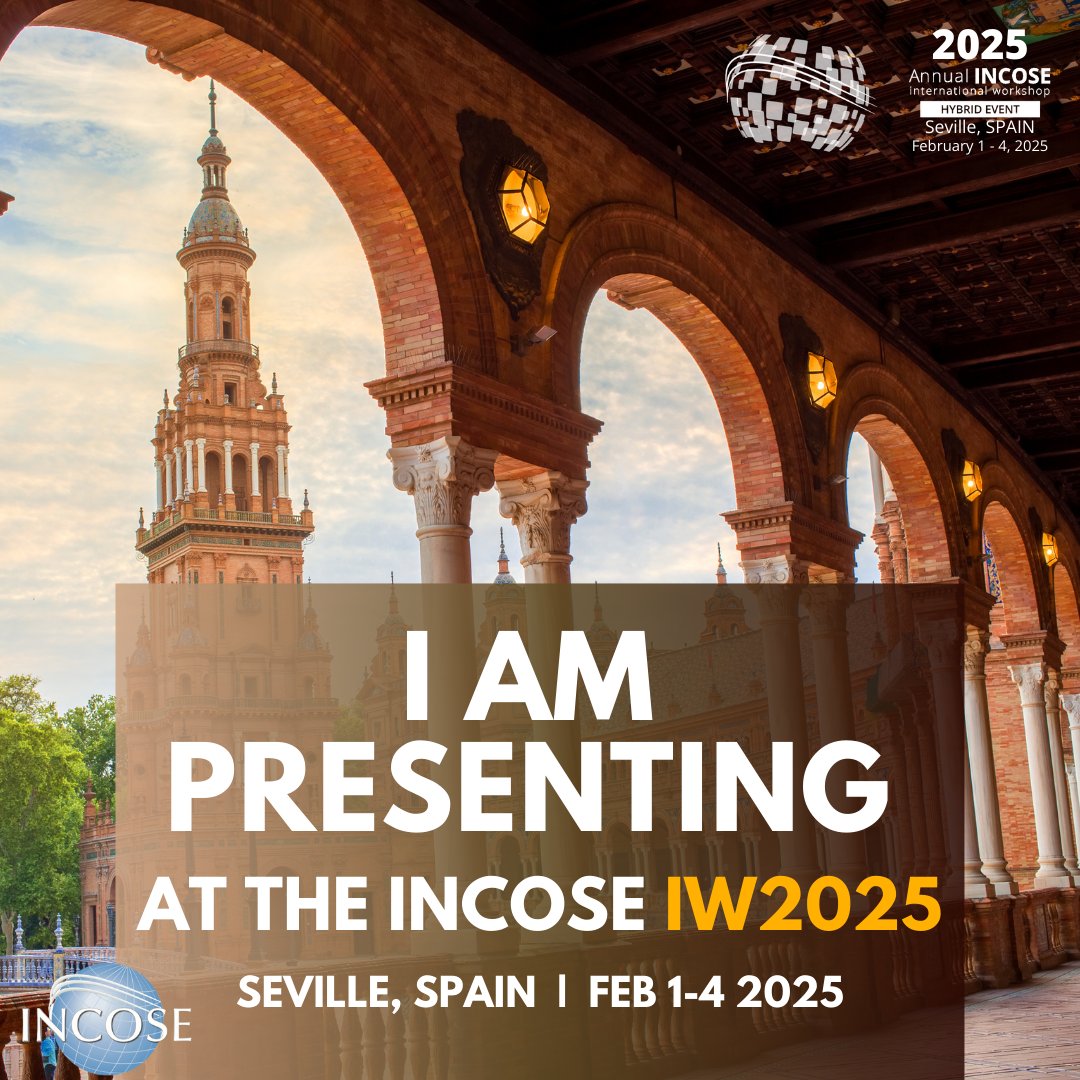
By an invitation from the INCOSE Natural Systems Working Group (NSWG), Dr. Layton presented on BiSSL work at the 2025 International Workshop. The talk titled “Biological Ecosystems as Quantitative System Design Inspiration for Resilient and Sustainable Human Networks” covered highlights from the BiSSL approach to using inspiration from ecological systems to improve sustainability and resilience in human networks.

What can engineers and designers learn about sustainability from nature?
Natural ecosystems are an untapped source of design inspiration for improving the sustainability of human networks. This month’s Engineering 4 Change (E4C) Seminar Series features Dr. Astrid Layton Ph.D., Assistant Professor at Texas A&M University and Donna Walker Faculty Fellow in Mechanical Engineering. Her work explores how ecological food webs inspire sustainable engineering solutions. Join us, with Dr. Layton, for a session moderated by: Dr. Jesse Austin-Breneman , Associate Professor at Olin College of Engineering.
🌱 Discover how natural ecosystems can guide sustainable design
♻️ Explore the principle of ‘waste equals food’ in circular economy models
🚀 See examples of material cycling and energy efficiency
💬 Engage online with researchers, students and technical professionals worldwide
E4C’s Seminar Series features academic laboratories researching solutions to meet the UN’s Sustainable Development Goals. The world’s cutting edge research deserves a platform with a global audience. Join us for presentations of new findings from investigative teams worldwide.
🗓️ January 15th, 16:00 UTC – 11 am ET
🔗 Sign up here: https://bit.ly/3ZJGyvo

Highlights from the presentation have been posted on their website: https://www.engineeringforchange.org/webinars/engineering-design-for-sustainability-learning-from-natures-systems-to-actually-achieve-waste-equals-food/

Dr. Astrid Layton will be visiting the University of Wisconsin-Madison to give a seminar on the research going on in the BiSSL group for their graduate seminar series. Her talk, titled “Tackling Engineering’s Sustainability and Resilience Problems Using Biological Systems,” will cover some of the bio-inspired techniques that BiSSL has found to be helpful when improving engineering systems for sustainability and resilience goals.


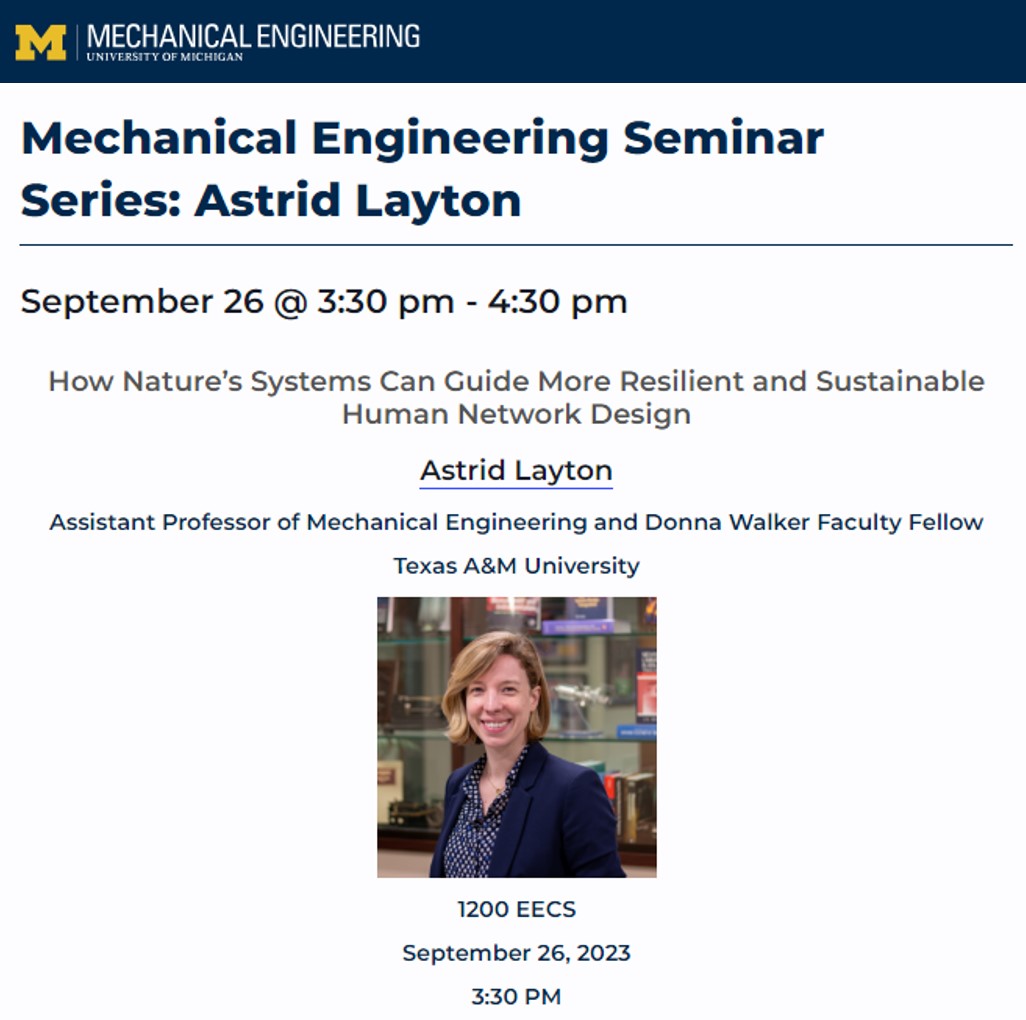
Dr. Layton gave an invited seminar presentation at University of Michigan titled “How Nature’s Systems Can Guide More Resilient and Sustainable Human Network Design” Sept. 26, 2023. The talk coincided with some excellent collaborative brainstorming with Dr. Sita Syal and other new contacts.
Abstract: Inspiration from nature has produced some fascinating, novel, and life-changing solutions for the human world. Most of these bio-inspired designs however have been product-based, but taking a systems perspective when we look to nature taps inspirations that can improve the critical networks we depend on. This talk focuses on biological ecosystems, in particular, complex networks of interacting species that are able to support individual needs while maintaining system-level functions during both times of abundance and unexpected disturbances. This talk will show how these networks can offer inspiration for achieving both sustainability AND resilience. Quantitative ecosystem descriptors and analysis techniques adapted from ecology enable desirable ecosystem characteristics to be used as design guides for things like industrial resource networks, water networks, supply chains, and power grids.
Following the ASEE 2023 workshop on our makerspace modeling/analysis GUI use, Dr. Layton was invited to come give a research seminar at University of Pittsburgh to share the NSF funded makerspace work her and Dr. Julie Linsey at Georgia Tech have been doing. Her talk was titled: “From Makerspaces to Industries: How Bio-Inspired Network Models Can Alter Functioning Via Form”
The youngest attendee Renee was 10 years old and already a makerspace expert!


BiSSL director Dr. Astrid Layton was invited to give a research seminar to the INCOSE Natural Systems Working Group.
Abstract: Inspiration from nature has produced some fascinating, novel, and life-changing solutions for the human world. Most of these bio-inspired designs however have been product based. Taking a systems perspective when we look to nature taps inspirations that can improve the critical networks we depend on. This talk focuses on biological ecosystems, in particular, complex networks of interacting species that are able to support individual needs while maintaining system-level functions. These networks offer inspiration for achieving both sustainability AND resilience in the design of our human-engineered networks. Quantitative ecosystem descriptors and analysis techniques adapted from ecology enable desirable ecosystem characteristics to be used as design guides for things like industrial resource networks, water networks, supply chains, and power grids.
“Biological Ecosystems as Quantitative System Design Inspiration for Resilient and Sustainable Human Networks” Dr. Astrid Layton

 BiSSL: Bio-inspired Systems Lab