BiSSL Student Presentation at IEEE Texas Power & Energy Conference (TPEC) 2019

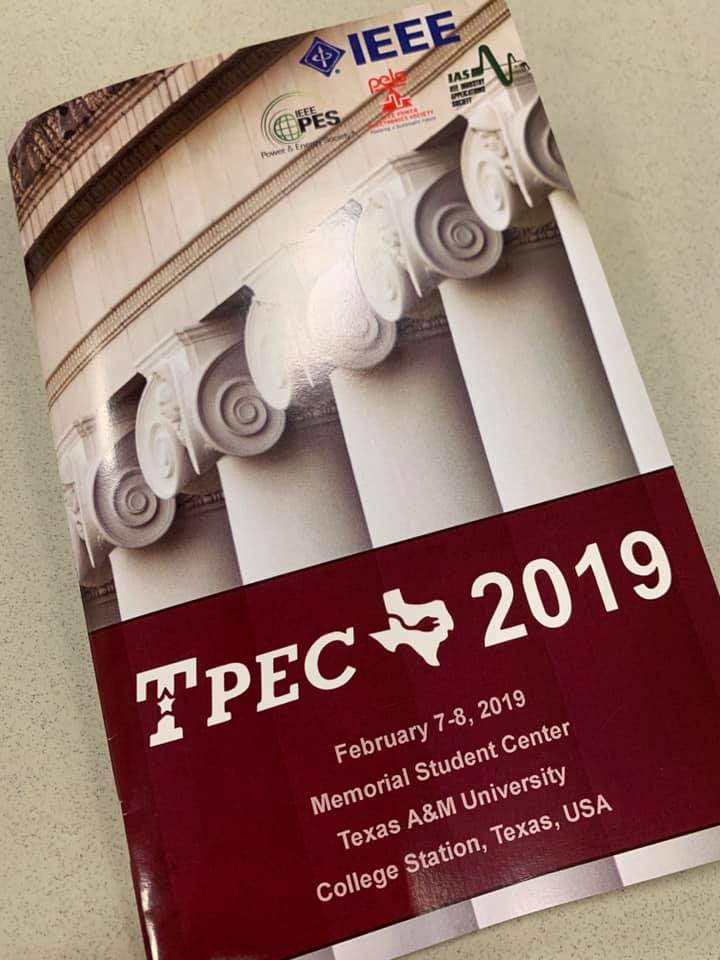
Enjoying the presentations going on at IEEE TPEC2019 (Texas Power and Energy Conference), including work we did with Dr. Kate Davis and her group, being presented by BiSSL MS student Varuneswara Panyam in College Station, TX.

Extreme events continue to show that existing power grid configurations can be vulnerable to disturbances. Drawing inspiration from naturally robust biological ecosystems presents a potential source of robust design guidelines for modern power grids. The robust network structure of ecosystems is partially derived from a unique balance between pathway efficiency and redundancy. Structural and basic-functional similarities support the application of ecological properties and analysis techniques to power grid design. The work presented here quantitatively investigates the level of similarity between ecosystems and power grids by applying ecological network metrics to a basic, realistic hypothetical 5-bus power system. A comparison between the power grid’s performance and average ecosystem performance substantiates the use of the ecological robustness metric for the development of a bio-inspired power grid optimization model. The bio-inspired optimization model re-configures the five-bus grid to mimic ecosystem robustness. The results demonstrate the potential of ecosystems to provide new robust design principles for power grids.

51354321_2126790484300523_6795573362551685120_n
“Bio-Inspired Design for Robust Power Networks” first authored by Varuneswara Panyam

Three BiSSL Student-Led Papers Accepted for the 2019 CIRP Life Cycle Engineering Conference

Congratulations to three of our BiSSL graduate students, Varun Panyam, Tirth Dave, and Colton Brehm, for the acceptance of each of their conference papers to the 26th CIRP Life Cycle Engineering Conference on Advancing Industrial Sustainability, to be held at Purdue University May 2019.

The evolution of power systems has recently seen a strong increase in renewable energy integration. This evolution has resulted in bidirectional pathways with two-way exchanges between the grid and consumers that is beginning to resemble the cyclic organization of food webs. Ecologically-similar cycling of materials and energy in industrial networks has previously been shown to improve network efficiency and reduce costs. The cyclic organization of food webs is proposed here as a design principle to quantify the effectiveness of two-way connections between the grid and consumers. The presence of ecosystem-like cycling in traditional power grid networks is investigated using the ecological metrics cyclicity and cycling index. Two hypothetical 5-bus grids are modified to replicate the two-way exchanges of real power systems with consumer renewable energy generation. The results show a positive correlation between increased structural cycling in grids and reliability improvements measured by the North American Electric Reliability Corporation (NERC) standard N-1 contingency analysis. These results suggest that the metrics cyclicity and cycling index can play a role in quantifying and improving the sustainability of power grids.

“An ecosystem perspective for the design of sustainable power systems” first authored by Varuneswara Panyam

Economic, environmental, and social advantages have been achieved over the years through byproducts and waste exchanges between industries. These Eco-Industrial Parks (EIPs) are touted to be ecologically similar, however when they are analyzed using Ecological Network Analysis (ENA) techniques it has been found that they do not successfully mimic analogous ecosystems. ENA coupled with average food webs characteristics are used here to create a bio-inspired design optimization for the water distribution network of the Kalundborg EIP in Denmark. The bio-inspired solution is compared to a cost-based solution to illustrate what the former can offer beyond a conventional approach. Both solutions similarly minimize freshwater consumption, however the bio-inspired solution has additional benefits that suggest a more sustainable and robust design, such as the ability to maintain network function in the event of a connection losses. The results suggest that consumption and cost reductions alone may not be the best optimization route.

“Bio-inspired design for resilient water distribution networks” first authored by Tirth Dave

Industrial Ecology uses ecological systems as a guide for improving the sustainability of complex industrial systems. Eco-Industrial Parks (EIPs) have gained support as a solution that seeks to simultaneously reduce environmental burdens and promote economic interests by exchanging materials and energy between industries to their mutual benefit. Recent studies have focused on drawing relations between food webs (FWs) and EIPs to improve the sustainability of the latter using ecological metrics, such as the level of cycling or average connections between actors. This study incorporates a new ecological metric, nestedness, into the discussion of sustainable design for EIPs. The association of nestedness with mutualistic ecological networks supports its application to EIP design. The work here improves the understanding of holistic network structure with the goal of improving future design decisions for EIPs with purposeful placement of material and energy flows.

“Designing eco-industrial parks in a nested structure to mimic mutualistic ecological networks” first authored by Colton Brehm

Winners Announced: Matrix Tray Student Design Competition

Faculty sponsors Dr. Astrid Layton (far left, Mechanical Engineering) and Dr. Ahmed Ali (far right, Architecture)

We would like to thank everyone for your participation in the design competition! There were many innovative submissions that highlighted the excellent students here at A&M, across all disciplines. I’m happy to finally be able to announce the winners to you all! The jury is pleased to announce that three prizes, first, second, and a tie for third, as well as one honorable mention, have been awarded to the following submissions:

First prize of $1000 goes to:

  • The team of Will McKinney and Brooks McKinney for their innovative modular aquaponics design

Second prize of $500 goes to:

  • Britteny Martinez for her unique flexible and customizable ceiling tile design

Third prize of $200 is split between two designs:

  • The team comprised of Aamer Arshad Kazi, Sitangshu Chatterjee, Het Pandit, Vivek Patel, and Omprakash Das for their design of an innovative optic fibre matrix containment unit
  • Shelby Warrington for her customizable lamp shade featuring colored glass design

Honorable Mention goes to:

  • The team of Sarojeet Deb and Shantanu Vyas with their green building façade design

The winners have been announced on the competition website: https://matrixtraydesign.wordpress.com/competition-results/

BiSSL Student Varuneswara Panyam Gives Seminar Presentation for the Energy and Power Group

The presentation (in A&M’s Electrical & Computer Engineering department on November 26th at 3pm in ETB 1003) will cover preliminary research from his MS on redesigning the modern power grid for robustness following principles from Nature’s ecosystems. All are welcome!

1401_ecen_1x1-primary

Abstract: Extreme events continue to show that current power grid configurations, designed for efficiency, are vulnerable to disturbances. Naturally robust ecological networks present a potential source of robust design guidelines for modern power grids. Ecosystems balance pathway efficiency with redundancy to achieve robust network structure. Structural similarities between these two system-types support the application of ecological properties and analysis techniques to power grid design. In the talk, I will discuss the analogy between the two systems and an optimization model that our group has created to reconfigure a power grid to mimic ecosystems’ robust behavior.

Bio: Varuneswara Panyam is an MS student in the Department of Mechanical Engineering at Texas A&M University. He received his Bachelor’s degree in Mechanical Engineering from Shiv Nadar University in 2016. His Ph.D. research is focused on bio-inspired design of power systems.

Matrix Tray Student Design Competition

BiSSL is one of two research labs cohosting an A&M student weekend design concept competition coming up November 2nd-7th, with prizes of $1000 (first prize) $500 (second prize) and $200 (third prize). Texas A&M students with winning designs will have the opportunity to work with Dr. Astrid Layton and Dr. Ahmed Ali’s multidisciplinary research team (both Mechanical Engineering and Architecture departments).

General Motors is committed to becoming landfill-free by 2020 and to achieve this, they are seeking to divert byproducts from ending up in landfills by generating potential applications for their more challenging materials. This includes the matrix trays used to package electronics through the automated manufacturing process. Texas A&M Architecture and Mechanical Engineering are pairing with General Motors to host a design competition to promote byproduct reuse and sustainable industry practices, specifically looking for design concepts that generate new applications for these matrix trays. Deliverables are a short (1 page or less) description and a visual aid (computer generated drawing or neat hand drawing) explaining the design concept.

For more information on the competition please visit https://matrixtraydesign.wordpress.com/

Registration is open to A&M student individuals or teams, with a deadline of November 1st at midnight, registration can be done here.

“Want to fight climate change? Educate a girl”

TED Oct. 9, 2018 / Shabana Basij-Rasikh

A coalition of researchers, scientists, business leaders and policymakers came together in 2017 to identify the most substantive solutions to not just halt global warming, but actually cause an annual decline in the concentration of greenhouse gases in our atmosphere. The result was a ranked list of the 100 most powerful solutions to reversing global warming, educating girls was number 6.

To put that in perspective: Rooftop solar panels are #10. Electric vehicles come in at #26. Educating girls ranks at #6.

Read the article here… 

BiSSL Undergrad Shelby Warrington travels to the 2018 Annual Conference & Expo for the Association for the Advancement of Sustainability in Higher Education (AASHE), held in Pittsburgh, PA

“We stand at a key moment in history. As sustainability challenges intensify and the window for action grows smaller every day, the need for leadership by higher education is greater than ever. With a theme of “Global Goals: Rising to the Challenge,” the 2018 AASHE Conference & Expo will examine the critical role of higher education in achieving the United Nations Sustainable Development Goals (SDGs). Adopted by the world’s governments in September 2015, the 17 SDGs establish ambitious global targets to end poverty, protect the planet and ensure prosperity for all by 2030.”

BiSSL MS Student Varuneswara Panyam’s Poster Accepted to 3rd Annual Texas A&M Conference on Energy

“Bio-Inspired Robust Power Grid Design”

The Texas A&M Energy Research Society (ERS), in partnership with the Texas A&M Energy Institute, is pleased to present the Third Annual Texas A&M Conference on Energy. Varun’s poster is to be presented during Poster Session 2 (3-4:30pm) on Tuesday, September 25th, 2018. The poster covers preliminary work done by MS students Varuneswara Panyam and Bogdan Pinte and their advisors Dr. Kate Davis (Electrical Engineering) and Dr. Astrid Layton (Mechanical Engineering).

BiSSL Student to Attend National Science Foundation’s 2018 Summer School

BiSSL MS student Varuneswara Panyam was accepted to and will attend the National Science Foundation’s summer school on Decision Making in Engineering Systems at the University of Southern California, Los Angeles, June 23-29, 2018. The six-day summer school will introduce graduate students to the foundations of decision-making in large systems and is hosted by Dr. Ali Abbas, Director of the Neely Center, at the University of Southern California.

Topics covered include

  • Characterizing uncertainty in a systems engineering and design environment
  • Building Preference – Value – Utility models for systems engineering and design
  • Introducing the basic axioms of decision-making, and methods to analyze flawed methods of decision making
  • Research methodologies for decision-making in systems engineering and design
  • Future research directions
  • Practical applications of decision-making in systems engineering featuring guest speakers from industry and academia

Read more about the summer school here…