New Systems Engineering Journal Publication

A new open access publication is out in the Wiley and INCOSE journal Systems Engineering from BiSSL in collaboration with Dr. Julie Linsey at Georgia Institute of Technology! The article, co-authored by Samuel Blair, Garrett Hairston, Claire Kaat, and Henry Banks and titled “Bio-inspired human network diagnostics: Ecological modularity and nestedness as quantitative indicators of human engineered network function,” investigates the use of modularity and nestedness, 2 analyses that are traditionally used in ecology to study interaction patterns in mutualistic networks (ex. plant-pollinator networks), for human-engineered interaction networks. The paper uses two university engineering makerspaces, modeled as student-tool interaction networks, as case studies to highlight the ability of the approaches to quantitatively monitor the interaction patterns over time and even capture network disturbances (in the case study COVID-19 occurred over the course of data collection).

Abstract:

Analyzing interactions between actors from a systems perspective yields valuable information about the overall system’s form and function. When this is coupled with ecological modeling and analysis techniques, biological inspiration can also be applied to these systems. The diagnostic value of three metrics frequently used to study mutualistic biological ecosystems (nestedness, modularity, and connectance) is shown here using academic engineering makerspaces. Engineering students get hands-on usage experience with tools for personal, class, and competition-based projects in these spaces. COVID-19 provides a unique study of university makerspaces, enabling the analysis of makerspace health through the known disturbance and resultant regulatory changes (implementation and return to normal operations). Nestedness, modularity, and connectance are shown to provide information on space functioning in a way that enables them to serve as heuristic diagnostics tools for system conditions. The makerspaces at two large R1 universities are analyzed across multiple semesters by modeling them as bipartite student-tool interaction networks. The results visualize the predictive ability of these metrics, finding that the makerspaces tended to be structurally nested in any one semester, however when compared to a โ€œnormalโ€ semester the restrictions are reflected via a higher modularity. The makerspace network case studies provide insight into the use and value of quantitative ecosystem structure and function indicators for monitoring similar human-engineered interaction networks that are normally only tracked qualitatively.

Blair S, Hairston G, Banks H, Kaat C, Linsey J, Layton A. Bio-inspired human network diagnostics: Ecological modularity and nestedness as quantitative indicators of human engineered network function. Systems Engineering. 2024; 1-13. https://doi.org/10.1002/sys.21756

Annual Conference on Systems Engineering Research (CSER) 2024

BiSSL Ph.D. student Alexander Duffy will be presenting his research at the annual Conference on Systems Engineering Research (CSER) on March 25-27, 2024 in Tucson, AZ. His paper, titled “Satellite Network Architecture Performance: Setting the Stage for Bio-Inspired Network Design,” covers:

Abstract: Satellite networks, here defined as groups of artificial satellites where the satellites are interconnected by communications links, are increasing in size, number, and criticality. As humanityโ€™s reliance on these networks grows, so too does the need for these networks to be resistant against and quickly recover from disturbances โ€“ that is, they need to be resilient. Prior work has found that human networks such as supply chains, water distribution networks, and power grids can improve their resilience by mimicking biological food webs in their design. This paper begins an investigation into whether satellite networks can also benefit from this bio-inspired system approach. The performance of five hypothetical-realistic satellite network case studies is quantified here using global instantaneous coverage, architectural accuracy, and in-network latency. These performance attributes are then compared to the architectural characteristics of biological food webs using Ecological Network Analysis (ENA) metrics, relating species and their predator-prey interactions in a food web to interactions between satellites in a satellite network. The findings suggest that the bio-inspired route holds promise for improving both the performance and resilience of these critical space networks.

Two New BiSSL Papers Published

Two journal papers related to the use of bio-inspired system design approaches for cyber-physical systems from the BiSSL group have recently been accepted for publication! The 1st stems directly from a current ongoing grant with Sandia National Labs with BiSSL Ph.D. student Emily Payne as co-author and the 2nd is a culmination of multiple collaborations across mechanical and electrical engineering at Texas A&M and is led by former BiSSL Ph.D. student Abheek Chatterjee, now a post-doc at NIST.

Abstract: Cyber-physical systems have behavior that crosses domain boundaries during events such as planned operational changes and malicious disturbances. Traditionally, the cyber and physical systems are monitored separately and use very different toolsets and analysis paradigms. The security and privacy of these cyber-physical systems requires improved understanding of the combined cyber-physical system behavior and methods for holistic analysis. Therefore, we propose leveraging clustering techniques on cyber-physical data from smart grid systems to analyze differences and similarities in behavior during cyber-, physical-, and cyberphysical disturbances. Since clustering methods are commonly used in data science to examine statistical similarities in order to sort large datasets, these algorithms can assist in identifying useful relationships in cyber-physical systems. Through this analysis, deeper insights can be shared with decision-makers on what cyber and physical components are strongly or weakly linked, what cyber-physical pathways are most traversed, and the criticality of certain cyber-physical nodes or edges. This paper presents several types of clustering methods for cyber-physical graphs of smart grid systems and their application in assessing different types of disturbances for informing cyber-physical situational awareness. The collection of these clustering techniques provide a foundational basis for cyber-physical graph interdependency analysis.

Jacobs, N., S. Hossain-McKenzie, S. Sun, E. Payne, A. Summers, L. Al Homoud, A. Layton, K. Davis, and C. Goes. (2024) โ€œLeveraging Clustering Techniques for Cyber-Physical System Analysis to Enhance Disturbance Characterization.โ€ The Institution of Engineering and Technology (IET) Cyber-Physical Systems: Theory & Applications.

Abstract: The design of resilient infrastructure is a critical engineering challenge for the smooth functioning of society. These networks are best described as Cyber-Physical Systems of Systems (CPSoS): integration of independent constituent systems, connected by physical and cyber interactions, to achieve novel capabilities. Bio-inspired design, using a framework called the Ecological Network Analysis (ENA), has been shown to be a promising solution for improving the resilience of engineering networks. However, the existing ENA framework can only account for one type of flow in a network. Thus, it is not yet applicable for the evaluation of CPSoS. The present work addresses this limitation by proposing a novel multigraph model of CPSoS, along with guidelines and modified metrics that enable ENA evaluation of the overall (cyber and physical) network organization of the CPSoS. The application of the extended framework is demonstrated using an energy infrastructure case study. This research lays the critical groundwork for investigating the design of resilient CPSoS using biological ecosystems inspiration.

Chatterjee, A., H. Huang, R. Malak, K. Davis, and A. Layton. (2024) โ€œExtending Ecological Network Analysis to Design Resilient Cyber-Physical System of Systems.โ€ IEEE Open Journal of Systems Engineering.

Graduate Awards and Fellowships for 3 BiSSL PhD Students

Two BiSSL Ph.D. students – Hadear Hassan and Emily Payne – have been awarded 2023 J. Mike Walker โ€™66 Impact Awards. The award is given to two male and two female graduate students who have demonstrated academic/scholarly achievements, as well as have leadership and/or entrepreneurial focus/experience and innovative excellence. The winners each receive a $5,000 fellowship. BiSSL Ph.D. student Luis Rodriguez was awarded a Sally and Ray Bowen โ€™58 Fellowship for 2022/23. Congratulations Hadear, Emily, and Luis! They’ll all be recognized at the 2023 Mechanical Engineering Scholarship & Fellowship Banquet in October in the Memorial Student Center.

Luis Rodriguez (back left) and Hadear Hassan (front 2nd from left) had their awards presented at the 2023 Mechanical Engineering Scholarship & Fellowship Banquet. They are both co-advised by Dr. Cynthia Hipwell (front-center).
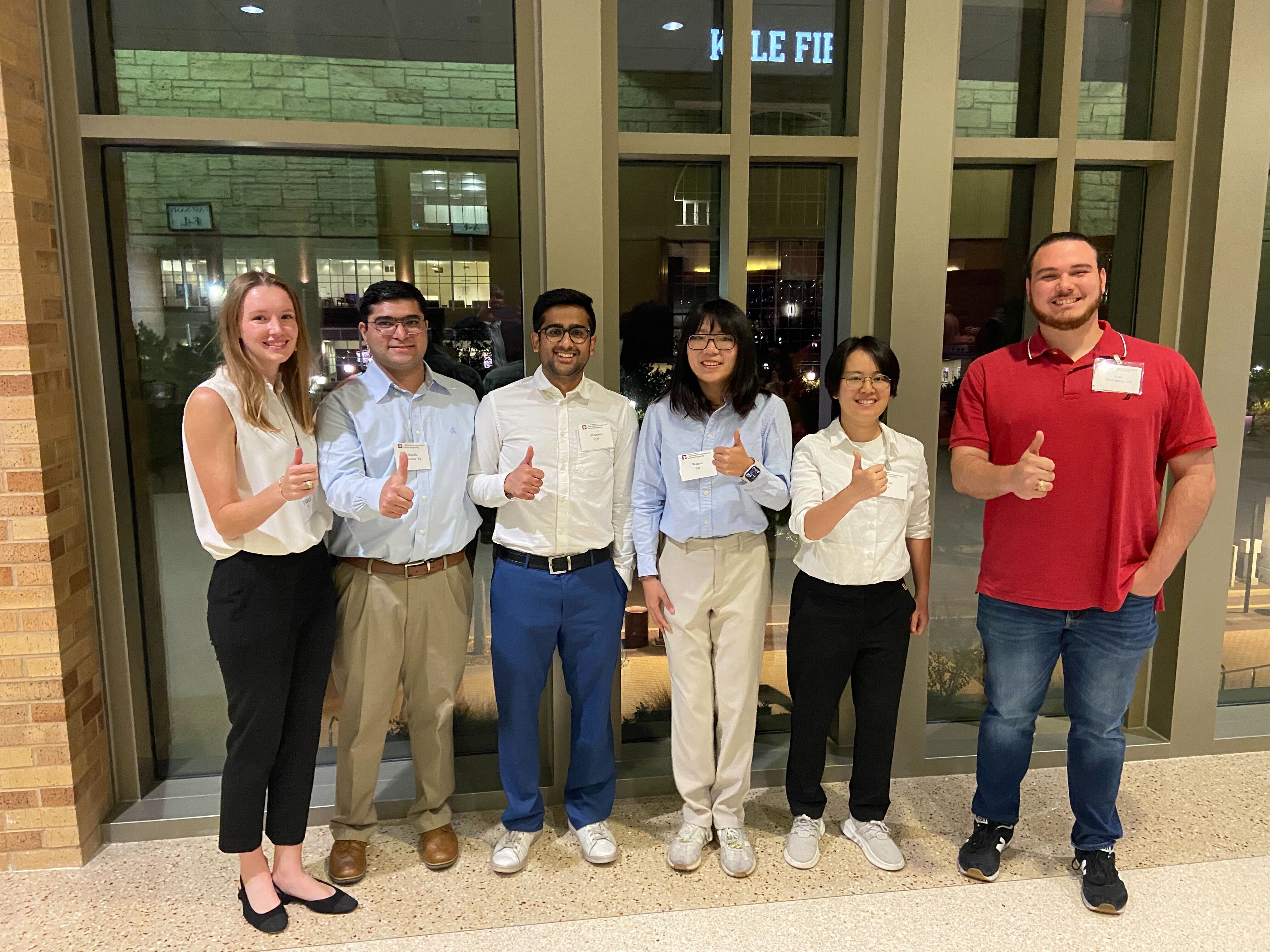
(L-R) Emily Payne (BiSSL), Maulik Kotecha (Product Synthesis Engineering Lab), Shantanu Vyas (Mixed-Initiative Design Lab), Wanyu Xu (Product Synthesis Engineering Lab), Qiyu Li, Luis Rodriguez (BiSSL)

Successful IDETC-CIE 2023 in Boston

Another excellentย ASME (American Society of Mechanical Engineers)ย IDETC-CIE conference is in the books!

BiSSL Ph.D. studentsย Hadear Hassanย andย Emily Payneย from theย J. Mike Walker ’66 Department of Mechanical Engineering at Texas A&M Universityย each presented their first-authored papers, sharing their research that will help us achieve a moreย sustainableย andย resilientย world.

Hadear’s (in collaboration with Emily) was on “Quantifying the Sustainability and Robustness of Manufacturing Systems Using Energy and Ecological Network Analysis” and Emily’s (in collaboration with former undergraduate researcher Hannah Wagner) was on “Resilienceย & Sustainability in Certified Green Buildings:ย Applying Ecosystem Concepts to Aid in More Dynamicย Green Communities.”

Dr. Layton also presented the work of MS student Samuel Blair (who graduated in May 2023) on “Measuring the Health of Makerspaces During Large Disruptions such as the COVID-19 Pandemic.”

We also got to hang out with Dr. Abheek Chatterjee, who graduated from our lab last December!

(L-R) Abheek Chatterjee, Astrid Layton, Emily Payne, Hadear Hassan

Sandia National Lab Visit

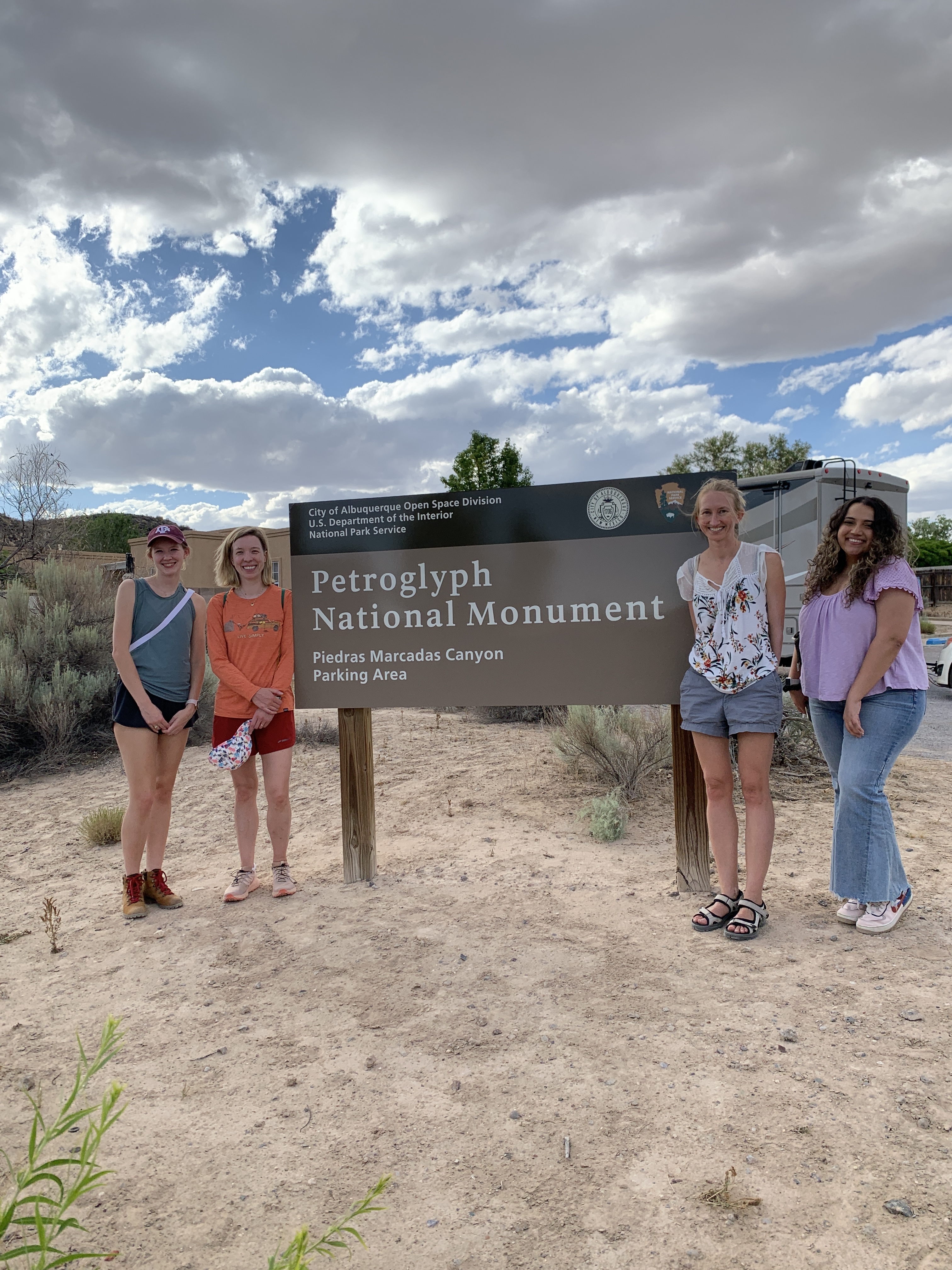
Ph.D. student Emily Payne and Dr. Astrid Layton joined collaborators Dr. Kate Davis and her Ph.D. students Leen and Akram for a visit to Sandia National Lab in Albuquerque, NM. The trip was part of an ongoing collaborative LDRD grant with Sandia looking at cyber-physical power systems for resilience. The trip even evolved some exploring Petroglyph National Monument!

BiSSL Ph.D. Student Emily Payne Chosen as a TEX-E Fellow

Texas Entrepreneurship Exchange for Energy (TEX-E) is a first-of-a-kind collaboration among The University of Texas at AustinTexas A&M UniversityUniversity of HoustonRice University, and Prairie View A&M Universityโ€”powered by Greentown Labs and MITโ€™s Martin Trust Center for Entrepreneurshipโ€”to create a powerful student-driven entrepreneurship ecosystem in Texas. More information can be found here: https://greentownlabs.com/tex-e/

A&M Feature on BiSSL Ph.D. Student Emily Payne

“Fashioning an engineering education via discipline and design” by Grace Dalton.

“Growing up, Emily Payne enjoyed drawing and being creative. In high school, she took practicum-level fashion courses involving practical applications of fashion theory and excelled in her projects.
ย 
Trace the pattern. Measure. Check numbers. Cut and stitch. Fit the garment. Adjust and tweak. Review results. Those were the steps she carefully followed when creating a garment in high school. It seemed inevitable that Payne would become a designer until she found herself contemplating what seemed like a different world entirely โ€” engineering. …”

BiSSL Ph.D. Student Hadear Hassan Awarded 2023 Association of Former Students Distinguished Graduate Student Award

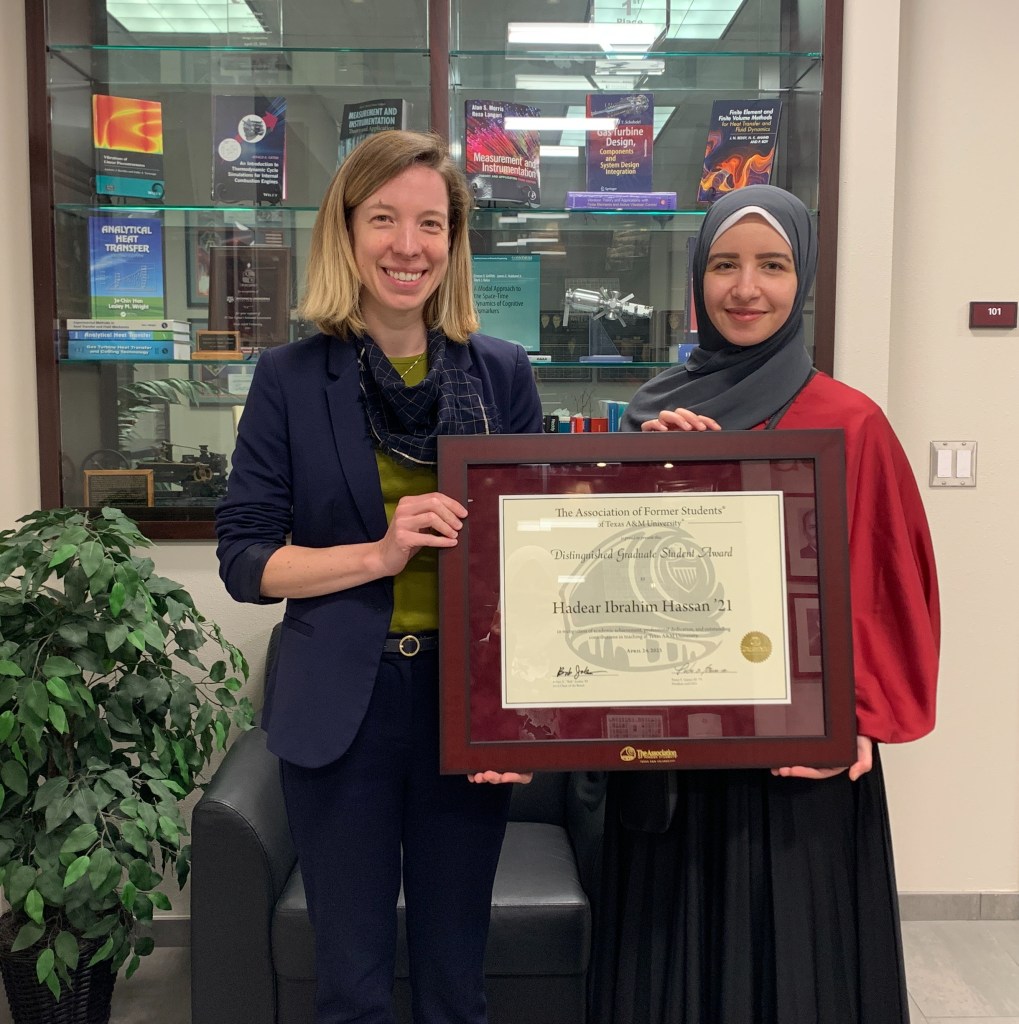
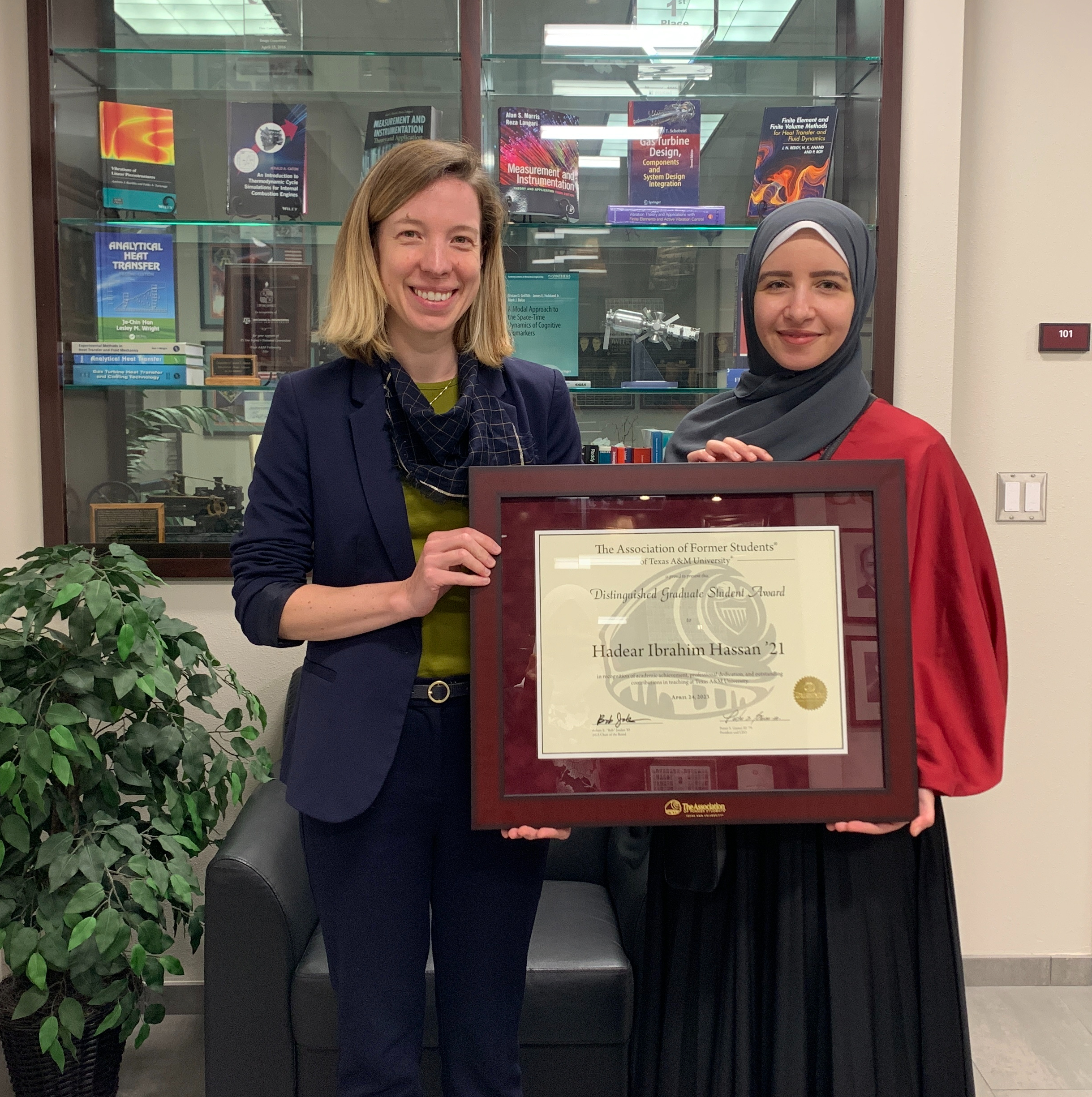
Dr. Astrid Layton and award-winning BiSSL Ph.D. student Hadear Hassan.

Hadear has been awarded the 2023 Association of Former Students Distinguished Graduate Student Award for teaching!

Each year they select a group of graduate students to receive the Association of Former Students Distinguished Graduate Student Awards in one of two categories: Excellence in Research-Doctoral and Excellence in Teaching-Masterโ€™s and Doctoral. Student nominations arrive from faculty advisors or departments, and nomination represents a true honor and accomplishment, due to strenuous eligibility requirements. A panel of reviewers including faculty and administrators chooses award recipients.

โ€œThe Distinguished Graduate Student Awards recognize the top tier of Texas A&Mโ€™s graduate students for exemplifying our core values in classrooms and laboratories. These awards have been presented annually since 1965 thanks to generous gifts to The Association of Former Studentsโ€™ Annual Fund,โ€ said Porter S. Garner III โ€™79, President and CEO of The Association of Former Students. โ€œWe are pleased to be able to honor these exceptional Aggies for their important contributions to Texas A&Mโ€™s world-class teaching and cutting-edge research.โ€