Ph.D. candidate Abheek Chatterjee presented two student-led papers at this year’s IDETC-CIE conference. BiSSL MS student alum Tyler and Abheek collaborated on the paper “Exploring the Effects of Partnership and Inventory for Supply Chain Resilience Using an Ecological Network Analysis,” presented to Design for Manufacturing and the Life Cycle (DFMLC). Abheek also collaborated with undergraduate alum Cade Helbig and Dr. Rich Malak on the paper “A Survey of Graph-Theoretic Approaches for Resilient System of Systems Design,” presented to System Engineering and Information Knowledge Management (SEIKM).
students
BiSSL Ph.D. Student Abheek Chatterjee Becomes a 2022/23 Texas A&M Energy Institute Fellow!
Texas A&M Energy Institute Graduate Fellowships recognize outstanding energy research work performed by Ph.D. students under the supervision of Affiliated Faculty Members of the Texas A&M Energy Institute. The fellowships are $5,000 each, with a term of September through May.
Two BiSSL MS Students Graduate!
Congratulations to Tyler Wilson and Garrett Hairston for graduating with their MS degrees, they both defended their MS theses this May. Garrett started in the BiSSL group as an undergraduate researcher back in Fall 2019 and Tyler began his MS with BiSSL in Fall 2020.
Garrett’s thesis is titled: “Using Bio-Inspired Techniques to Design for Improved Sustainability and Robustness in Net Zero Communities”
In the global effort to combat climate change, the continued emergence of Net Zero Communities (NZCs) can play a large role in establishing a sustainable foundation on which progress can be made. NZC design, however, is complicated by the need to balance the system’s ability to achieve sustainable performance with its ability to maintain system operation during disturbances. These two design objectives, sustainable use of resources and system robustness, are often found in opposition to one another, but design inspiration can be taken from biological ecosystems, which have benefitted from generations of incremental evolution to display positive network characteristics with regards to both efficient resource use and robustness. This thesis focuses on applying the knowledge of what makes these ecosystems successful, as well as the techniques ecologists use to characterize them, to identify Net Zero (NZ) modifications that can simultaneously improve both of the aforementioned design objectives. First, a dataset of NZCs including quantitative energy and water flows throughout each case is constructed. This dataset then enables the use of Ecological Network Analysis on NZC networks, specifically identifying Finn’s Cycling Index (FCI) and Degree of System Order (DoSO) as metrics corresponding to sustainable and robust design, respectively. The results show that for the NZ modifications tested, a strong correlation exists between FCI and NZ performance, suggesting that FCI can be used as a proxy for sustainable network behavior. Additionally, a negative correlation emerges between FCI and DoSO. This result is significant as lower DoSO is indicative of improved network robustness, especially in the face of increasingly large disturbances, meaning that the modifications tested were in direct support of both sustainability and robustness. These findings hold true through disturbance testing, where the modified networks with higher NZ performance are also able to maintain the highest levels of operation during a disturbance. As such, this thesis provides proof of concept that bio-inspiration can be used to inform NZC design and impart improved sustainability and robustness into the networks.
Hairston, Garrett. (2022) “Using Bio-inspired Techniques to Design for Improved Sustainability and Robustness in Net Zero Communities.” MS, Mechanical Engineering, Texas A&M University.
Tyler’s thesis is titled: “Designing and Optimizing Supply Chain Networks for Resilience using Ecological Network Analysis”
Abstract: Traditional supply chain policies and design efforts, such as lean-manufacturing, prize efficiency over all other factors and are being challenged as supply chains struggle to bounce back from recent disruptions. Supply chain design guidelines that address resilience require a balanced approach between efficiency and redundancy, one that presents flexibility in a way that acknowledges profit requirements. Ecological Network Analysis reveals a unique balance of pathway efficiency and redundancy within ecosystems. This balance results in efficient steady-state operations and survival upon disruption. Supply chain networks are evaluated here using the same ecological analysis, providing design guidelines for achieving a balanced system-level resilience. Significant insights include that the validity of ecologically inspired supply chain design is contingent on the supply chain’s properties and that under the right conditions, the ecological balance of efficiency and redundancy can vastly improve the performance of supply chains during disruptions.
Wilson, Tyler. (2022) “Designing and Optimizing Supply Chain Networks for Resilience using Ecological Network Analysis.” MS, Mechanical Engineering, Texas A&M University.
BiSSL Ph.D. Student Abheek Chatterjee Awarded the 2022 “J. Mike Walker ’66 Graduate Student Teaching Award”
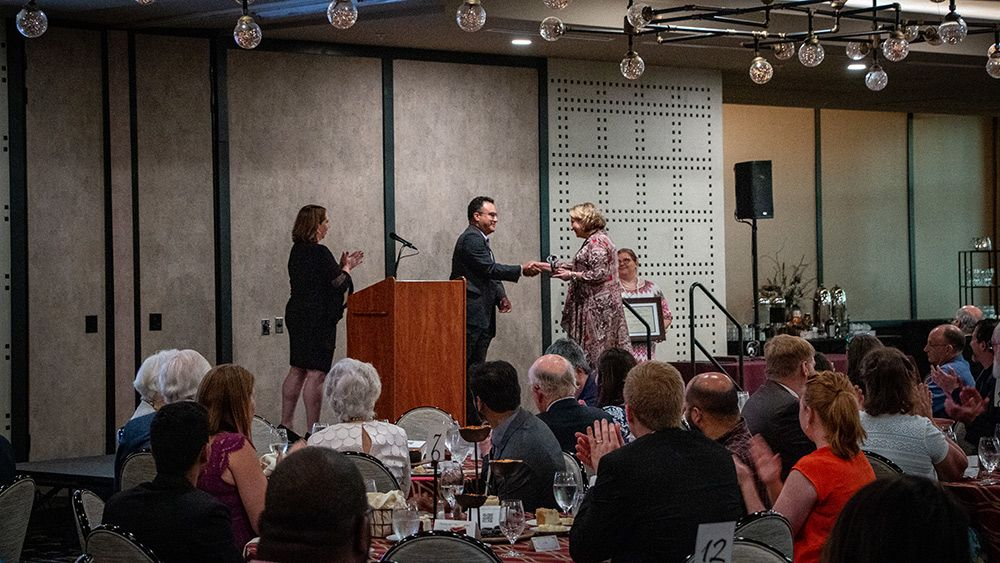
A huge congratulations to Ph.D. student Abheek Chatterjee for being awarded the 2022 Graduate Student Teaching Award from the Mechanical Engineering Department. Based on several nominations, the department will present Abheek with the award at the spring Faculty and Staff award celebration.
Two BiSSL Students Have IDETC 2022 Papers Accepted
BiSSL MS student Tyler Wilson and Ph.D. student Abheek Chatterjee have had two papers accepted to ASME’s 2022 International Design Engineering Technical Conferences & Computers and Information in Engineering Conference (IDETC/CIE2022). The papers will be presented in St. Louis, Missouri in August.
Tyler and Abheek collaborated on the paper “Exploring the Effects of Partnership and Inventory for Supply Chain Resilience Using an Ecological Network Analysis,” submitted to Design for Manufacturing and the Life Cycle (DFMLC).
Abheek collaborated with undergraduate Cade Helbig and Dr. Rich Malak on the paper “A Survey of Graph-Theoretic Approaches for Resilient System of Systems Design,” submitted to System Engineering and Information Knowledge Management (SEIKM).
BiSSL Collaborative Paper Accepted to the 2022 ASEE Conference & Exposition
A collaborative paper with Dr. Julie Linsey at Georgia Institute of Technology, led by BiSSL Ph.D. student Samuel Blair and co-written with MS student Garrett Hairston, has been accepted to the 2022 ASEE Conference & Exposition. The paper, titled “Modularity Analysis of Makerspaces to Determine Potential Hubs and Critical Tools in the Makerspace,” was accepted to the Design in Engineering Education Division. The conference will be held in Minneapolis, MN at the end of June.
Abstract: Globally, universities have heavily invested in makerspaces. Purposeful investment however requires an understanding of how students use tools and how tools aid in engineering education. This paper utilizes a modularity analysis in combination with student surveys to analyze and understand the space as a network of student-tool interactions. The results show that a modularity analysis is able to identify the roles of different tool groupings in the space by measuring how well tool groups are connected within their own “module” and their connection to tools outside of their module. A highly connected tool in both categories is considered a hub that is critical to the network. Poorly connected tools indicate insignificance or under utilization. Makerspaces at two universities were investigated: School A with a full-time staff running the makerspace and School B run by student-volunteers. The results show that 3D printers and metal tools are hubs at School A and 3D printers, metal tools, and laser cutters are hubs at School B. School B was also found to have a higher overall interaction with all the tools in the space. The modularity analysis results are validated using two-semesters worth of student self-reported survey data. The results support the use of a modularity analysis as a way to analyze and visualize the complex network interactions occurring within a makerspace, which can support the improvement of current makerspaces and development of future makerspaces.
Blair, Samuel, Henry Banks, Garrett Hairston, Julie Linsey, and Astrid Layton. 2022. “Modularity Analysis of Makerspaces to Determine Potential Hubs and Critical Tools in the Makerspace.” ASEE 2022 Conference & Exposition, Minneapolis, MN.
Systems Engineering Research Center – Doctoral Students Forum
The BiSSL group is very proud of our own Ph.D. student Abheek Chatterjee, who was one of a select few graduate students chosen to present their doctoral research at the SERC Annual Sponsor Research Review’s Doctoral Student Forum. His presentation is titled “Ecology-Inspired Design of Resilient and Affordable System of Systems.”
Three BiSSL Graduate Students Awarded Graduate Fellowships for Fall 2021!
Congratulations to Ph.D. candidate Abheek Chatterjee, Ph.D. student Samuel Blair, and MS student Garrett Hairston for being awarded J. Mike Walker ’66 Department of Mechanical Engineering Graduate Fellowships for Fall 2021 in recognition of the great research they’ve been doing as graduate students!
New BiSSL Publication in the Systems Engineering journal
Big congratulations to BiSSL Ph.D. student Abheek Chatterjee for his paper “Ecology‐inspired resilient and affordable system of systems using degree of system order” – which investigates applying ecological resilience measures to the design of Systems of Systems (SoS) and has now been published!
Abstract: This research tests the value of using an ecology-inspired architectural metric, called the metric Degree of System Order (DoSO), to identify resilient and affordable engineered System of Systems (SoS) architectures. Analysis of long-surviving biological ecosystems (nature’s resilient SoS) using DoSO has revealed a unique balance of efficient and redundant interactions in their architectures. This balance is hypothesized to enable both effective resource utilization under normal operation and adaptability to survive and recover from perturbations. Optimal trade-off between resilience (the ability to survive and recover from disruptions) and affordability is highly desirable in engineering SoS as well. To test this analogy, the resilience vs. affordability tradespace of a large number of notional SoS architectures is investigated using the DoSO metric. Results indicate that the majority of Pareto optimal SoS architectures, under various disruption scenarios, lie in the ecologically identified favorable DoSO range. Further, SoS architectures within this DoSO range were found to have better resilience and affordability attributes, in general, than the architectures outside it. Evaluation of the DoSO metric does not require detailed simulations and is the first network architecture metric to consider resilience vs. affordability trade-offs, making it a valuable addition to the SoS engineering toolset.
A. Chatterjee, R. Malak, and A. Layton, “Ecology-inspired Resilient and Affordable System of Systems using Degree of System Order,” Systems Engineering, pp. 1-16, 2021, Art no. SYS21598, doi: 10.1002/sys.21598.
Two BiSSL Presentations at the 2021 ASME IDETC Conference
Three BiSSL students had conference papers presented at the 2021 International Design Engineering Technical Conference!
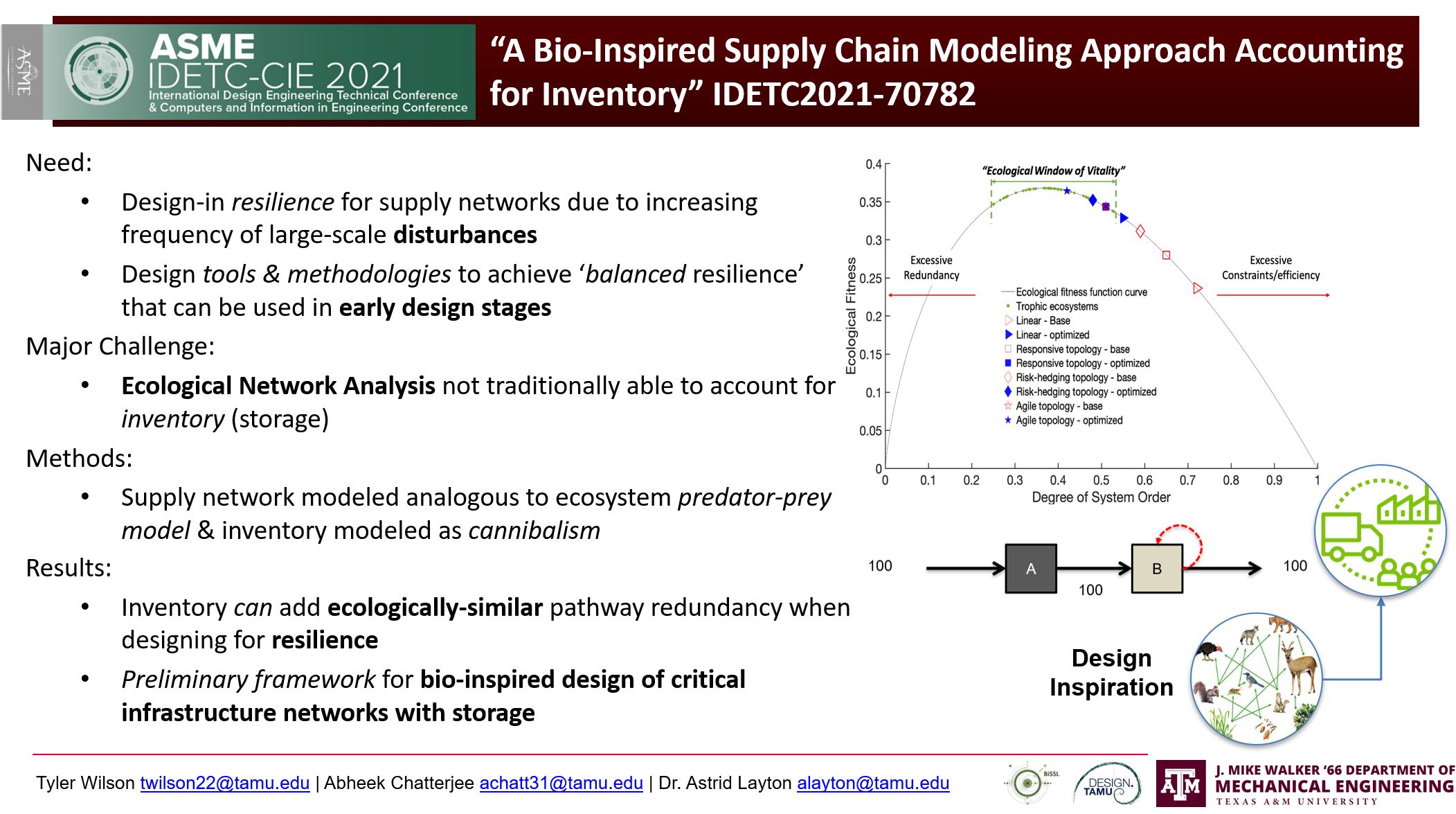
Ph.D. candidate Abheek Chatterjee and MS student Tyler Wilson presented their paper on modifying bio-inspired system design methodologies for supply chains, enabling the impact of storage to be considered when applying resilience characteristics from nature. Their paper was presented on Tuesday, August 17 in the Design Theory and Methodology session DTM-04 Design Research: Empirical and Experimental Studies.
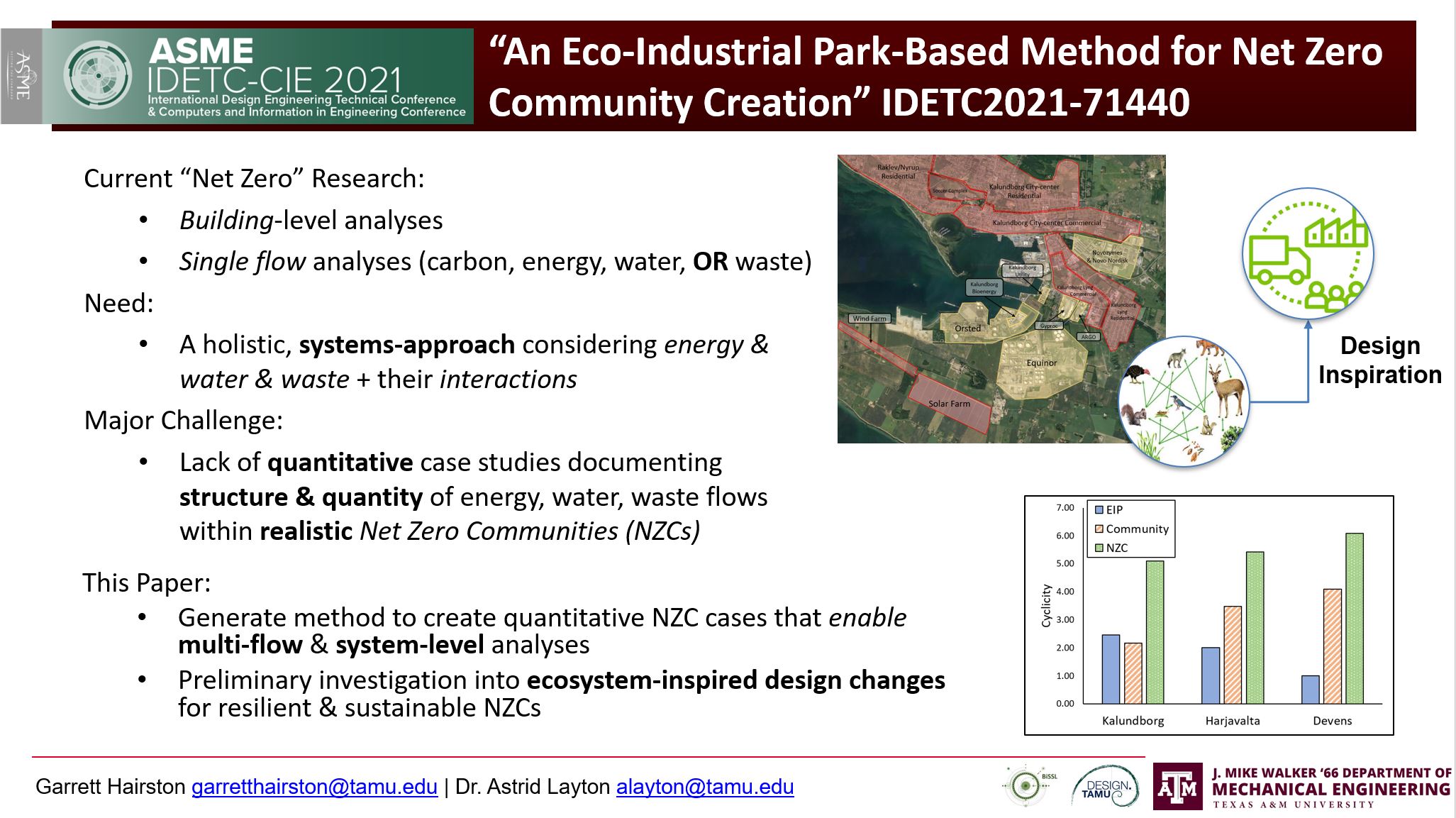
MS student Garrett Hairston presented his paper, which focuses on using a system perspective to develop net zero design guidelines for multi-use (industrial, residential, commercial) communities from biological food webs, on Thursday, August 19 in the Design for Manufacturing and the Life Cycle session DFMLC-08-01/DAC-20-01: Modeling and Optimization for Sustainable Design and Manufacturing.