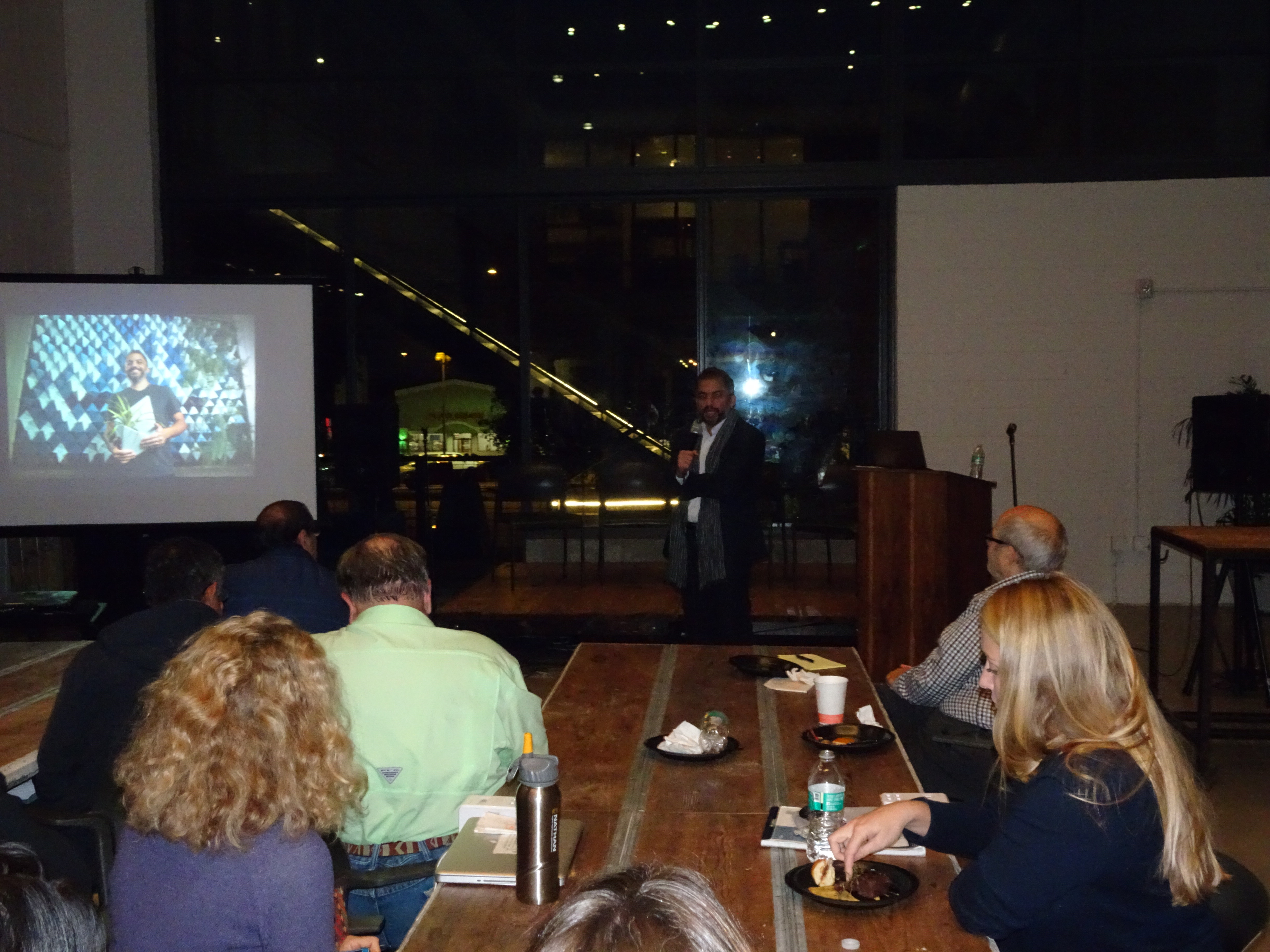
Dr. Layton and BiSSL Master’s student Jewel Williams will help Austin Technology Incubator celebrate its launch as the new Circular Economy Incubator! Discussions with industry experts and entrepreneurs about real-world solutions, including leading Circular Economy companies: Wisetek, Remade, re:3D, and Leaf and Flour. Keynote to be given by BiSSL collaborator Dr. Ahmed Ali on Circular Design for the Built Environment.
TheAustin Technology Incubator(ATI) is the deep technology incubator of The University of Texas at Austin working with university and community entrepreneurs to commercialize their breakthrough innovations. For over 29 years, ATI has used a customized approach to support entrepreneurs addressing the world’s most pressing problems by connecting startups with the expertise, relationships, and funding sources they need to succeed in the marketplace.
Read more about the event and the companies presenting here…
A coalition of researchers, scientists, business leaders and policymakers came together in 2017 to identify the most substantive solutions to not just halt global warming, but actually cause an annual decline in the concentration of greenhouse gases in our atmosphere. The result was a ranked list of the 100 most powerful solutions to reversing global warming, educating girls was number 6.
To put that in perspective: Rooftop solar panels are #10. Electric vehicles come in at #26. Educating girls ranks at #6.
“We stand at a key moment in history. As sustainability challenges intensify and the window for action grows smaller every day, the need for leadership by higher education is greater than ever. With a theme of “Global Goals: Rising to the Challenge,” the 2018 AASHE Conference & Expo will examine the critical role of higher education in achieving the United Nations Sustainable Development Goals (SDGs). Adopted by the world’s governments in September 2015, the 17 SDGs establish ambitious global targets to end poverty, protect the planet and ensure prosperity for all by 2030.”
Dr. Layton will discuss her path from being an undecided freshman undergraduate student at the University of Pittsburgh to her Assistant Professor position in Mechanical Engineering at Texas A&M, as well as how her research interests started and evolved.
Tuesday August 28th from 2-3pm the ASME CIE Systems Engineering and Information Knowledge Management (SEIKM) technical committee will host a panel on “Networks and Systems.” The panel will consist of Mr. Babak Heydari (Assistant Professor, Stevens Institute of Technology) speaking on Complex Socio-Technical Systems, Dr. Astrid Layton (Assistant Professor, Texas A&M University) speaking on Bio-Inspired Network Analysis Techniques, and Dr. Sara Behdad (Assistant Professor, University at Buffalo, SUNY) speaking on Network Approaches for Sustainable Design and Manufacturing.
The Texas A&M Energy Research Society (ERS), in partnership with the Texas A&M Energy Institute, is pleased to present the Third Annual Texas A&M Conference on Energy. Varun’s poster is to be presented during Poster Session 2 (3-4:30pm) on Tuesday, September 25th, 2018. The poster covers preliminary work done by MS students Varuneswara Panyam and Bogdan Pinte and their advisors Dr. Kate Davis (Electrical Engineering) and Dr. Astrid Layton (Mechanical Engineering).
BiSSL MS student Varuneswara Panyam was accepted to and will attend the National Science Foundation’s summer school on Decision Making in Engineering Systems at the University of Southern California, Los Angeles, June 23-29, 2018. The six-day summer school will introduce graduate students to the foundations of decision-making in large systems and is hosted by Dr. Ali Abbas, Director of the Neely Center, at the University of Southern California.
Topics covered include
Characterizing uncertainty in a systems engineering and design environment
Building Preference – Value – Utility models for systems engineering and design
Introducing the basic axioms of decision-making, and methods to analyze flawed methods of decision making
Research methodologies for decision-making in systems engineering and design
Future research directions
Practical applications of decision-making in systems engineering featuring guest speakers from industry and academia
Congratulations to our students Varuneswara Panyam and Tirth Dave for their paper titled “Understanding Ecological Efficiency and Robustness for Network Design Using Thermodynamic Power Cycles” getting accepted into the International Design Engineering Technology Conferences, Design Theory and Methodology. The conference will be held in Quebec City, Canada from August 26-29, 2018.
Ecology has acted as a source for sound design principles and studies of ecosystems have examined how ecological principles can enhance sustainable human network design. Engineered systems are often designed for maximum performance, but in many cases, robustness is lost due to unwanted variations in inputs or efficiency. Taguchi’s signal to noise ratio and other quality engineering principles are well known fundamentals in the field of robust design. In this paper, we will introduce flow-based metrics from ecological network analysis (ENA) for robustness, efficiency, and redundancy. Ecosystem robustness is related to the balance between flow path diversity and system delivery efficiency. Systems with diverse flows are more resilient to a disturbance since there are redundant pathways, but are inefficient because they contain many flow paths with the same endpoints. Efficient systems are better able to transfer material and energy, but this is at the cost of fewer pathways so the system is brittle. Thus to survive a disturbance, an ecosystem system balances redundancy with efficiency. Thermodynamic power cycles are used to understand the relationship between energy efficiency, measured using first law efficiency, and ecological robustness and an ecological balance of efficiency to redundancy (as measured by ascendency vs development capacity). The result highlights the importance of understanding differences in the meaning of efficiency between two fields, and that from an engineering standpoint robustness does not have to be sacrificed to obtain energy efficiency.
“Understanding Ecological Efficiency and Robustness for Network Design Using Thermodynamic Power Cycles”
“Bio-Inspired Design of Complex Energy Systems to Achieve Robust, Efficient, and Sustainable Networks”
Proposals were assessed based on the following criteria: (a) innovative and transformative potential of proposed research work in energy; (b) quality of interdisciplinary research group; (c) potential for developing a successful proposal for government funding; and (d) potential for securing external government funding.