Dr. Astrid Layton was invited by the Center for Additive Manufacturing and Design Innovation (CAMDI) in the Cockrell School of Engineering at the University of Texas at Austin to share BiSSL group work on bio-inspired system resilience. Information about her talk, titled “Learning from Nature to Design Resilient Systems,” can be found in the flying below.
Author: alayton6
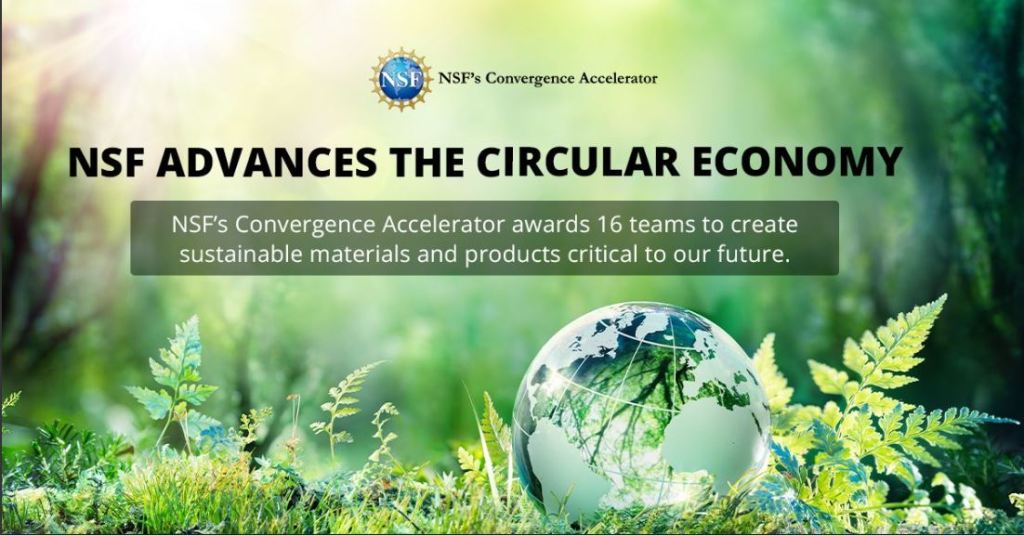
The BiSSL group joins 1 of 16 teams that have been selected for NSF’s Convergence Accelerator Grant

NSF’s Convergence Accelerator is developing use-inspired solutions to address challenges aligned to the manufacturing, reuse and recycling of critical materials and products. The BiSSL group joins one of sixteen teams that have been selected for the program’s Track I: Sustainable Materials for Global Challenges.
The project is titled: Toward Water Circularity: Mining Green Hydrogen and Value-Added Materials from Hypersaline Brines, and is led by Oregon State University. The team is made up of: Dr. Zhenxing Feng (PI), Dr. Alex Chang (Co-PI), Dr. Astrid Layton (Co-PI), and Dr. Kelsey Stoerzinger (Co-PI). Feng, Chang, and Stoerzinger are all at Oregon State University in the Department of Chemical, Biological, and Environmental Engineering.
ABSTRACT. This track I NSF’s Convergence Accelerator aims to converge advances in fundamental materials science with innovative design and manufacturing methods to couple their end-use and full life-cycle considerations for environmentally- and economically sustainable materials and products. Guided by this principle and motivated by the global goal of Net-Zero Emissions by 2050, this project focuses on demonstration of a sustainable production and manufacturing process for large-scale hydrogen deployment and critical materials mining from earth’s abundant hypersaline brines (e.g., seawater). Hydrogen is a green fuel that can help accelerate decarbonization processes, and materials such as Lithium and Rare Earth elements that are critical to U.S. supply chain independence. This project emphasizes transformation from a linear to a circular economy; it enables a convergent, innovative team of universities, industry partners, government agencies, and students/trainees to ensure that the knowledge developed transitions effectively into many aspects of practice. The proposed circular use of water for fuel by renewable energy and extraction of critical materials for renewable energy production has broad societal impacts for a sustainable future. This project integrates multidisciplinary thinking into the undergraduate and K-12 curriculum, producing future engineers and scientists with skills and interests to work on multidisciplinary problems. This research supports and benefits the local community, such as the Oregon Coast’s Blue Sector Partnership Network consisting of partners from workforce development, school districts (CTE), industry, government, research, maritime, municipalities, and blue technology.
This proposal aims to demonstrate the sustainable mining of green hydrogen in parallel with value-added critical elements from hypersaline brines (e.g., seawater) for clean energy applications. Motivated by the global goal of Net-Zero Emissions by 2050, circular economy principles guide our development of sustainable processes for materials/fuels production, utilization, and recycling. Seawater represents the most abundant resource on the earth, with immense surface accessibility and large amounts of solubilized elements imperative for clean energy technologies. Seawater can also be split using renewable energy (e.g., solar) to obtain hydrogen fuel, with benign oxygen gas as a byproduct. Hydrogen presents a zero-emission fuel (producing water in a fuel cell), part of a circular sustainable process. Developing an integrated solution for extracting hydrogen and critical elements from seawater requires a multidisciplinary team from universities, industry partners, government agencies, and students/trainees. With our patented technologies and research results in critical areas, we aim to integrate multidisciplinary knowledge, tools, and modes of thinking under the guidance of circular economy principles to accelerate and converge our research to two integrated prototypes: a mineral-water separation reactor and downstream electrolyzer (producing hydrogen from the reduced-saline effluent). In addition to this prototyping, we will also identify in Phase 1 additional areas of expertise through team activities to prepare our Phase 2 project. In parallel, we will engage local stakeholders (focused on the Oregon Coast with our local expertise) and create training programs to educate next-generation workforces with innovative circular concepts in both Phases.https://nsf.gov/awardsearch/showAward?AWD_ID=2236036&HistoricalAwards=false
Dr. Abheek Chatterjee graduates from the BiSSL group with his Ph.D.
Invited Research Seminar at the University of Miami, Department of Industrial and Systems Engineering
Dr. Astrid Layton was invited by the Department of Industrial and Systems Engineering at the University of Miami to share BiSSL group work on bio-inspired system resilience. Her talk, titled “Using Biological Inspiration to Guide the Design of Human Networks for Resilience” is also now featured in the University’s Climate Resilience Academy UM YouTube series.
Abstract: Biological ecosystems have been through millions of years of R&D, producing complex systems of systems made up of interacting species that are able to support individual needs while maintaining system-level functions. In this talk Dr. Layton will show that ecosystems offer a relatively untapped source of design inspiration for improving the resilience of our human engineered networks in conjunction with goals like sustainability and cost. Quantitative descriptors and analysis techniques are adapted from ecology, enabling desirable ecosystem characteristics to be used as optimization and design guides for industrial resource networks (or eco-industrial parks, EIPs), water networks, supply chains, cyber-physical systems, and power grids. Ecological characteristics such as high levels of materials/energy cycling and a unique balance between redundant and efficient pathways offer novel routes to achieving traditional engineering goals.
BiSSL MS Energy Student Alexander Duffy defends his thesis!
Masters of Energy student Alexander Duffy successfully defended his master’s thesis on Friday. The committee consisted of BiSSL head Dr. Astrid Layton, Dr. Katherine Davis from Electrical & Computer Engineering, and Dr. Helen Reed from Aerospace Engineering. His thesis was titled “Design and analysis of satellite networks for ecological resilience.”
BiSSL Ph.D. Student Abheek Chatterjee defends his thesis!
The first Ph.D. student to graduate from BiSSL, Abheek Chatterjee, successfully defended his dissertation on Wednesday! The committee consisted of BiSSL head Dr. Astrid Layton, Drs. Richard Malak and Douglas Allaire from Mechanical Engineering, and Dr. Nancy Currie-Gregg from Industrial & Systems Engineering. His thesis was titled “An Investigation of Ecologically-Inspired Architecting Principles for Resilient System of Systems Design.”
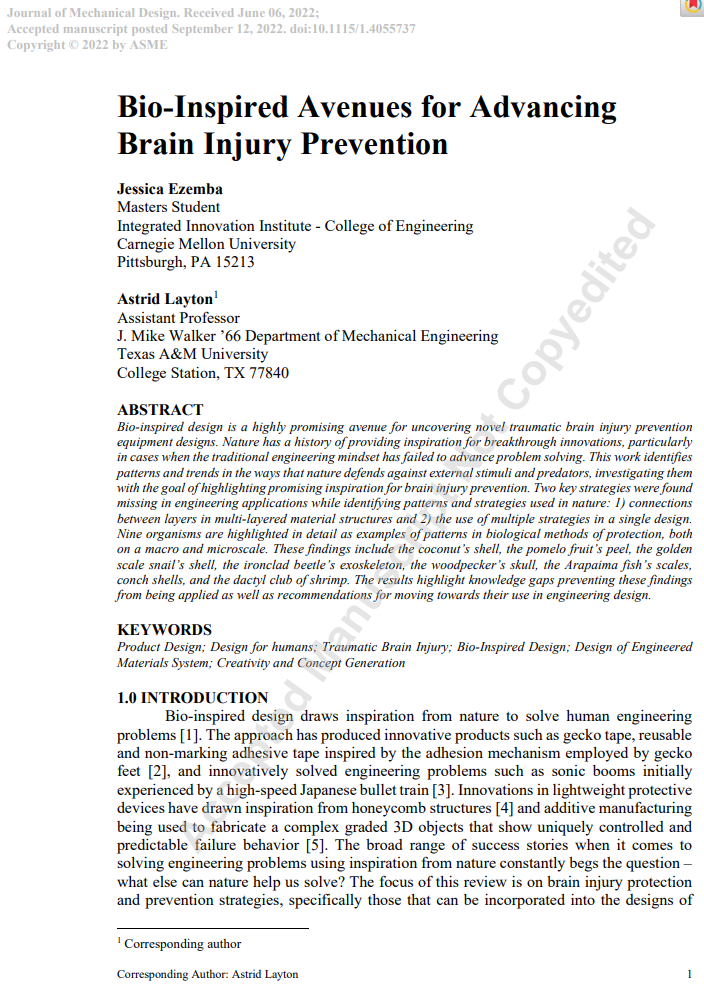
Huge congratulations to BiSSL alum Jessica Ezemba on her first authored paper being accepted to the Journal of Mechanical Design!
Jessica was an undergraduate researcher student in BiSSL while at Texas A&M. Her work combining her interest in brain injuries with bio-inspired design turned into a full-length journal article that has now been accepted for publication in the Journal of Mechanical Design. Jessica is currently a graduate student at Carnegie Mellon University in their MIIPS program and is planning on pursuing a Ph.D. thereafter.
The paper is titled “Bio-Inspired Avenues for Advancing Brain Injury Prevention” and can be found here:
Abstract: “Bio-inspired design is a highly promising avenue for uncovering novel traumatic brain injury prevention equipment designs. Nature has a history of providing inspiration for breakthrough innovations, particularly in cases when the traditional engineering mindset has failed to advance problem solving. This work identifies patterns and trends in the ways that nature defends against external stimuli and predators, investigating them with the goal of highlighting promising inspiration for brain injury prevention. Two key strategies were found missing in engineering applications while identifying patterns and strategies used in nature: 1) connections between layers in multi-layered material structures and 2) the use of multiple strategies in a single design. Nine organisms are highlighted in detail as examples of patterns in biological methods of protection, both on a macro and microscale. These findings include the coconut’s shell, the pomelo fruit’s peel, the golden scale snail’s shell, the ironclad beetle’s exoskeleton, the woodpecker’s skull, the Arapaima fish’s scales, conch shells, and the dactyl club of shrimp. The results highlight knowledge gaps preventing these findings from being applied as well as recommendations for moving towards their use in engineering design.”
(2022) *Ezemba, J.; Layton, A. “Bio-Inspired Avenues for Advancing Brain Injury Prevention.” Journal of Mechanical Design. DOI: 10.1115/1.4055737
BiSSL PhD Student Abheek Chatterjee becomes a 2022 Texas A&M College of Engineering Teaching Fellow
Congratulations to Ph.D. candidate Abheek Chatterjee for being selected by the College of Engineering as a Teaching Fellow for the Fall 2022 term!
BiSSL Ph.D. Student Hadear Hassan Awarded a J. Mike Walker ’66 Graduate Student Fellowship for Fall 2022.
Congratulations to Ph.D. student Hadear Hassan for being awarded a J. Mike Walker ’66 Department of Mechanical Engineering Graduate Fellowship for Fall 2022 in recognition of her great research!
Two BiSSL Student Papers Presented at the 2022 IDETC-CIE Conference in St. Louis, Missouri
Ph.D. candidate Abheek Chatterjee presented two student-led papers at this year’s IDETC-CIE conference. BiSSL MS student alum Tyler and Abheek collaborated on the paper “Exploring the Effects of Partnership and Inventory for Supply Chain Resilience Using an Ecological Network Analysis,” presented to Design for Manufacturing and the Life Cycle (DFMLC). Abheek also collaborated with undergraduate alum Cade Helbig and Dr. Rich Malak on the paper “A Survey of Graph-Theoretic Approaches for Resilient System of Systems Design,” presented to System Engineering and Information Knowledge Management (SEIKM).