TAMU Student Research Week

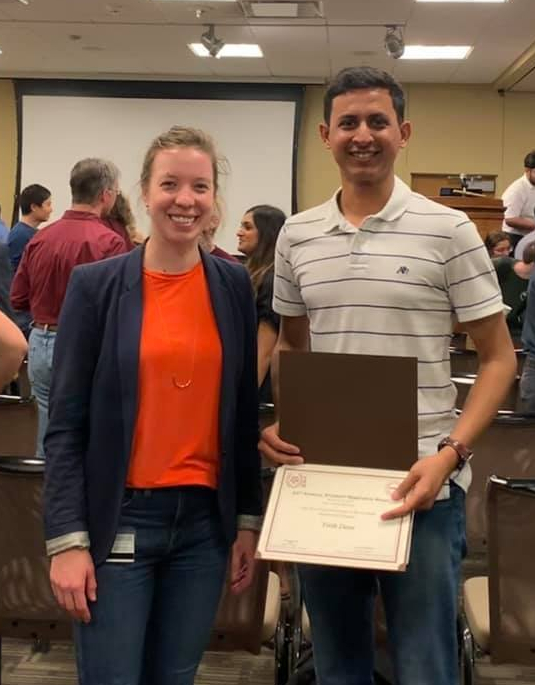
Dr. Astrid Layton and BiSSL MS student Tirth Dave with his award

BiSSL Master’s student Tirth Dave just won 1st place out of all Engineering Graduate Student Presentations at Student Research Week at Texas A&M University! His presentation was titled: “Sustainable Water Networks Design: A Bio-inspired Approach” 

Everyone here in the BiSSL group is so proud!

Student Research Week at Texas A&M is the largest, single-university student-run research symposium in the nation. Students get to show their research and have a chance to win up to $1,000 in award money and receive feedback from faculty and graduate student judges.

BiSSL MS Student Jewel Williams Selected for Invent for the Planet

iftp-promo-2019-feature-block-16Jan2019

BiSSL MS student Jewel Williams was one of only 60 students selected to participate in this weekend’s 48 hour Aggies Invent for the Planet event! We’re all wishing her good luck!

Feb. 15-17, 2019

Invent for the Planet: The sun never sets on innovation.

For 48 hours, college students from 30 universities around the world will be joining Texas A&M University virtually as we tackle some of the most challenging issues facing the planet today. From water insecurity solutions to stopping the spread of disease and creating new technology for the classroom, this competition will test the limits of your creativity and resourcefulness. Will your idea help save lives and improve life on Earth? From Feb. 15–17, the sun won’t set on innovation.

BiSSL Student to Attend National Science Foundation’s 2018 Summer School

BiSSL MS student Varuneswara Panyam was accepted to and will attend the National Science Foundation’s summer school on Decision Making in Engineering Systems at the University of Southern California, Los Angeles, June 23-29, 2018. The six-day summer school will introduce graduate students to the foundations of decision-making in large systems and is hosted by Dr. Ali Abbas, Director of the Neely Center, at the University of Southern California.

Topics covered include

  • Characterizing uncertainty in a systems engineering and design environment
  • Building Preference – Value – Utility models for systems engineering and design
  • Introducing the basic axioms of decision-making, and methods to analyze flawed methods of decision making
  • Research methodologies for decision-making in systems engineering and design
  • Future research directions
  • Practical applications of decision-making in systems engineering featuring guest speakers from industry and academia

Read more about the summer school here…

Spring 2019 J. Mike Walker ’66 Department of Mechanical Engineering Graduate Excellence Fellowships

meen logo

Congratulations to two of our BiSSL graduate research students Varuneswara Panyam and Colton Brehm, for winning the J. Mike Walker ’66 Department of Mechanical Engineering Graduate Excellence Fellowship for continuing students for the Spring 2019 semester! The highly competitive graduate scholarship awards graduate students doing excellent research in the department.

Journal of Industrial Ecology Best Paper Prizes: Journal article by Layton, Bras, and Weissburg awarded Second for the 2016 Graedel Prizes

Layton, A., B. Bras, and M. Weissburg. 2016. Industrial ecosystems and food webs: An expansion and update of existing data for eco‐industrial parks and understanding the ecological food webs they wish to mimic. Journal of Industrial Ecology 20(1): 85–98.

“Winners of the 2016 Graedel Prizes: The Journal of Industrial Ecology Best Paper Prizes” by Helge Brattebø, Reid Lifset

The Graedel Prizes were established to honor Professor Thomas Graedel, now emeritus from Yale University after an outstanding successful career as a researcher and pioneer in the field of industrial ecology (IE). The prizes are awarded to the best two papers published in the Journal of Industrial Ecology (JIE) every year; one paper written by a junior single author or first author (below the age of 36) and one paper written by a senior single author or first author.

“The winning papers, as well as the ones that were nominated but were not selected, demonstrate research of high scientific quality and relevance on a wide spectrum of topics in the field of industrial ecology.”

full article on the 2016 prize awards here

The two prize‐winning papers successfully competed among 12 nominated papers, out of which four were written by a junior author or junior first author. The paper by Ivanova and colleagues (2016), the winner in the junior author category, with a study on household consumption, was in a close race with the paper by Layton and colleagues (2016) offering a study on data and organization of eco‐industrial parks (EIPs) and food webs (FWs).

The second best paper in the junior author category by Layton and colleagues (2016) is an excellent paper with original and novel contributions to research methods for more fundamental understanding of the characteristics of EIPs and FW mimicry. In particular, the study offers significant improvements in systematic analysis of metrics and data processing for a large data set of EIPs and FWs. The paper analyzes to what extent the IE metaphor is actually implemented in EIPs, and FW structures are compared with EIP structures. The paper concludes that EIPs are less complex that their ecological counterparts, and that EIPs still have a long way to go to meet the resilient and efficient properties of natural systems. This is a valuable contribution to IE research: It improves the scientific links between ecology methods and IE methods and offers a basis for better ecosystem mimicry in circular economy initiatives. The study represents great value for the IE community and increases our understanding of the extent our metaphor actually holds. It is also valuable in terms of the data provided and analysis made of the current EIP structures. The paper is well written with proper illustrations, an excellent structure, layout and language, and with extensive data and documentation including supporting information.

full article on the 2016 prize awards here