BiSSL Collaborative Paper Accepted to the 2022 ASEE Conference & Exposition

A collaborative paper with Dr. Julie Linsey at Georgia Institute of Technology, led by BiSSL Ph.D. student Samuel Blair and co-written with MS student Garrett Hairston, has been accepted to the 2022 ASEE Conference & Exposition. The paper, titled “Modularity Analysis of Makerspaces to Determine Potential Hubs and Critical Tools in the Makerspace,” was accepted to the Design in Engineering Education Division. The conference will be held in Minneapolis, MN at the end of June.

Abstract: Globally, universities have heavily invested in makerspaces. Purposeful investment however requires an understanding of how students use tools and how tools aid in engineering education. This paper utilizes a modularity analysis in combination with student surveys to analyze and understand the space as a network of student-tool interactions. The results show that a modularity analysis is able to identify the roles of different tool groupings in the space by measuring how well tool groups are connected within their own “module” and their connection to tools outside of their module. A highly connected tool in both categories is considered a hub that is critical to the network. Poorly connected tools indicate insignificance or under utilization. Makerspaces at two universities were investigated: School A with a full-time staff running the makerspace and School B run by student-volunteers. The results show that 3D printers and metal tools are hubs at School A and 3D printers, metal tools, and laser cutters are hubs at School B. School B was also found to have a higher overall interaction with all the tools in the space. The modularity analysis results are validated using two-semesters worth of student self-reported survey data. The results support the use of a modularity analysis as a way to analyze and visualize the complex network interactions occurring within a makerspace, which can support the improvement of current makerspaces and development of future makerspaces.

Blair, Samuel, Henry Banks, Garrett Hairston, Julie Linsey, and Astrid Layton. 2022. “Modularity Analysis of Makerspaces to Determine Potential Hubs and Critical Tools in the Makerspace.” ASEE 2022 Conference & Exposition, Minneapolis, MN.

Two BiSSL Presentations at the 2021 ASME IDETC Conference

Three BiSSL students had conference papers presented at the 2021 International Design Engineering Technical Conference!

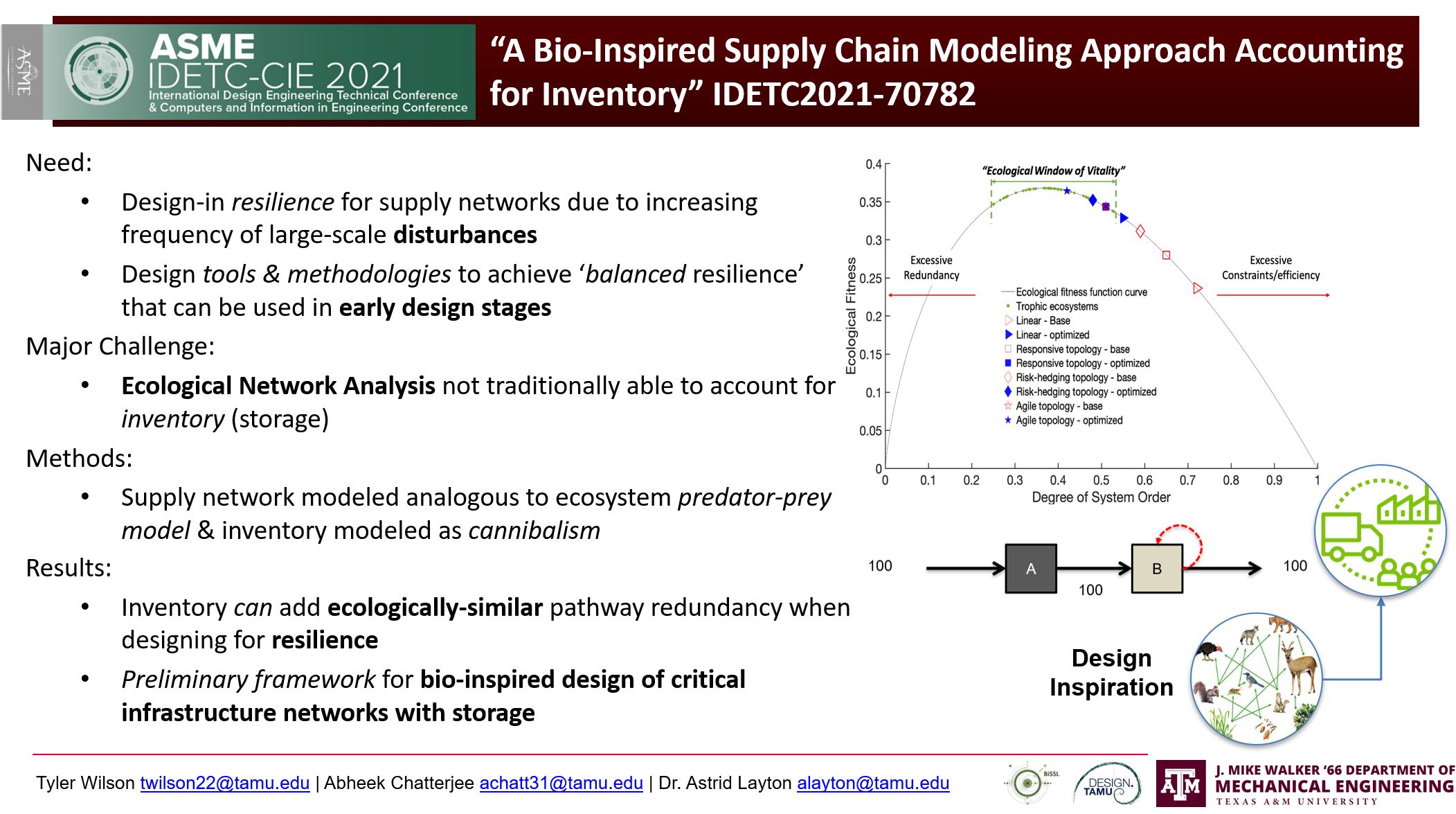
Ph.D. candidate Abheek Chatterjee and MS student Tyler Wilson presented their paper on modifying bio-inspired system design methodologies for supply chains, enabling the impact of storage to be considered when applying resilience characteristics from nature. Their paper was presented on Tuesday, August 17 in the Design Theory and Methodology session DTM-04 Design Research: Empirical and Experimental Studies.

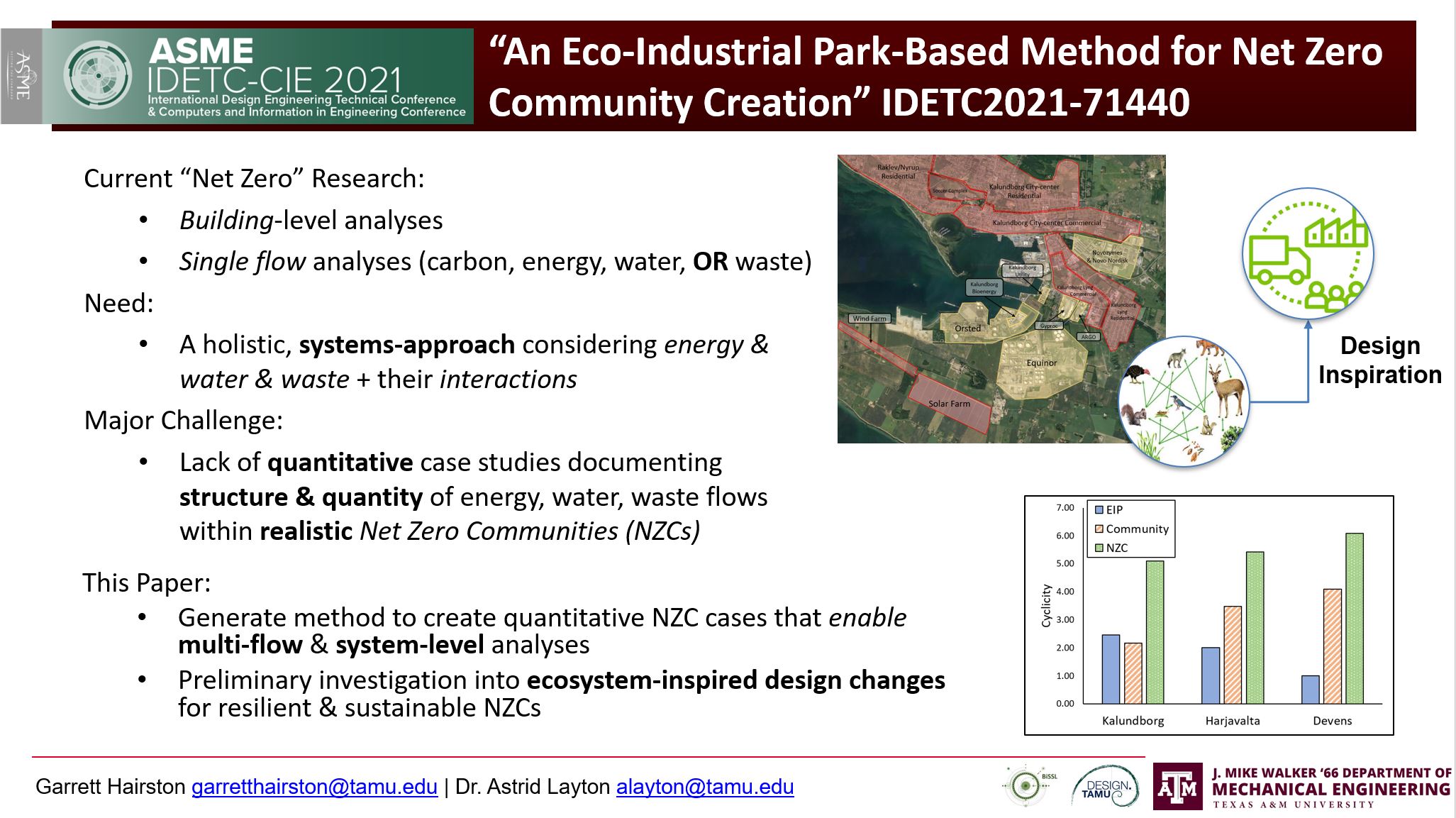
MS student Garrett Hairston presented his paper, which focuses on using a system perspective to develop net zero design guidelines for multi-use (industrial, residential, commercial) communities from biological food webs, on Thursday, August 19 in the Design for Manufacturing and the Life Cycle session DFMLC-08-01/DAC-20-01: Modeling and Optimization for Sustainable Design and Manufacturing.

Wilson, Tyler, Abheek Chatterjee, and Astrid Layton (2021) “Developing a Supply Chain Modeling Approach to Facilitate Ecology-Inspired Design for Sustainability and Resilience.” ASME 2021 International Design Engineering Technical Conferences and Computers & Information in Engineering Conference, virtual, Aug 17-19.
Hairston, Garrett, and Astrid Layton (2021) “An Eco-Industrial Park-Based Method for Net Zero Community Creation.” ASME 2021 International Design Engineering Technical Conferences and Computers & Information in Engineering Conference, virtual, Aug 17-19.

Two student-led conference papers accepted to the 2021 IDETC-CIE conference!

Three BiSSL students have had conference papers accepted to the 2021 International Design Engineering Technical Conference! Ph.D. candidate Abheek Chatterjee and MS student Tyler Wilson have co-authored a paper on modifying bio-inspired system design methodologies for supply chains, enabling the impact of storage to be considered when applying resilience characteristics from nature. MS student Garrett Hairston has had his first, first-authored paper accepted that focuses on using a system perspective to develop net-zero design guidelines for multi-use (industrial, residential, commercial) communities from biological food webs.

Abstract: “Supply chain policies and design efforts are traditionally focused on efficiency objectives such as reducing operational costs. With the occurrence of the most devastating pandemic in decades and the continually increasing prevalence of natural disasters, this focus has been challenged, and the need to focus on supply chain resilience has become apparent. Achieving long-lasting sustainable development in supply chains requires a balance of efficiency-focused measures that enhance economic and environmental sustainability and resiliency measures. Ecological Network Analysis has revealed a unique balance between pathway efficiency and redundancy in ecosystems’ network architecture. This enables both efficient operations under normal circumstances and resilience to perturbations. This same analysis can be used to evaluate the balance of sustainability and resilience in supply chain networks, providing insights into what kind of supply chain design and policy decisions lead to more ecosystem-like architectures. This study lays the groundwork for such efforts by studying four supply chain topologies (formed by prevalent supply chain strategies) using ENA. Inventory (storage) is not well understood in the typical flow analysis used in ENA but is an essential facet of supply chain design and must be included in a supply chain analysis. This study overcomes this limitation by proposing a method to include inventory in the ENA framework. The analysis conducted revealed two significant insights: (a) the agile supply chain strategy is the most ecologically similar and (b) it is possible that there are optimal inventory levels (given partnership strategies) to utilize bio-inspiration in supply chain design.”

Wilson, Tyler, Abheek Chatterjee, and Astrid Layton (2021) “Developing a Supply Chain Modeling Approach to Facilitate Ecology-Inspired Design for Sustainability and Resilience.” ASME 2021 International Design Engineering Technical Conferences and Computers & Information in Engineering Conference, virtual, August.

Abstract: “Much emphasis is placed on the role of Net Zero Communities (NZCs) in achieving a sustainable future. Systems research on the topic, including the application of bio-inspired techniques already used on other human networks, is currently hindered by the lack of case studies documenting the structure and quantity of energy, water, and waste flows within realistic NZCs. This work proposes and preliminarily tests a method of generating a database of hypothetical-realistic NZCs by expanding the system boundaries for well-documented Eco-industrial Park (EIP) networks. The expansion includes residential and commercial actors from the community surrounding the EIP. Past studies using Ecological Network Analysis (ENA) to improve the environmental and economic performance of these EIPs have resulted in a quantitative database of case studies. Combining these industrial hubs to nearby residential, commercial, agricultural, etc. actors can generate potential multi-use networks on which similar design work can be conducted. Three EIP to NZC cases are generated and analyzed focusing on their system structure. Cyclicity, an ENA metric used to quantify the presence and complexity of cyclic pathways in a network, has been shown to promote the efficient use of resources in both biological and human networks. Cyclicity values for the original EIP networks, the community additions, and the potential NZC case studies reveals that there are many meaningful interactions that occur between actors that are only visible once the system boundaries are expanded to the NZC level. This offers a glimpse into the potential benefits of approaching the NZ problem, and sustainable living more generally, on a system scale – an analysis that will be further enabled by the generation of an NZC database initiated by this work.”

Hairston, Garrett, and Astrid Layton (2021) “An Eco-Industrial Park-Based Method for Net Zero Community Creation.” ASME 2021 International Design Engineering Technical Conferences and Computers & Information in Engineering Conference, virtual, August.

Collaborative student-led conference paper accepted to the 2021 ASEE Annual Conference & Exposition

BiSSL MS student Samuel Blair has had his first, first-authored conference paper accepted to the American Society of Engineering Education 2021 annual conference! The conference was to be held in Long Beach, CA but unfortunately has since shifted to an entirely virtual format. The paper is titled “Bipartite Network Analysis Utilizing Survey Data to Determine Student and Tool Interactions in a Makerspace” and is a collaborative work with our partners at Georgia Institute of Technology, Dr. Julie Linsey and her MS student Henry Banks. The conference will take place July 26-29, 2021.

Abstract: “Engineering makerspaces are a powerful new tool in the educators’ toolbox. A growing body of empirical data demonstrates their benefits to student learning, but more needs to be done to ensure they meet their full potential. Analyzing the design of these spaces to maximize student tool interactions and identify barriers to entry supports goals for these spaces to be inclusive environments were all students are comfortable. The representation of student interactions with tools in a graph form enables analysis on the tools by mapping combinations between tools and shared student. The bipartite model of the network allows for students to be the “actors” while the tools are the “events” that students interact with. Using the one way interaction allows for a matrix simplifying the complex interactions in the space. The matrix can then be manipulated to yield important information about makerspaces. The results of this ongoing research propose advice regarding what tools and tool types are the most accessible to students, primarily high interaction tools such as basic 3D printers and handheld tools. Utilizing the analysis can also reveal how tools depend on higher interaction tools such as the advanced forms of 3D printing, as well as what student groups have may need extra support or outreach to increase their inclusion.”

Blair, S., Banks, H., Linsey, J., & Layton, A. (2021). Ecosystem Modularity as a Guide for Makerspaces Evaluations. Paper presented at the ASEE 2021 Conference & Exposition, virtual.

BiSSL PhD student Abheek Chatterjee wins “Best Paper” award for his 2020 IDETC-CIE conference paper!

Abheek his paper was written in collaboration with Dr. Richard Malak, in CIE’s SEIKM division titled “Exploring a Bio-Inspired System of Systems Resilience vs. Affordability Tradespace

Abstract: “The objective of this study is to investigate the value of an ecologically inspired architectural metric called the Degree of System Order in the System of Systems (SoS) architecting process. Two highly desirable SoS attributes are the ability to withstand and recover from disruptions (resilience) and affordability. In practice, more resilient SoS architectures are less affordable and it is essential to balance the trade-offs between the two attributes. Ecological research analyzing long-surviving ecosystems (nature’s resilient SoS) using the Degree of System Order metric has found a unique balance of efficient and redundant interactions in their architecture. This balance implies that highly efficient ecosystems tend to be inflexible and vulnerable to perturbations while highly redundant ecosystems fail to utilize resources effectively for survival. Motivated by this unique architectural property of ecosystems, this study investigates the response to disruptions vs. affordability trade-space of a large number of feasible SoS architectures. Results indicate that the most favorable SoS architectures in this trade-space share a specific range of values of Degree of System Order. This suggests that Degree of System Order can be a key metric is engineered SoS development. Evaluating the Degree of System Order does not require detailed simulations and can, therefore, guide the early stage SoS design process towards more optimal SoS architectures.”

A. Chatterjee, R. Malak, and A. Layton, “Exploring a Bio-Inspired System of Systems Resilience vs. Affordability Tradespace,” presented at the ASME 2020 International Design Engineering Technical Conference, virtual, 2020.

Two student papers are presented at the 2020 IDETC-CIE Conference

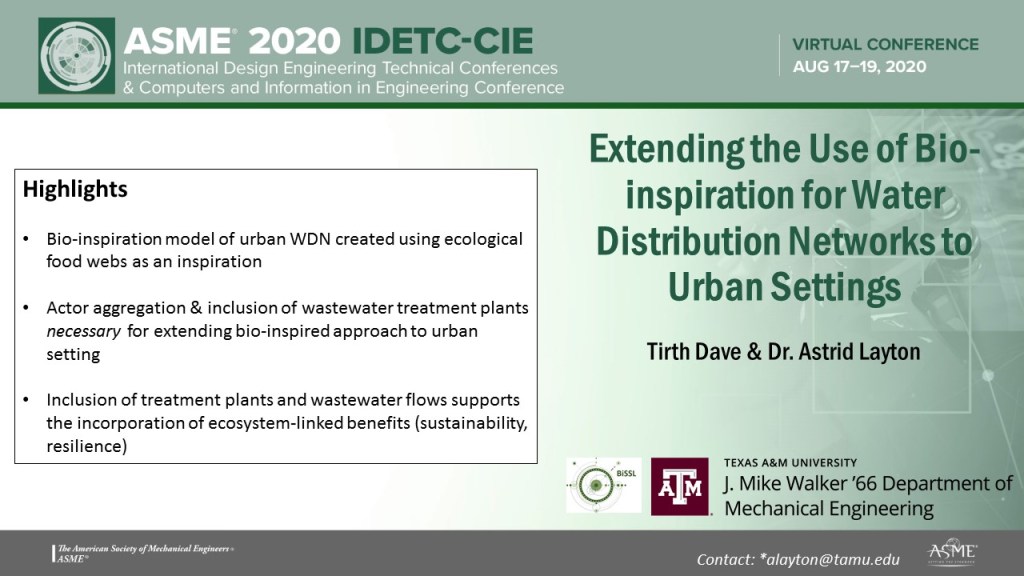
BiSSL alum Tirth Dave gave a presentation on his conference paper “Extending the Use of Bio-inspiration for Water Distribution Networks to Urban Settings” in IDETC’s DTM division.

BiSSL Ph.D. student Abheek Chatterjee presented his paper, written in collaboration with Dr. Richard Malak, in CIE’s SEIKM division titled “Exploring a Bio-Inspired System of Systems Resilience vs. Affordability Tradespace.” The paper was presented in the Complex Systems Engineering and Design session.

ASEE 2020 Conference Presentation

Exciting work done by MS alum Colton Brehm, in collaboration with Dr. Julie Linsey at Georgia Tech, was presented at the American Society for Engineering Education (ASEE) 2020 conference virtually. Colton’s conference paper that was presented and discussed is titled: “Using a Modularity Analysis to Determine Tool and Student Roles within Makerspaces.” We’re really excited to continue this work with new A&M BiSSL PhD student Samuel Blair! The conference continues all week! https://www.asee.org/annual-conference/2020

CIRP Life Cycle Engineering (LCE) 2020 Virtual Conference

Two BiSSL students, PhD student Abheek Chatterjee and recent MS graduate Colton Brehm, had their first authored peer-reviewed publications presented at the 2020 CIRP Life Cycle Engineering conference. The conference, originally meant to be in Grenoble, France was entirely virtual due to COVID-19.

Abstract: “Supply chain design has traditionally focused on using the shortest path or the minimum number of paths to reduce operational costs. This approach, however, fails to account for a system’s response to external disruptions. A novel supply chain design is proposed that mimics the optimal balance of efficient and redundant pathways found in nature’s resilient ecosystems. A comparison of traditional and bio-inspired supply chain designs are done using a disruption scenario, showing that the bio-inspiration significantly reduces the supply chain’s vulnerability to cascading failures.”Chatterjee, A., & Layton, A. (2020). Bio-inspired Design for Sustainable and Resilient Supply Chains. Paper presented at the 27th CIRP Life Cycle Engineering (LCE) Conference, Grenoble, France.

https://www.youtube.com/embed/-djMmo7RRiU?version=3&rel=1&showsearch=0&showinfo=1&iv_load_policy=1&fs=1&hl=en&autohide=2&start=14146&wmode=transparentYou can see the 10 minute presentation from Day 2 (May 14) of the CIRP LCE 2020, Circular Economy track, given by Abheek Chatterjee, here on YouTube (start 2:55:47).

“The sustainability of industrial practices is a growing point of emphasis in the research and business communities demanding effective systems-level solutions. Eco-Industrial Parks (EIPs), networks of co-located industries connected through mutually beneficial collaborations are a popular systems-level solution but have experienced highly variable degrees of success. Nestedness, a structure prevalent in mutualistic networks found in nature is our design focus for improved outcomes. This paper investigates how ecologically-similar nestedness values in EIPs relate to reductions of freshwater imports. The results indicate a range of nestedness values that support water conservation and critical thresholds for maximizing capital investments.”Brehm, C., Chatterjee, A., & Layton, A. (2020). Mimicking the nested structures of ecosystems in the design of industrial water networks. Paper presented at the 27th CIRP Life Cycle Engineering (LCE) Conference, Grenoble, France.

https://www.youtube.com/embed/dpAxPXpEymc?version=3&rel=1&showsearch=0&showinfo=1&iv_load_policy=1&fs=1&hl=en&autohide=2&start=7725&wmode=transparentYou can see the 10 minute presentation from Day 1 (May 13) of the CIRP LCE 2020, Eco-Design track, given by Colton Brehm, here on YouTube (start 2:08:47).