Three New BiSSL Students joining the group Spring 2021

We’d like to welcome three new undergraduate students to the BiSSL research group this semester! Learn more about them at out “Students” page on the website!

Jessica Ezemba

Undergraduate student Jessica Ezemba joined the BiSSL group Spring 2021 to continue with research she started in MEEN 440 Honors – Bio-Inspired Engineering Design. Jessica’s research interests include brain injury prevention. She is researching biology draw inspiration from how brain injury is prevented or minimized in nature.

Angel Alex

Undergraduate Mechanical Engineering student Angel Alex joined the BiSSL lab group in Spring 2021. She is working on research of Net-Zero Communities and the benefits of implicating their design with ecological network analysis.

Undergraduate Biomedical Engineering student Christian Mendiondo joined the BiSSL lab group in Spring 2021, inspired by what he learned in Bio-Inspired Engineering Design (MEEN 440). He’ll be working on a design project focused around robotic prosthetics.

Collaborative Research paper accepted to the Journal of Mechanical Design

Abstract: “In this work, we show that bioinspired function-sharing can be effectively applied in engineering design by abstracting and emulating the product architecture of biological systems that exhibit function-sharing. Systems that leverage function-sharing enable multiple functions to be performed by a single structure. Billions of years of evolution has led to the development of function-sharing adaptations in biological systems. Currently, engineers leverage biological function-sharing by imitating serendipitously encountered biological structures. As a result, utilizing bioinspired function-sharing remains limited to some specific engineering problems. To overcome this limitation, we propose the Function-Behavior-Structure tree as a tool to simultaneously abstract both biological adaptations and the product architecture of biological systems. The tool uses information from an existing bioinspired design abstraction tool and an existing product architecture representation tool. A case study demonstrates the tool’s ability to abstract the product architectural characteristics of function-sharing biological systems. The abstracted product architectural characteristics are then shown to facilitate problem-driven bio-inspiration of function-sharing. The availability of a problem-driven approach may reduce the need to imitate biological structures to leverage biological function-sharing in engineering design. This work is a step forward in analyzing biological product architectures to inspire engineering design.”

Bhasin, D., McAdams, D., & Layton, A. (2021). A Product Architecture-Based Tool for Bioinspired Function-Sharing. Journal of Mechanical Design, 143, 0814011-0814010. doi:10.1115/1.4049151

MEGSO, MEFEGs, and MEEN Girls present: “Info Session for Grad School”

October 6-7, 2020

The Mechanical Engineering Graduate Student Organization (MEGSO), the Mechanical Engineering Female Graduate Student Group (MEFEGs), and the Mechanical Engineering Undergraduate Women’s group (MEEN Girls) are together hosting an informational session series about “Graduate School as a Mechanical Engineer.”

Faculty/Staff Panel: Tuesday, October 6th 3:30-4:30pm
Student Panel: Wednesday, October 7th 4:30-5:30pm

Ask questions or come to hear the answers! Find out about admittance procedures, what it’s like to be a graduate student firsthand, and what opportunities you can unlock!

Article in ASME’s Mechanical Engineering Magazine: “How the Food Web Can Keep the Electricity Flowing” by Jean Thilmany

“Whether intended or not, engineered, industrial systems often mirror those found in the natural world. Case in point: the relationship between today’s electrical power grid and the way food chains function.

Drawing on principles from bio-designed systems—in this case, the food web—will help scientists build more resilience into the electrical power grid, said Astrid Layton, an assistant professor of mechanical engineering at Texas A&M University. She collaborates with Katherine Davis, an A&M assistant professor of electrical engineering, on the project.

A more resilient power grid means reducing the damage from outages and shorten their duration, Layton said.”https://www.asme.org/topics-resources/content/how-the-food-web-can-keep-the-electricity-flowing

Purdue’s Environmental & Ecological Engineering Department Graduate Seminar

Excited to share our BiSSL group’s research to the Environmental & Ecological Engineering Department at Purdue! Feel free to virtually stop by if you’re free, I’ll be talking about “Ecosystems as Design Inspiration for Resilient and Sustainable Human-Engineered Networks.”

Seminar Abstract: Biological ecosystems have been through millions of years of R&D, producing complex networks of interacting species that are able to support individual needs while maintaining system-level functions. In this talk, Dr. Layton will show that biological networks offer a relatively untapped source of design inspiration for improving the sustainability and resilience of our human-engineered networks. Quantitative descriptors and analysis techniques are adapted from ecology through close collaboration with ecologists, enabling desirable ecosystem characteristics to be used as optimization guides for industrial resource networks (or eco-industrial parks, EIPs), water networks, supply chains, and power grids. Characteristics such as a high level of cycling of materials/energy within the system and a unique balance between redundant and efficient pathways are connected back to the achievement of traditional engineering goals such as cost and robustness.

Texas A&M’s Civil and Environmental Engineering Department: Environmental, Water Resources, and Coastal Engineering Graduate Seminar

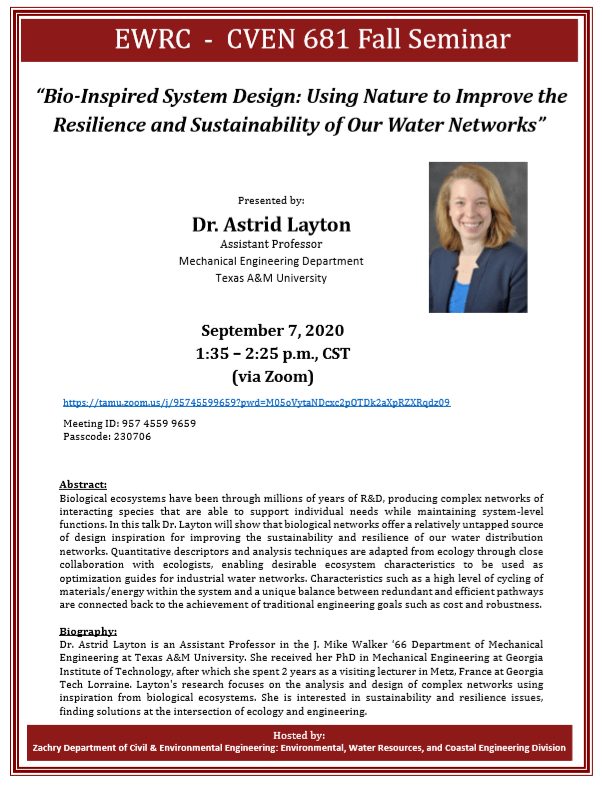
Honored to have been invited to give a graduate seminar in A&M’s Civil Engineering Department for the Environmental, Water Resources, and Coastal Engineering students. Feel free to virtually stop by if you’re free, I’ll be talking about my research regarding “Bio-Inspired System Design: Using Nature to Improve the Resilience and Sustainability of Our Water Networks.”

Seminar Abstract: Biological ecosystems have been through millions of years of R&D, producing complex networks of interacting species that are able to support individual needs while maintaining system-level functions. In this talk Dr. Layton will show that biological networks offer a relatively untapped source of design inspiration for improving the sustainability and resilience of our water distribution networks. Quantitative descriptors and analysis techniques are adapted from ecology through close collaboration with ecologists, enabling desirable ecosystem characteristics to be used as optimization guides for industrial water networks. Characteristics such as a high level of cycling of materials/energy within the system and a unique balance between redundant and efficient pathways are connected back to the achievement of traditional engineering goals such as cost and robustness.

Fall 2020 J. Mike Walker ’66 Department of Mechanical Engineering Graduate Excellence Fellowship

Congratulations to BiSSL PhD student Abheek Chatterjee for winning a J. Mike Walker ’66 Department of Mechanical Engineering Graduate Excellence Fellowship for continuing students for the Fall 2020 semester! The highly competitive graduate scholarship awards graduate students doing excellent research, academic performance, and leadership in the department.

meen logo

BiSSL PhD student Abheek Chatterjee wins “Best Paper” award for his 2020 IDETC-CIE conference paper!

Abheek his paper was written in collaboration with Dr. Richard Malak, in CIE’s SEIKM division titled “Exploring a Bio-Inspired System of Systems Resilience vs. Affordability Tradespace

Abstract: “The objective of this study is to investigate the value of an ecologically inspired architectural metric called the Degree of System Order in the System of Systems (SoS) architecting process. Two highly desirable SoS attributes are the ability to withstand and recover from disruptions (resilience) and affordability. In practice, more resilient SoS architectures are less affordable and it is essential to balance the trade-offs between the two attributes. Ecological research analyzing long-surviving ecosystems (nature’s resilient SoS) using the Degree of System Order metric has found a unique balance of efficient and redundant interactions in their architecture. This balance implies that highly efficient ecosystems tend to be inflexible and vulnerable to perturbations while highly redundant ecosystems fail to utilize resources effectively for survival. Motivated by this unique architectural property of ecosystems, this study investigates the response to disruptions vs. affordability trade-space of a large number of feasible SoS architectures. Results indicate that the most favorable SoS architectures in this trade-space share a specific range of values of Degree of System Order. This suggests that Degree of System Order can be a key metric is engineered SoS development. Evaluating the Degree of System Order does not require detailed simulations and can, therefore, guide the early stage SoS design process towards more optimal SoS architectures.”

A. Chatterjee, R. Malak, and A. Layton, “Exploring a Bio-Inspired System of Systems Resilience vs. Affordability Tradespace,” presented at the ASME 2020 International Design Engineering Technical Conference, virtual, 2020.

Two student papers are presented at the 2020 IDETC-CIE Conference

BiSSL alum Tirth Dave gave a presentation on his conference paper “Extending the Use of Bio-inspiration for Water Distribution Networks to Urban Settings” in IDETC’s DTM division.

BiSSL Ph.D. student Abheek Chatterjee presented his paper, written in collaboration with Dr. Richard Malak, in CIE’s SEIKM division titled “Exploring a Bio-Inspired System of Systems Resilience vs. Affordability Tradespace.” The paper was presented in the Complex Systems Engineering and Design session.

Research paper accepted to the journal Reliability Engineering & System Safety

BiSSL PhD student Abheek Chatterjee just had his full-length research paper accepted in the Journal Reliability Engineering &System Safety! The paper, titled “Mimicking Nature for Resilient Resource and Infrastructure Network Design,” investigates the use of ecological robustness – a functional characteristic of ecological food webs, to guide the design of a supply chain case study to improve its ability to survive network disturbances.

Abstract: “Increasingly prevalent extreme weather events have caused resilience to become an essential sustainable development component for resource and infrastructure networks. Existing resilience metrics require detailed knowledge of the system and potential disruptions, which is not available in the early design stage. The lack of quantitative tools to guide the early stages of design for resilience, forces engineers to rely on heuristics (use physical redundancy, localized capacity, etc.). This research asserts that the required quantitative guidelines can be developed using the architecting principles of biological ecosystems, which maintain a unique balance between pathway redundancy and efficiency, enabling them to be both productive under normal circumstances and survive disruptions. Ecologists quantify this network characteristic using the ecological fitness function. This paper presents the required reformulation required to enable the use of this metric in the design and analysis of resource and infrastructure networks with multiple distinct, but interdependent, interactions. The proposed framework is validated by comparing the resilience characteristics of two notional supply chain designs: one designed for minimum shipping cost and the other designed using the proposed bio-inspired framework. The results support using the proposed bio-inspired framework to guide designers in creating resilient and sustainable resource and infrastructure networks.”

Chatterjee, A., & Layton, A. (2020). “Mimicking Nature for Resilient Resource and Infrastructure Network Design.” Reliability Engineering and System Safety. DOI: 10.1016/j.ress.2020.107142